
CanucksArmy has no direct affiliation to the Vancouver Canucks, Canucks Sports & Entertainment, NHL, or NHLPA
Regret-rospective: Ranking the Canucks’ most regretful recent contract extensions
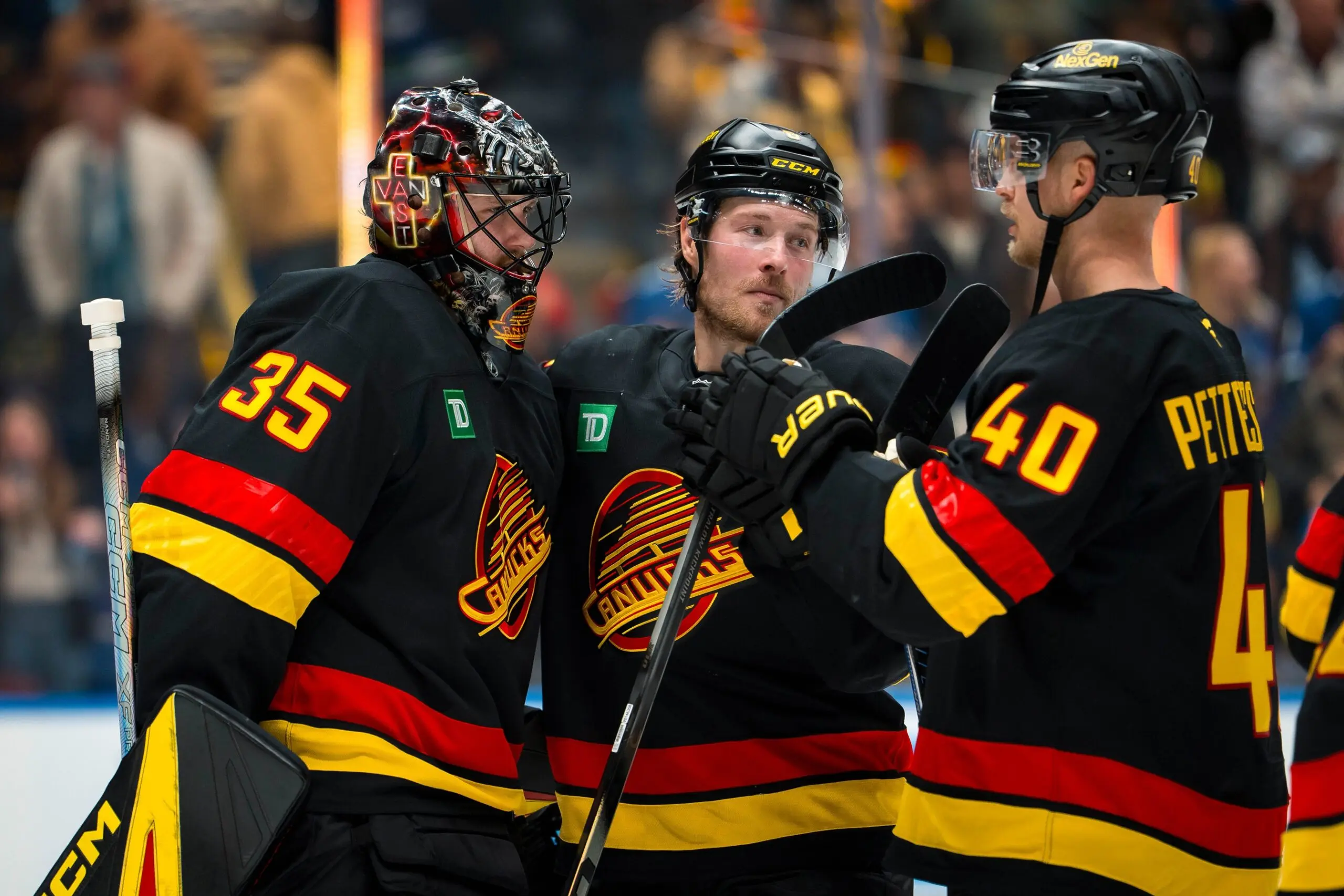
Photo credit: © Bob Frid-Imagn Images

Jun 15, 2026, 12:30 EDTUpdated: Jun 15, 2026, 12:25 EDT


The Carolina Hurricanes are your 2026 Stanley Cup Champions. And they might not be done there. The Hurricanes will head into their summer with nearly $12 million in cap space and only really Alexander Nikishin and Frederik Andersen (if they choose) to re-sign from their championship roster.
It’s an enviable position to be in, and it’s one the Hurricanes arrived at through efficient contract management. That’s something we’ve suggested that the Vancouver Canucks can learn from as they continue to add and maintain young talent in the early stages of their rebuild. But it’s also something the Canucks and their faithful can reflect on and learn from through their own recent regretful actions.
Here in this occasional, hindsight-oriented Regret-rospective column, we’ve focused almost entirely on the Canucks’ poorly-thought-out trades and ill-fated free agent signings of the past decade or so, but one area we haven’t paid enough attention to is the in-house contract extensions. And that’s something to be rectified, because if there’s one thing that the outgoing regime of Patrik Allvin and Jim Rutherford were worst at, it was probably handling contract extensions.
It says a lot that the number of contract extensions we’re not including on this list of regrets (like Filip Hronek, Drew O’Connor, or Linus Karlsson) is far shorter than the list of extensions we are including.
Put another way, if the Canucks could reach back over the past five years and have the option to undo all their bad trades, all their bad free agent additions, or all their bad contract extensions, they’d pretty much have to choose the extensions. This has been an underrated failing of the Canucks of late, and the proof is largely still on the books.
The following contract extensions are ranked in escalating order of regretfulness.
#6: Marcus Pettersson, six years at $5.5 million (signed February 2025)
The non-Elias Pettersson wins the award for ‘least regrettable, but still regrettable, contract extension,’ if that’s worth anything. The relatively low cap hit here, which remains far from the level of play Pettersson has put forth in every season of his career save for the 2025-26 campaign, helps greatly here.
Were they able to go back in time, the Canucks would probably not have traded for Pettersson in the first place. They certainly wouldn’t have traded what turned out to be the 12th overall pick for him (and O’Connor, to be fair), and they probably wouldn’t have signed him to a near-instant six-year extension. Holding on to that pick would have been best, maintaining the ability to flip Pettersson to a contender would have been fine, and avoiding this contract altogether would not have been a bad thing.
As it is, however, this seems like a contract that the Canucks can get out from under easily enough, so long as Pettersson is willing to waive the no-movement clause currently attached to it. This, plus the high probability of Pettersson rebounding at least a little under a new coaching staff, combine to make this one only relatively regrettable.
#5: Elias Pettersson, eight years at $11.6 million (signed March 2024)
Surprised to see the other Pettersson so low on this list? Don’t be. There are some major circumstantial differences at play with this one.
No one can be happy with the returns on Pettersson’s extension, which made him the highest-paid Canuck in franchise history. But at the time of the signing, Pettersson was an RFA, 25, and putting the finishing touches on an 89-point campaign after notching 102 the year before.
This was an extension the Canucks had to make, as opposed to most of the rest of this list, where trades were a realistic option instead, and that earns them some grace. Plus, if we’re being honest, the real regrettable extension here was the three-year, $7.35 million deal that Jim Benning signed Pettersson to back at age 22. Failing to go long-term with Pettersson then cost the Canucks a larger cap hit on this current contract, and the fallout from that has been enormous.
The real regret here is what the large pay increase seems to have done to Pettersson’s game and its perception, therefore. Even if this contract virtually had to be signed, it’s tough not to feel bad about what’s happened since.
#4: Kevin Lankinen, five years at $4.5 million (signed February 2025)
Compared to the rest of the contracts on this list, Lankinen’s deal is relatively small in dollars, but that doesn’t mean it’s not still laden with regret.
The Canucks did not really need to commit to Lankinen at the point at which they extended him, with Thatcher Demko and Arturs Silovs still in the fold. Instead, they could have cashed in on Lankinen’s strong season to that point (and bargain bin, one-year cap hit) and sold him to the highest bidder at or near the 2025 Trade Deadline.
The Canucks chose to extend him for a whopping five years. Lankinen’s play reverted to his career average, or a little below it, for 2025-26. But that’s not the real regrettable part. The truly regrettable part is that the Canucks had to move Silovs for virtually nothing because they had both Lankinen and Demko under contract, and might have to do the same this offseason with Nikita Tolopilo.
Trade Lankinen as a pending UFA instead, and the Canucks get whatever that return would have been, plus they get to keep Silovs and/or Tolopilo at a cheaper overall cap hit. Now, they’ll probably have to wiggle their way out from under this Lankinen extension eventually, all the same.
#3: Conor Garland, six years at $6 million (signed July 2025)
The Garland extension is an interesting one to talk about, because it’s the one that the Canucks have already gotten out from under. At the same time, the regrets here are all about lost potential trade capital.
In retrospect, the best course of action would have been to auction Garland off to the highest bidder at the 2025 Trade Deadline. He was completing a 50-point season, had one playoff run and another full year left on his contract past that point, and no trade protection to speak of. Chances are, the asking price would have begun at a first-round pick and only gone up from there.
Instead, the Canucks held on to Garland, then signed him to a whopping six-year extension a year early. They’d wind up trading him before it even kicked in near the 2026 Deadline, and for only a second and a third round pick.
Yes, they got out from under it. But they could have avoided the Garland extension altogether and started their rebuild with some badly needed extra assets, had they played this card a little smarter.
#2: Thatcher Demko, three years at $8.5 million (signed July 2025)
It’s a dead heat between Demko and Brock Boeser for the top spot. And, in the end, Demko’s extension was less than half the length of Boeser’s, so it feels less regrettable in comparison. Less regrettable, but still plenty regrettable. Like Garland and Lankinen, the Canucks really missed on their window to trade Demko.
His peak value came after the 2023-24 season, in which Demko was nominated for the Vezina Trophy, but that probably wasn’t a realistic time to trade him. Instead, his value was still plenty high as of the 2025 Trade Deadline, as he was still in the starting job and the full extent of his injuries was not yet known.
Like Garland, the Canucks could have flipped Demko with one year remaining on his deal (and no trade protection) for a real haul, had they chosen to go down that route. We’re talking about a first-rounder here, too, as a minimum, and maybe more if the bidding really got out of hand.
Instead, the Canucks extended Demko to a big-money deal, only to learn that his injuries were worse than previously assumed. Now, they’ve got the third-highest-paid goalie in the league at a point where he’s going to be either injured or stealing necessary losses away from the rebuild, and he’s practically unmovable. Oh, and he’s about to acquire an NMC of his own as of July 1.
#1: Brock Boeser, seven years at $7.25 million (signed July 2025)
In a sense, it feels a bit unfair to give Boeser the top spot on the most regrettable list. For one, his contract technically expired before this new one was signed, so it’s not technically an extension. Also, of all the players listed here, he’s probably performed the best post-extension as compared to his pre-extension expectations. That said, this contract was incredibly risky and questionably timed when it was signed, and those truths are only all the more apparent here now, a year later.
Simply put, to have a 29-year-old starting a seven-year, expensive extension right at the beginning of a rebuild is a burden. There’s something to be said about Boeser’s continued role on the team as a veteran mentor and positive role model, but those things aren’t exclusive to him and aren’t worth $7.25 million. The harsh reality is that Boeser is very likely to get at least a little worse with each passing year of this deal, and its length ensures it will still be a factor when the rebuild nears completion. If Boeser’s contract isn’t in the way now, it will be eventually, and it could be incredibly difficult to move by that point. Nothing could be more regrettable than an unnecessary extension signed now getting in the way of eventual extension discussions with, say, the third overall selection from this upcoming draft.
On top of all that, there’s also that aforementioned lost trade potential. Boeser could have and should have been dealt as a pending UFA at or near the 2025 Trade Deadline. Allvin said the offers weren’t good enough at the time, but we didn’t really believe him then, and looking back on it now, pretty much anything would have represented a better alternative than the outcome we got.
Sponsored by bet365


Breaking News
- JPat: A word on Aatu Räty’s past, present, and future as Canucks place young centre on waivers
- Canucks place Aatu Räty on NHL waivers
- WWYDW: Who or what has most surprised you through 10% of the Canucks’ season?
- The Statsies: Brock Boeser has his best game of the year in Canucks’ loss to Islanders
- The Stanchies: Despite growing pains on defence, Canucks battle valiantly in 3-2 loss to Islanders

Vancouver CanucksTeam Cap Summary

Cap Summary
2026-27
2027-28
Projected Cap Hit
$88,074,947
$71,329,167
Projected Cap Space
$15,925,053
$42,170,833
Current Cap Space
$17,163,668
$42,170,833
Active Players
23/23
13/23
Draft Picks
Round
'27
'28
1
1
1
2
2
2
3
1
1