
CanucksArmy has no direct affiliation to the Vancouver Canucks, Canucks Sports & Entertainment, NHL, or NHLPA
Should the Canucks still have any interest in the Hurricanes’ Alexander Nikishin?
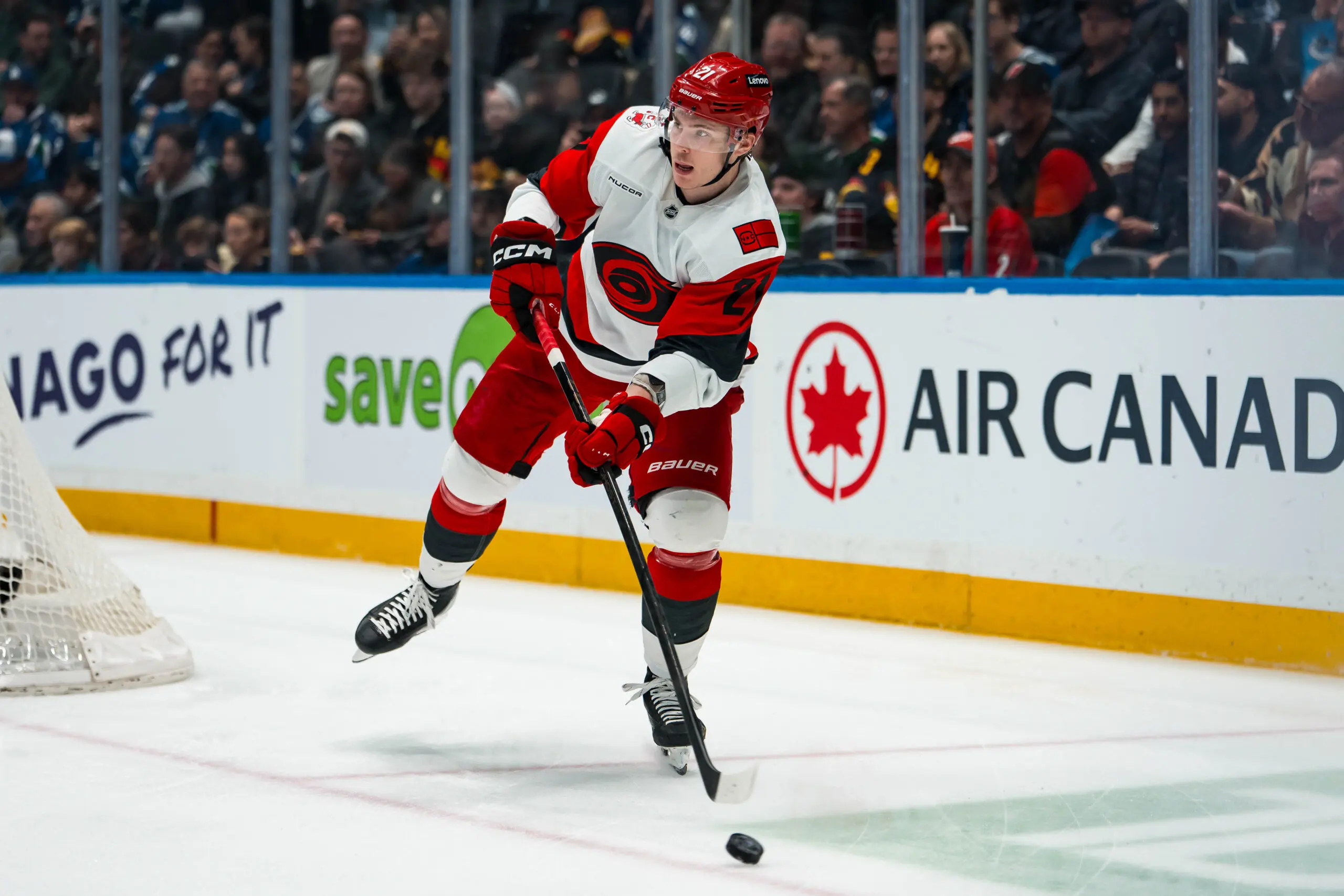
Photo credit: Bob Frid for IMAGN IMAGES via Reuters Connect

Aug 10, 2026, 13:45 EDTUpdated: Aug 10, 2026, 15:58 EDT


Of all the specific situations going on around the NHL right now in the midst of the dog days of summer, one of the most interesting has to be what’s going on with Alexander Nikishin and the Carolina Hurricanes.
It’s probably not fair to call this a contract holdout yet, what with Training Camp still about a month away. But this deep into the summer, there are only eight restricted free agents in the entire NHL who have yet to sign their next contract. That list is Cutter Gauthier, Adam Fantilli, Zack Bolduc, Simon Edvinsson, Arber Xhekaj, Vincent Iorio, and Kevin Korchinski.
If Nikishin isn’t the best player on that list, he at least stands out as the player most likely to be traded ahead of the 2026-27. In fact, there have been rumours of the Hurricanes outright intending to do so ever since their offseason began with the lifting of the Stanley Cup.
Even better, some of those rumours have included the Vancouver Canucks.
There’s enough smoke here to suggest that, at the very least, the Canucks have been interested in acquiring Nikishin at some point in the past. Which makes sense; he’s long been considered one of the best prospects in hockey, and the Canucks and Hurricanes have been involved in multiple trade discussions over the past year or two.
One has to assume that Nikishin’s name came up a time or two when Carolina began seriously kicking the tires on Elias Pettersson back during the latter’s own RFA negotiations. And given that the primary piece in the Quinn Hughes return ended up being Zeev Buium, another high-profile young LD. If the Hurricanes ever put together a competitive offer of their own for Hughes, one has to imagine it included Nikishin.
One might also think that, with Buium now in hand, the Canucks’ interest in Nikishin would have shifted. But it’s worth noting that a lot of the speculation tying him to Vancouver have come about during this summer, long after Buium had already arrived. That leads to a question of whether the Canucks are really still interested in Nikishin, and if so, why and how interested?
The general appeal of Nikishin is obvious enough. He’s not just an incredibly talented young player, he’s an incredibly talented young player in a unique contractual situation that just might make him easier and cheaper to acquire than such a player normally would be.
Nikishin stepped straight out of the KHL and into four playoff games for the Hurricanes in 2025 before officially starting his rookie campaign in 2025-26. He finished with 33 points in 81 regular season games and finished seventh in Calder Trophy voting. Nikishin only added one more point in his 17 playoff games after a Round One injury, but he did win the Stanley Cup, so he’s got that going for him.
It’s an impressive first showing by any measure. But it’s perhaps made more significant by the fact that it didn’t come out of nowhere. Nikishin has long been lauded as one of the best D prospects in all of hockey, and Carolina’s biggest challenge was in waiting for him to extricate himself from Russia before he could join them.
So why would the Hurricanes even be interested in trading Nikishin in the first place? As is often the case, it mostly comes down to money. Nikishin and his camp have been very clear that they are only interested in a long-term extension, and a big one at that. The number that seems to be floating around as an ask is eight years at $8 million per.
The Hurricanes, with almost $10 million in remaining cap space and no one else left to sign, have the room to accommodate Nikishin’s ask. But they might not have the willpower. As the reigning champs, the Hurricanes have slightly different priorities than the rest of the league, and managing a Cup-winning roster is unique. Were they to sign Nikishin at $8 million, he’d instantly become their top-paid defender, ahead of Jaccob Slavin and K’Andre Miller. It would make Nikishin the third-highest Hurricane, overall.
It’s a contract ask that might reasonably be easier for another team to justify. A team that has visions of Nikishin playing a top-pairing role for them down the line. It’s harder for the Hurricanes, who have Nikishin more firmly on their bottom-pairing, to justify, and signing such a deal really blows up their whole salary structure.
Furthermore, there are whispers out there that this was all part of the plan. Nikishin was always a little reluctant to sign in Carolina, and waited a full five seasons after being drafted to do so. Some say that Nikishin only agreed to come to Carolina in the first place if they’d be willing to trade him elsewhere after he had established himself, and while that’s unconfirmed, it makes at least a little sense given the way it has all played out.
That covers why the Hurricanes might be willing to part with him, but what about the Canucks’ end of things?
Could the Canucks still want Nikishin?
It’s true that Buium makes Nikishin a little more redundant than he was before Buium’s arrival. Both are in the upper tiers of young left-shot defencemen currently in the league. Buium is younger, and probably has the higher offensive ceiling, but Nikishin has the size and physicality advantage and is no offensive slouch himself. Their games are distinct enough that they could definitely co-exist on the same blueline.
Contract-wise, one has to question the wisdom in putting so many chips on LD. Nikishin is supposedly asking for $8 million a year, and Buium might want even more than that to sign an eight-year deal of his own with the Canucks. That’s at least $16 million committed to the left side right there.
Then again, Nikishin did spend a lot of his rookie season – about a third of his regular season minutes and 86% of his playoff minutes – playing on the right side with left-shooting partners like Shayne Gostisbehere. Nikishin might just be one of those rare both-sides defenders, and that would certainly make it easier to fit him in on the Canucks.
The contract itself could almost be seen as a positive for Vancouver. Whereas paying Nikishin $8 million right now is daunting for the Hurricanes, the Canucks don’t care too much about their current expenditures. Their concerns are down the road. And given the rapid inflation the NHL is experiencing right now, even an $8 million contract has a likelihood to age very well over the course of eight years. Getting a player of Nikishin’s calibre under contract now, so that he can make a major impact in a few years when the Canucks hope to be competitive again, is a move that works exceptionally well with their timeline.
Long-term, it would give the Canucks a youthful top-three of Buium, Nikishin, and Tom Willander. If Nikishin stays on the left side, it eliminates the need to find another top-four-capable LD in the course of the rebuild, and the long-term top-two there can be Buium and Nikishin. If Nikishin goes over to the right side, he and Willander become the long-term top-four plan, and the eventual trade of Filip Hronek becomes that much easier to manage.
In that, however, we are getting a bit ahead of ourselves. It would be pretty easy for the Canucks to justify an 8×8 contract for Nikishin if that were all it cost to get him. But the Hurricanes retain his rights as an RFA, so there’d have to be a trade-cost involved, too, and it would be a high one.
Nikishin is not, for the record, eligible for an offer sheet – not that the Canucks want to be giving up unprotected first round picks, anyway.
Instead, the Canucks would have to ply the Hurricanes with other young, NHL-ready players of a slightly lesser calibre than Nikishin, and then hope to make up the difference with some other assets.
In this, we imagine Buium is firmly off the table, as are young centres Braeden Cootes and Caleb Malhotra. The idea of a Willander-for-Nikishin swap is really interesting, as Nikishin is considered to be higher-end, and yet Willander is younger and just had a fine rookie campaign of his own. In the end, the Canucks are probably wisest to hang on to the genuine RD here and keep Willander off the table.
Someone like Victor Mancini would definitely be offered up, but doesn’t close the value gap much. The younger Elias Pettersson makes some sense, and does profile a bit like a lesser Nikishin. He’d be a hard one for the Canucks to give up after all that positive development, but wouldn’t it be a bit funny if the Hurricanes finally traded for an Elias Pettersson, and it was this one?
If the Hurricanes didn’t already have Logan Stankoven, there might be something to offering up Marco Rossi, but having both Stankoven and Rossi in the same top-six seems a tad redundant. Still, maybe there’s something there.
We might find ourselves at a bit of an impasse here. The Canucks won’t put their truly high-end pieces on the table for Nikishin, as well they should not. But then there’s a bit too much of a gap between that and the value of what they might offer instead – the Mancinis, the Petterssons, the Jonathan Lekkerimäkis. And without the ability to offer up unprotected first-round picks to balance it out, the odds seem highest that the Canucks are ultimately outbid by one of those other teams out there ready and willing to sign Nikishin to the extension he wants.
Should the Canucks be interested in Nikishin? Yes. At this stage in their rebuild, the primary goal is adding young talent to the roster, and there aren’t many, if any, younger and more talented players on the active trade block right now than Nikishin. The Canucks should rightly make the very best offer for Nikishin they can without compromising on any of their own blue-chip assets.
They should also, at the end of the day, be prepared for that offer to be beaten. That’s just the way things go sometimes.
PRESENTED BY VIVID SEATS



Breaking News
- The Canucks have every reason to give Leevi Meriläinen a run of starts
- A look inside the Canucks early-season penalty killing struggles
- ‘Best news ever’: Max Lapierre thrilled to see Canucks put Sedins, Johnson, and Malhotra in charge
- The Statsies: Numbers back the eye test on Jonathan Lekkerimäki in Canucks’ loss to Hurricanes
- The Stanchies: 3 positives, 3 negatives, rebuilding lessons, and more from Canucks’ loss to Canes

Vancouver CanucksTeam Cap Summary

Cap Summary
2026-27
2027-28
Projected Cap Hit
$88,074,947
$71,329,167
Projected Cap Space
$15,925,053
$42,170,833
Current Cap Space
$16,790,545
$42,170,833
Active Players
23/23
13/23
Draft Picks
Round
'27
'28
1
1
1
2
2
2
3
1
1