
CanucksArmy has no direct affiliation to the Vancouver Canucks, Canucks Sports & Entertainment, NHL, or NHLPA
Where does Caleb Malhotra rank among the Canucks’ all-time best Canadian prospects?
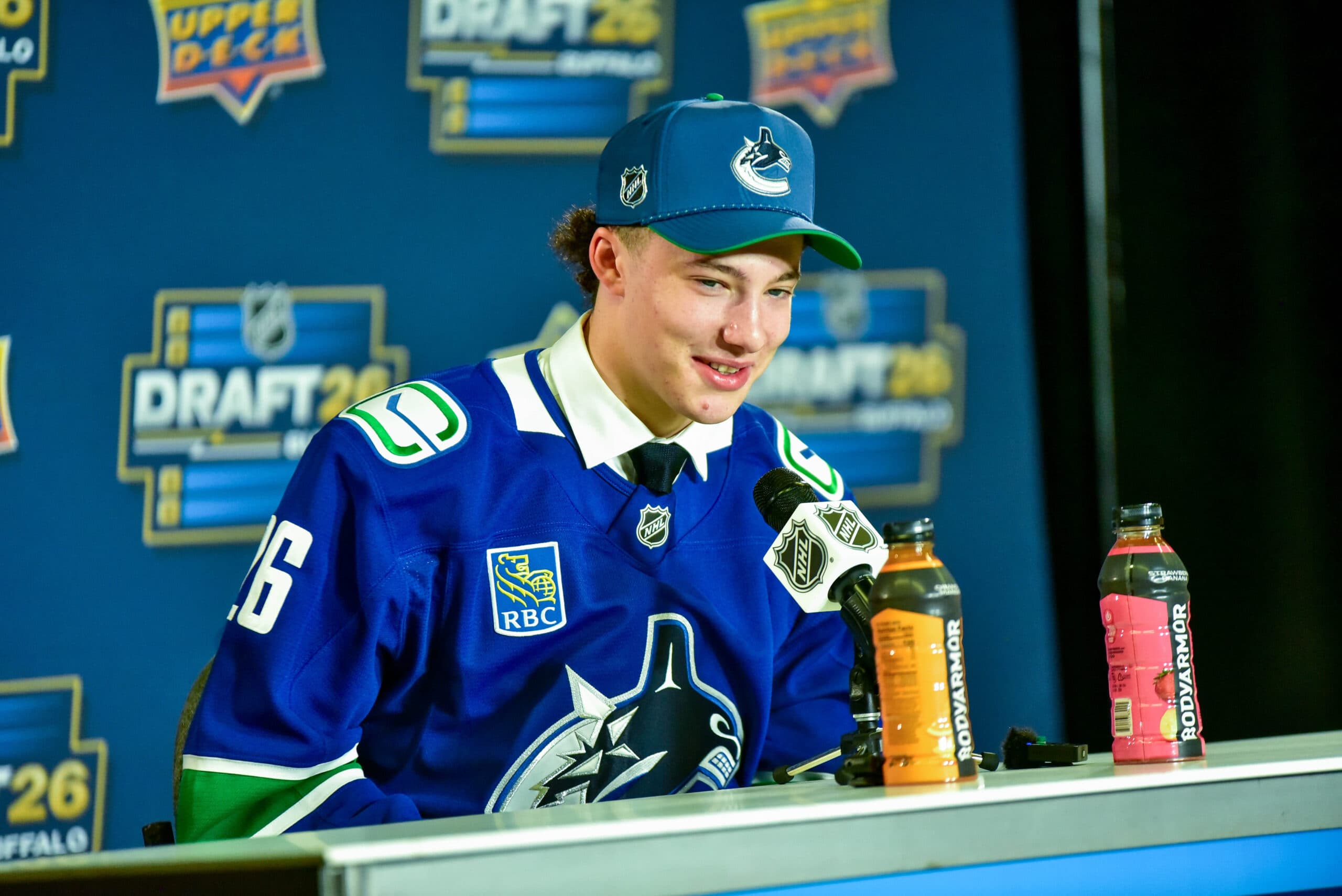
Photo credit: Steven Ellis | The Nation Network

Jul 22, 2026, 16:00 EDTUpdated: Jul 22, 2026, 13:26 EDT


The Vancouver Canucks kicked off their rebuild in earnest by making Caleb Malhotra the third overall selection in the 2026 NHL Entry Draft. It was an exciting pick for a number of reasons, not the least of which were Malhotra’s significant local ties. Malhotra was born in Victoria, spent time around the Canucks with his father Manny as a kid, played for the Chilliwack Chiefs, and is the nephew of BC sports legend Steve Nash.
We’d never want to give any credence to the crowd who insist that where a player is from really matters. Such thinking is, by it’s very nature, narrow-minded. But in terms of initial excitement and enjoyment, one can’t deny that it’s a cool feeling to have the Canucks’ top prospect be not just a Canadian, but a BC-born talent, at that.
Just think of the upcoming thrill of seeing Malhotra centre Team Canada at the 2027 World Junior Championships. The majority of Canucks fans are Canadians, after all, and there’s at least some extra emotional investment to be found there.
In the estimation of NHL scouts and pundits, Malhotra is definitely the Canucks’ most-hyped prospect since at least Quinn Hughes, and perhaps beyond that. In terms of the Canucks’ most-hyped Canadian prospects, we’d have to go a lot further back to find someone even close.
It all brings to mind a question about where Malhotra might rank in an all-time list of the Canucks’ greatest Canadian prospects. Note that, when we say that, we’re not talking about outcome or hindsight, but about their status back when they were a prospect, exclusively. Pre-arrival potential, rankings on the annual prospect charts, or just plain hype, if you will.
Hopes are high for Malhotra, and so is the hype. He might not be the Canucks’ greatest Canadian prospect of all-time, but he’s at least in the conversation. So, let’s have that conversation.
To start, we’ve got to go back to the beginning, to the first and often underrated Canucks’ prospect, Dale Tallon. It’s tough to talk about prospects from an era where they were scouted so differently, but Tallon was a stellar prospect by any measure. He scored 39 goals and 79 points in 54 OHA games for his draft year, and that was as a defender. That was enough to make him the second overall pick in 1970 and the Canucks’ first pick ever, and it means that Tallon has to be included in any discussion of all-time best Canadian prospects.
Besides Tallon and Malhotra, the Canucks have selected a Canadian in the top-five of the draft on ten other occasions. That included three straight third overall picks after Tallon, with those being Jocelyn Guevremont, Don Lever, and Dennis Ververgaert. All were fine prospects who turned into fine NHLers, but none reached anywhere near the expectations of a Tallon, or anything like the hype of a modern prosect, so we’ll leave them off to the side for now.
After a bit of a break, the team next picked Bill Derlago at fourth overall in 1978. Derlago was a real star for the Brandon Wheat Kings of the WHL, putting up 96- and 89-goal seasons ahead of his draft. Yes, you read that correctly, goals, not points.
Derlago’s career was an odd one. He put up eight points in nine games as a rookie for the Canucks right out of the draft, suffered a sophomore slump the next year, and was traded to the Toronto Maple Leafs thereafter, along with a guy we’re about to mention, for Tiger Williams. Derlago went on to score as many as 40 goals in a season for the Leafs.
Derlago may have technically disappointed in Vancouver, but that doesn’t take anything away from his status as one of the most potent prospects the Canucks have ever drafted.
The next year, in 1979, the Canucks drafted the other individual from that trade, Rick Vaive, at fifth overall. Vaive’s junior numbers weren’t quite as strong as Derlago’s, but then Vaive jumped into pro hockey with the WHA in his draft year, and managed 26 goals and 59 points in 75 games playing against adults.
This will be the only time in Canucks’ history that they manage to snag a proven 25-goal pro scorer in the amateur draft, there can be no doubt about that. Unfortunately, Vaive didn’t have much time to show his stuff in Vancouver before being traded, but he did turn into a three-time 50-goal scorer.
Jim Sandlak pops into the picture as the fourth overall pick in 1985, but he doesn’t quite match the sizzle of some of these previous names. His OHL draft year saw Sandlak post a respectable, but non-thrilling, 40 goals and 64 points in 58 games for the London Knights. Then again, much of the hype around Sandlak came from the fact that he stood 6’4” at a time when not many did. He was a unique prospect more than a truly great one, and that continued to show throughout his career.
We get to our biggest name three years later with the 1988 and Trevor Linden, who the Canucks made the second overall pick. This is the first (only?) time in franchise history that the Canucks have walked away with the agreed-upon best Canadian prospect in the draft. From contemporary reports, many scouts had Linden neck-and-neck with Mike Modano for the first overall selection that year.
And while history would state that the Minnesota North Stars still made the correct pick with Modano, Linden’s status as a prospect cannot be discounted.
In his draft year, Linden posted 46 goals and 110 points in 67 regular season games for the Medicine Hat Tigers. Then he posted 13 goals in 16 playoff games, too. More than that, Linden had already developed a reputation as a leader, a class act, and a true character piece. The hype was enormous, and Linden delivered on it almost instantly.
Now get ready for the surprise contender on our list: Petr Nedved. ‘Wait,’ you insist, ‘Nedved’s a Czech!’ That’s true, but Czechia didn’t exist yet when the Canucks picked Nedved at second overall in 1990, and Nedved had already defected from its predecessor, Czechoslovakia. Nedved was playing for the Seattle Thunderbirds when the Canucks drafted him, and working on his Canadian citizenship. He’d ultimately compete for Team Canada at the 1994 Olympics before returning to Team Czechia in later years.
Nedved is, in as many words, a Canadian. Whether he truly counts as a ‘product of Canada’, or a Canadian prospect, for the purposes of this thought experiment is up for debate. But if he does count, he’s undoubtedly in the conversation. Nedved posted 65 goals and 145 points in his only WHL season, and looked good enough to be drafted ahead of Jaromir Jagr.
It’d be most of a decade before the Canucks drafted anyone else in the top-five, never mind a Canadian. The next such pick came in 1998, when the Canucks picked Bryan Allen at fourth overall.
Allen got plenty of press, especially in that era, but even when he was drafted, it was as a defensive defender. He topped out at 19 OHL points in his draft year. As such, it’s tough to call him a truly hyped prospect, especially in comparison with some of the offensive superstars we’ve discussed thus far.
And it’d be a really long time after that until the Canucks again drafted a Canadian in the top-five. All the way to 2026 and Caleb Malhotra, in fact.
Beyond top-five selections, there are a few other names that could enter the picture here. Cody Hodgson was drafted at tenth overall 2008, but then had an absolute monster of a Draft+1 season. With 92 points in 53 regular season games, 31 points in 21 playoff games, and 16 points in six games at the WJC, Hodgson became one of the most-discussed prospects in hockey, and with good reason.
Bo Horvat started to get talked about as a future captain during his own Draft+1 season, though the stats didn’t pop off the page quite as much with him.
And we’d be remiss if we didn’t leave a little space for Luc Bourdon, the 10th overall pick in 2005 who seemed to be on an extremely positive development curve before his tragic and untimely demise.
There are probably some names we’re missing here, especially from the older generations, but we think we’ve got the ballpark. Malhotra probably reasonably enters what could be called the Canucks’ top handful of Canadian prospects of all-time, joining names like Tallon, Linden, Derlago, and, if you count him, Nedved.
Where Malhotra falls specifically within that group is up for debate, of course. If we’re talking hype, specifically, well then modern day prospects get mountains more expectations and press than the prospects of the ’70s and ’80s, so it’s not really a fair competition.
Attempting to gauge ‘prospect quality,’ or their one-time potential, is a little more possible. On that front, we’d put him firmly behind both Linden and Nedved at first blush, and that will probably hold up to scrutiny. He may be a small step behind Tallon, too, though the fog of time makes that harder to say with certainty. Some of the rest of the names on this list could be debatable head-to-head with Malhotra, but we’re not seeing much here that rates cleanly ahead of Malhotra’s potential at this time.
By that reckoning, Malhotra is probably in the running to be a top-three Canadian Canucks prospect of all-time, and should fit very comfortably within most all-time top-five rankings. Even his harshest critics would have a tough time keeping him out of a reasonable top-ten.
Others’ mileage will always vary, but for most, that he’s even in this discussion is reason enough for some additional rebuild-related excitement coming out of this most recent draft.
READ NEXT: Former Canucks sleep doctor Pat Byrne on Vancouver’s 2026-27 schedule: ‘One of the biggest messes I’ve ever seen’
Sponsored by bet365


Breaking News
- Canucks Game Day: Dealing with the Devils in early Saturday start in New Jersey
- The Canucks have every reason to give Leevi Meriläinen a run of starts
- A look inside the Canucks early-season penalty killing struggles
- ‘Best news ever’: Max Lapierre thrilled to see Canucks put Sedins, Johnson, and Malhotra in charge
- The Statsies: Numbers back the eye test on Jonathan Lekkerimäki in Canucks’ loss to Hurricanes

Vancouver CanucksTeam Cap Summary

Cap Summary
2026-27
2027-28
Projected Cap Hit
$88,074,947
$71,329,167
Projected Cap Space
$15,925,053
$42,170,833
Current Cap Space
$16,790,545
$42,170,833
Active Players
23/23
13/23
Draft Picks
Round
'27
'28
1
1
1
2
2
2
3
1
1