
CanucksArmy has no direct affiliation to the Vancouver Canucks, Canucks Sports & Entertainment, NHL, or NHLPA
What the Canucks are getting with third overall pick Caleb Malhotra
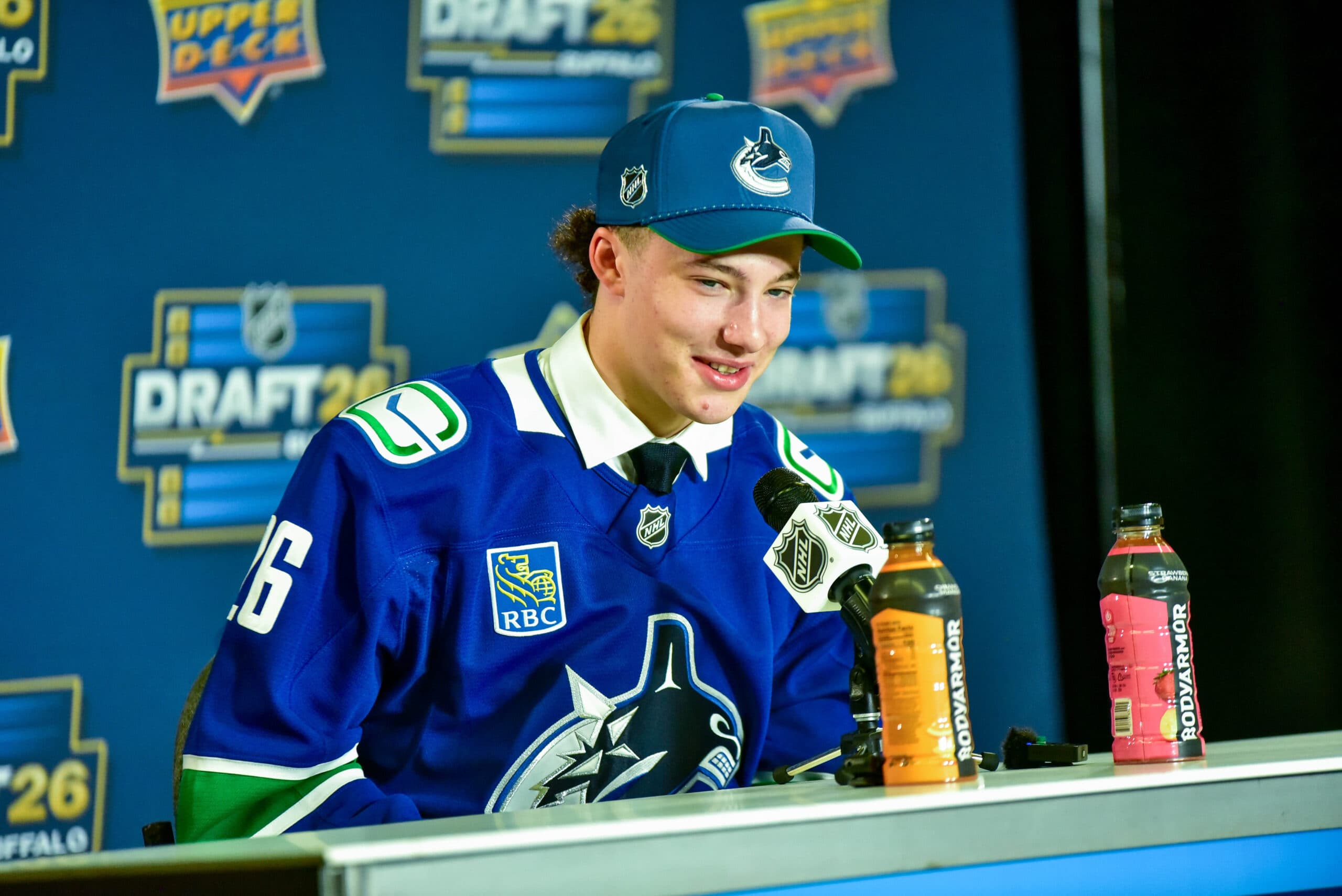
Photo credit: Steven Ellis | The Nation Network


The Vancouver Canucks entered the 2026 NHL Draft in Buffalo knowing they had an opportunity they hadn’t enjoyed in nearly three decades.
Holding the third overall selection for the first time since selecting Daniel and Henrik Sedin in 1999, Vancouver had its choice from a handful of prospects that many believed could eventually become NHL stars.
And there was no shortage of debate leading up to draft day, both among fans and NHL scouts alike. Would the Canucks bolster their blue line with one of the draft’s premier defencemen? Could one of the consensus top-two forwards, Gavin McKenna or Ivar Stenberg, unexpectedly fall into their lap? Or would they opt for the 200-foot, high-character centre who had been linked to the organization for much of the season?
Ultimately, they chose the latter.
With the third overall selection, the Canucks drafted Brantford Bulldogs centre Caleb Malhotra, the son of newly appointed head coach Manny Malhotra. Whether you agreed with the pick or not, it wasn’t difficult to understand why Vancouver believed he was the right player for the organization. At the end of the day, he offers a clear pathway to NHL games and projects as a player who could one day wear a letter at the professional level, while also possessing more offensive upside than most gave him credit for heading into the season.
His impressive rookie season in the OHL only strengthened that profile, allowing him to climb from being viewed as a mid-first-round prospect entering the season to becoming a legitimate top-three candidate by the time the draft arrived.
A remarkable rise up draft boards
There weren’t many players who improved their draft stock more than Malhotra over the past year.
After spending the 2024-25 season with the Chilliwack Chiefs of the BCHL, where he recorded 26 points in 44 regular-season games before helping the club reach the league final, Malhotra returned to Ontario for his draft season with the Brantford Bulldogs.
And boy, the transition couldn’t have gone much better.
Playing on one of the OHL’s most dangerous offensive teams, Malhotra finished second on the Bulldogs and second among all rookies in scoring with 84 points in 67 games before carrying that production into the playoffs. Those offensive totals certainly opened eyes, but they ultimately became the icing on the cake to what was already one of the most complete 200-foot profiles in the draft.
At his floor, Malhotra is highly regarded as a dependable two-way centre whose intelligence and work ethic gave him an excellent chance of reaching the NHL. This season, however, he showed there was considerably more offence in his game than previously believed. He attacked the middle of the ice with greater confidence, became a far more willing shooter, and began creating offence for himself rather than simply facilitating for teammates.
Don’t get it twisted: Brantford was a powerhouse, and Malhotra undoubtedly benefited from playing in such a talented lineup. But he also drove play on his own, created opportunities off the rush, and displayed a much greater willingness to lean on his offensive instincts. By season’s end, the question became less about whether he could become an NHL player and more about how high in an NHL lineup he could eventually play.
Hockey sense is what separates him
Every draft class features elite skaters, elite shooters, and elite puck handlers. What becomes much harder to find are players who consistently think the game one step ahead of everyone else. And that factor seems to be where Malhotra sets himself apart. His game is built around anticipation, and whether he’s supporting below the goal line in the defensive zone, reading a turnover through the neutral zone or identifying passing lanes before they fully develop, he consistently processes the game at an incredibly high level.
It’s one of those traits that’s difficult to appreciate simply by watching highlights. While he certainly produced his share of end-to-end rushes throughout the season, much of what makes him such an appealing prospect can be found in the smaller details that repeat themselves every shift.
He rarely cheats for offence, and because of that, coaches trust him in virtually every situation. Those habits tend to translate exceptionally well to professional hockey because they aren’t dependent on being bigger, stronger, or faster than the competition.
More than just a defensive centre
One of the biggest misconceptions surrounding Malhotra throughout the draft process was that he was simply another safe, defence-first prospect. While Brantford undoubtedly provided an outstanding environment for offensive production, Malhotra wasn’t just benefiting from talented linemates. As the season progressed, he became noticeably more assertive with the puck, attacking defenders with confidence instead of immediately looking to distribute.
While his shot became a legitimate weapon at the OHL level, his greatest offensive strength remains his playmaking. He consistently manipulates defenders with his eyes, draws pressure before slipping pucks into open space, and has an excellent understanding of timing inside the offensive zone.
His shot also took a noticeable step forward. While questions remain about whether he’ll consistently beat NHL goaltenders from distance, he showcased a quick, deceptive release throughout the season. Whether attacking off the rush or finding soft areas around the slot, Malhotra became increasingly comfortable finishing plays himself rather than always looking for the extra pass.
There are still legitimate questions about whether he’ll develop into a true offensive driver and No. 1 centre at the NHL level, particularly when compared to some of the more dynamic forwards selected around him. The hype surrounding his name reached another level over the final few months of the season, and it’s fair to wonder whether he can ultimately live up to those expectations.
The Canucks, however, clearly believe there’s considerably more offence in his game than many people initially projected.
The details NHL coaches love
One of the biggest reasons Malhotra continued climbing draft boards throughout the season is that his game doesn’t rely solely on offence to remain effective.
Even on nights when he isn’t finding the scoresheet, he’s still making an impact. He’s relentless on the forecheck without taking himself out of position, consistently tracks back through the neutral zone, supports his defencemen below the hash marks, and wins more puck battles than most players his age.
When asked to describe his own game following the draft, Malhotra’s answer mirrored many of the qualities Vancouver’s scouting staff has clearly valued throughout the draft process.
“I think I bring a lot of reliability and a two-way game,” Malhotra said. “I try to bring a culture and leadership and I am somebody that you want on the ice, and you want in your locker room.”
The Manny Malhotra connection
Of course, one storyline surrounding this selection was impossible to ignore.
The family connection with his father, Manny, the Canucks’ newly appointed head coach, naturally became one of the biggest talking points after the selection was announced. From the outside, it’s easy to understand why. Questions about coaching your own son at the NHL level are inevitable, particularly in a Canadian market.
Caleb, however, doesn’t appear to share those concerns. He admits that he and his father did not talk about whether he was going to be selected, and Manny has since indicated that he was unaware of where the team has his son pegged on their final rankings. They are both set on keeping things professional and hockey driven.
“Usually when I hop on the ice with him, he’s coach, and he’ll treat me like any other player,” Malhotra explained. “I’ve had that experience and that ability to just have him be coach, take his advice and take his instruction, and I think I’ve gotten quite good at it.
“I’m going to be able to be very professional and treat him like I would any other coach.”
Growing up around NHL hockey undoubtedly helped shape the player Malhotra has become. More importantly, the Vancouver market.
“I think growing up around the market and growing up around my dad, hearing how passionate everybody is in Vancouver about hockey, I think I’ve kind of learned what that pressure is like and how to deal with it.”
Where he fits in Vancouver’s future
The selection also says quite a bit about where Vancouver believes its prospect pool is headed. The organization has placed significant emphasis on centres over the past two drafts. Last year, it selected Braeden Cootes. This year, it added both Malhotra and Brooks Rogowski.
There are several common traits that run through all three players. They compete. They play reliable, structured hockey. And perhaps most importantly, they’re players coaches trust in difficult situations.
Whether that was by design or simply how the draft board unfolded, the Canucks are quietly building an impressive collection of young centres who project well to playoff hockey. Finding reliable 200-foot centres is one of the most difficult tasks in the NHL. Developing them internally is even harder.
Malhotra immediately becomes one of the organization’s most important prospects, building an incredibly sound middle alongside Braeden Cootes. Ultimately, both could realistically vie for the team’s captaincy in a few years’ time.
What still needs to improve?
Like every 18-year-old prospect, Malhotra remains a work in progress. His skating is already good, but there is another level to be taken to hang as a top centre in the NHL. Adding strength should naturally improve his explosiveness and allow him to create greater separation through the neutral zone.
There are also times when he can afford to trust his skill a little more. Because he naturally plays such a responsible game, he occasionally passes up opportunities to attack defenders one-on-one in favour of making the safer play.
Neither of those areas should be viewed as a major concern. If anything, they’re fairly common for an 18-year-old centre, particularly one who already thinks the game at such a high level. The main allure to Malhotra is his high floor, which should set a third-line centre foundation. Could he be a top-line pivot? That remains to be seen.
The next step: Boston University
Malhotra’s development won’t continue in the NHL next season. Instead, he’ll head to one of college hockey’s premier programs after committing to the Boston University Terriers.
When asked what he’s looking forward to most, his answer was simple.
“I think a new level of competition,” Malhotra said. “I think that’s what everybody’s seeking in college. I am very excited to play against some highly talented guys.”
It’s a pathway he will now share with his newly drafted teammate, Niklas Aaram-Olsen. Boston University has become one of the premier development programs in college hockey, consistently producing NHL-ready talent. For Malhotra, it provides an opportunity to continue refining his offensive game while adding strength and competing against older, stronger opponents before eventually making the jump to professional hockey.


Breaking News
- The Stanchies: 3 positives, 3 negatives, rebuilding lessons, and more from Canucks’ loss to Canes
- Instant Reaction: DeBrusk scores twice at 5v5 while Pettersson adds two assists in Canucks’ loss to Hurricanes
- Canucks notebook: Cotter’s keeping receipts, Elias Pettersson says he’s ‘having a lot of fun’
- Scenes from morning skate: Canucks healthy scratch Schenn and Gallagher against Stanley Cup champs in Carolina
- How many roster spots might the Canucks need to open up between now and next season?

Vancouver CanucksTeam Cap Summary

Cap Summary
2026-27
2027-28
Projected Cap Hit
$88,074,947
$71,329,167
Projected Cap Space
$15,925,053
$42,170,833
Current Cap Space
$16,699,785
$42,170,833
Active Players
23/23
13/23
Draft Picks
Round
'27
'28
1
1
1
2
2
2
3
1
1