That was a game.
The Vancouver Canucks
stunk up Rogers Arena with their 6-0 loss to the Edmonton Oilers. The stats to this game weren’t bad; they actually suggested a far more even contest than what the scoreline ended up being. But it also highlighted the disparity between Vancouver’s talent and Edmonton’s talent. One team had the ability to create and finish on scoring chances from all the right places, while the other simply didn’t have any scoring touch to convert on the few good things they managed to do.
Here’s the loss, by the numbers.
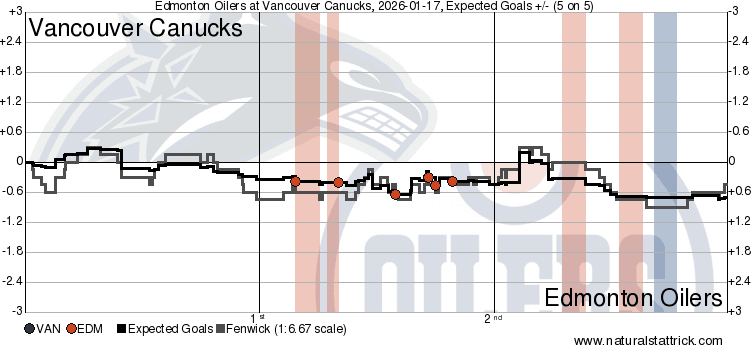
Game Flow
The game flow actually doesn’t look that awful at first glance. While the Oilers obviously had an advantage all game, it wasn’t drastically tilted in their favour. Unfortunately, it’s clear that they were simply more opportunistic — actually,
a lot more opportunistic than the Canucks. Edmonton only had a slight 52.33 xGF% edge in the second period off of 1.18 xGF at 5v5 play, but they managed to score five even-strength goals off of that. This is despite the Oilers also trailing 6-9 in the high-danger chance category. Again, it goes to show that generating chances is one thing, but having the talent to convert on it is a whole other realm, and something the Canucks definitely didn’t have.
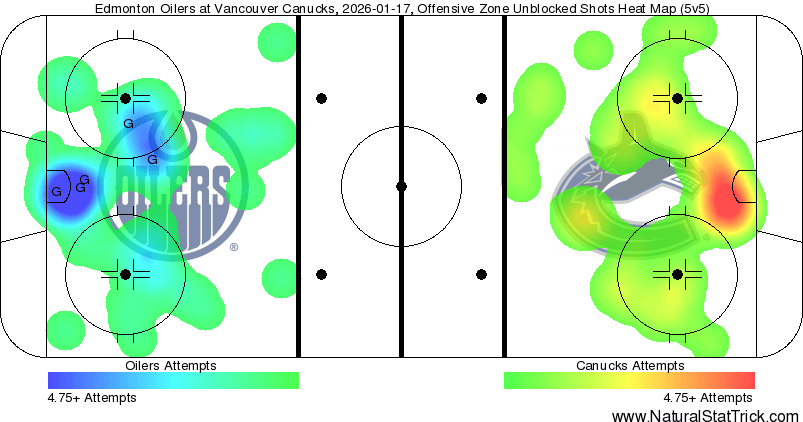
Heat Map
The heat map doesn’t look too bad when just glancing at the hot spots. The numbers actually were a lot closer than one might think, as despite a 32-35 Edmonton lead in overall scoring chances, both teams split a 16-16 high-danger chance battle. That’s evident in the similar-looking density in their high-danger hot spots, which is good for the Canucks. What wasn’t a good thing was seeing just how many of those high-danger chances the Oilers were able to bury, showing the Canucks just how to finish, while Vancouver couldn’t do anything against Tristan Jarry. Yeah, that’s got to feel great.
Individual Advanced Stats
Corsi Champ: In the reunion of the Abby line, Max Sasson led all Canucks with a 75.00 CF% last night. Playing primarily against the Oilers’ bottom six, Sasson did quite well for himself as he managed to record a 1.24 xGF, tied for third-best on the team, while also posting the third-best xGF% amongst all skaters with a 78.76. He was on ice for an 8-3 advantage in scoring chances, with a 7-3 edge in high-danger chances. Again, these are great things for Sasson himself, but if Max Sasson is your best player on any given night, that’s a big, big problem for the team itself.
Corsi Chump: Elias Pettersson was tasked with matchup duties against Connor McDavid, and his stats suffered heavily as a result. His team-low 28.57 CF% came with giving up a 6-12 shot difference, on ice for four goals against and a team-low 14.65 xGF%. Pettersson gave up a 1-13 scoring chance deficit with a further 0-7 hole in high-danger chances, though that is par for the course when playing against one of the best players on the planet. Interestingly enough, Pettersson was only on ice for one goal against when playing directly against the McDavid line, which is a good thing — it’s the other goals against that should be a bit of a concern.
xGF: Arshdeep Bains of all players led the Canucks in xGF%, coming in at 88.85. An 8-1 scoring chance lead and 7-1 high-danger chance advantage will do that for anyone, and Bains was able to profit from this to get a lot of momentum against the Oilers’ depth. Unfortunately, Bains is not a good enough player to make Edmonton pay for giving up share metrics like those, and it was reflected in the lack of impact on the scoreboard. Bains was one of the players tied for third in raw xGF at 1.24, with Filip Hronek leading the charge at 1.40.
GSAx: I honestly expected this to be worse, but given how much xGF the Oilers had in total,
Nikita Tolopilo didn’t do half bad. Hung out to dry by the team in front of him and facing down 5.29 xGF from Edmonton, the Belarusian posted a -0.71 GSAx, which isn’t horrific given the whole tirefire of a game in front of him. Four of the six goals were high-danger while the remaining two came off middle-danger, so again, it wasn’t as if Tolopilo was giving up gimme goals. Unfortunately for the netminder, Edmonton was just overwhelming and lethal when it came to burying those scoring chances against him.
Statistical Musings
But why: The line that posted the best stats was the aforementioned Abby line of Bains – Sasson – Karlsson, and it wasn’t even close, in all honesty. An 83.33 CF%, 7-1 shot difference, a 0.92 xGF, 89.37 xGF%… those are all great numbers, and ones that should result in some actual offensive production. The unfortunate part of the equation is that these three aren’t exactly play drivers, and despite doing plenty of good things, there just isn’t enough talent between the trio to convert those opportunities into goals. It’s frustrating because they had a good game that just didn’t translate at all.
But why, part 2: I don’t understand why Adam Foote is insisting on playing Tom Willander and Victor Mancini together. The two young right-handed defencemen are simply getting outclassed as of late, and the numbers back it up. Together, the pairing recorded 35.00 CF% and a 24.11 xGF%, on ice for a 3-10 hole in scoring chances and a 2-4 deficit in high-danger chances in just 11:25 TOI together. It can’t possibly be good for their development to be playing this way, and hopefully, no bad habits form from this haphazard setup.
As a team
CF% – 44.07% HDCF% – 45.24% xGF% – 34.36%
The Canucks weren’t in the fight and couldn’t find an answer, not only to stem the bleeding on home ice but to respond to the shellacking they were getting at the hands of the Oilers. It’s incredibly frustrating to watch, and one has to think that
these players are still trying to win hockey games — and that might make it all the worse. To think that Vancouver was just a win away, two years ago, from beating these Oilers in the second round of the playoffs. How time flies.
Vancouver welcomes the return of Bo Horvat and the New York Islanders tomorrow night.
Stats provided by naturalstattrick.com
PRESENTED BY VIVID SEATS