


"We're generating good offence, we just have to make sure we're helping our goaltenders out." 🗣️ Head Coach Adam Foote meets with the media ahead of today's game against the Senators. #Canucks | @theprovince

CanucksArmy has no direct affiliation to the Vancouver Canucks, Canucks Sports & Entertainment, NHL, or NHLPA
At this point, who is the Canucks’ core?
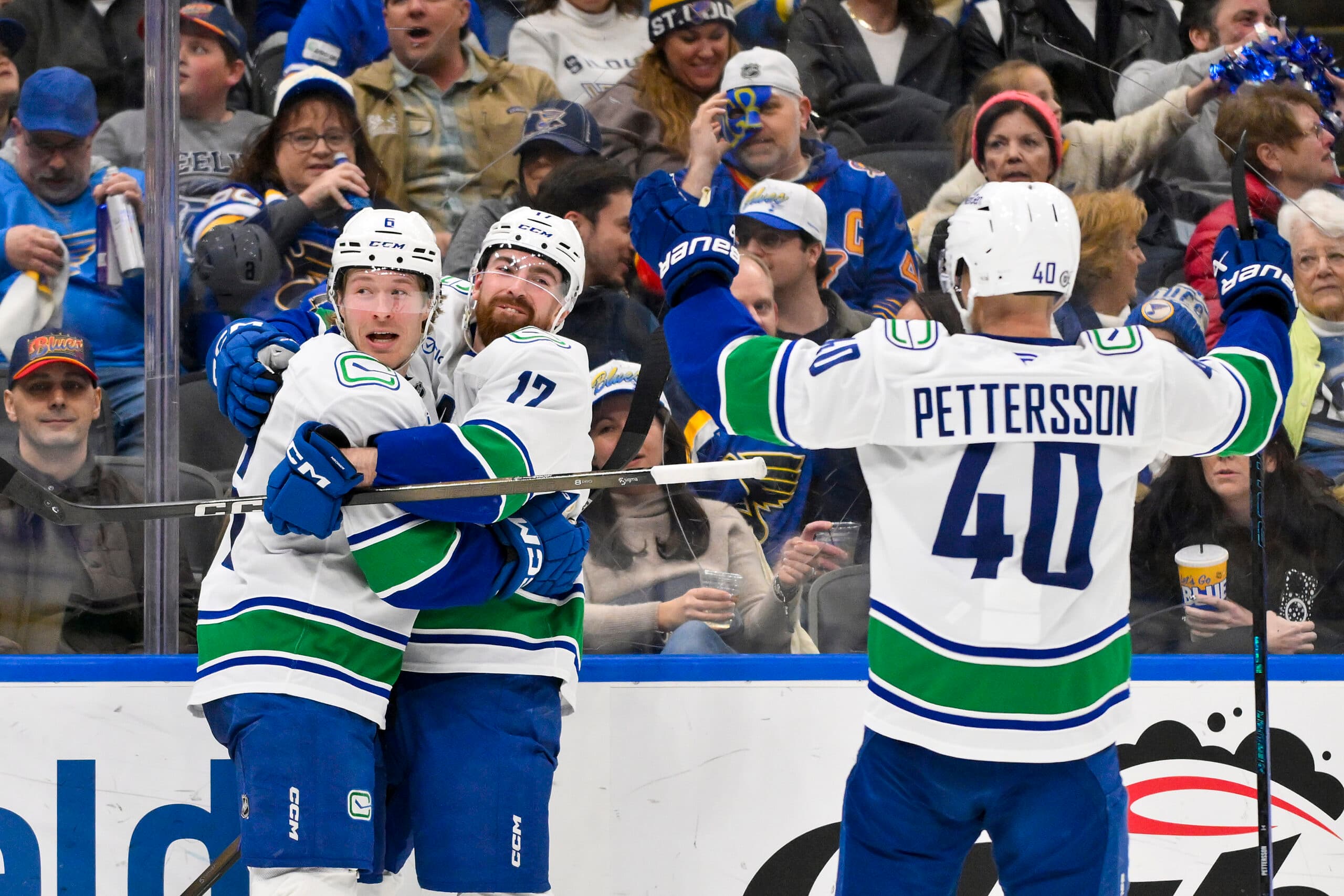
Photo credit: © Jeff Curry-Imagn Images

By Tyson Cole
Jan 16, 2026, 17:30 ESTUpdated: Jan 16, 2026, 17:28 EST
Since the calendar flipped to 2026, the Vancouver Canucks are still searching for their first victory of the year. They failed to do so in front of the home fans early in the month against the Seattle Kraken and Boston Bruins, and couldn’t secure even a single point on their six-game Eastern road trip.
That’s not to say the road trip wasn’t entirely encouraging for Canucks fans, however. Vancouver widened their cushion to six points behind the Winnipeg Jets for last place in the NHL, and President of Hockey Operations Jim Rutherford further clarified that the team is headed toward a rebuild.
In Rutherford’s interview, he mentioned that at the start of their retool/rebuild process, the plan was to not part with any core player. Which got us thinking: at this point, what even is the core of the Vancouver Canucks now?
The core of a sports team is built around the players who best represents the identity of how the team wants to play. And before the Quinn Hughes trade, he was the clear core piece of the team. He was the entire Canucks identity; the team funnelled play through him, and it was evident on a nightly basis that the team was only going as far as he led them.
A handful of players were lumped into that core group with the Captain. But now with him gone, that group is more murky.
On paper, Elias Pettersson, Brock Boeser, Conor Garland, Jake DeBrusk, Filip Hronek and Thatcher Demko would be the players who stand out as the new core of the team. However, that’s not who the core appears to be internally.
Head Coach Adam Foote was asked whose voice he’s noticed picked up in the room as a leader since the Hughes trade.
“[Filip] Hronek has really stepped it up this year, as far as his leadership. [He’s] matured a lot,” Foote replied. “He’s got good support; [Brock] Boeser’s always there, [Conor] Garland; you’ve got [Tyler] Myers and Marcus Pettersson on defence as well. So they’ve got a good group there.”
The full response can be found at the 2:30 mark below:
With that response from the Coach, the team presumably considers its core group of leaders to be Hronek, Boeser, Garland, M. Pettersson, and Myers. (Notice how a certain player, who’s making the most money on an annual basis on the entire team and consistently wears an ‘A’ nearly every game, was not listed as someone who has not stuck out to the Coach as a leader since the Hughes departure. Interesting.)
If those five players listed are the team’s core, then we’re here to argue that the Canucks really don’t have a core; that most of the Canucks’ next core players are either not on the team, or not even in the organization yet.
The Canucks have a pair of defencemen on the NHL team right now who could be part of the future core: Zeev Buium and Tom Willander. Last year’s first-round pick, Braeden Cootes, could be lumped into that category, but it’s likely their 2026 and 2027 – and maybe 2028 – first-round picks are the ones leading the Canucks’ core of the future.
With that said, if there really isn’t a core on the current Canucks roster, management should have no hesitation in moving any players on the team. In fact, management can view it as trading these “core players” will help the organization net futures that could turn into the next Canucks core.
In PostMedia’s Patrick Johnston’s interview with Rutherford, the Canucks President touched on the importance of keeping veterans, but that doesn’t mean they all have to be these veterans who stay and lead the next best Canucks core.
Along the way, there will be opportunities to also add veteran players who would play a developmental role for the team’s younger players. He cited Chicago’s signing of Nick Foligno in 2023 as an example of such a move. The veteran forward is now Chicago’s captain.“I think signing veteran players is actually necessary,” he said. “You can’t just take a bunch of 22-year-olds and throw them to the wolves. It’s a tough, tough league.”In other words, sure, they will take calls on the likes of Myers, Filip Hronek or Marcus Pettersson, but there’s no fire sale here. Some of those guys will stay.
The core of a sports franchise should be a player that the rest of the team looks up to; a player who will lead by example on and off the ice. It’s encouraging to hear that Filip Hronek has been the player who has stepped up the most for the team in Hughes’ absence. Maybe he’s one of the players who stays through this rebuilding phase to help mend the next best core of the Canucks team.
And at this point, Hronek might be the only player to really consider as a definitive core piece to this Canucks team right now. The team does not have a clear identity that they play to night in and night out, or somebody they lean on to help lead the charge. This management group will need to prioritize building the team the right way, focusing on strong character players, mixed with high-end skilled players that can lead by example and help mould the next best Vancouver Canucks core, because this team lacks a good example of that right now.
Sponsored by bet365


Breaking News
- Canucks trade Aatu Räty to Maple Leafs for forwards Jacob Quillan and Brandon Buhr
- What’s behind the early struggles from Canucks’ Zeev Buium and Filip Hronek?
- Canucks’ Räty clears NHL waivers, will report to AHL Abbotsford
- Blackfish: Romani opens strong, Cootes continues to impress and Malhotra shows his offensive potential
- Scenes from morning skate: Chytil to make season debut for Canucks vs. Panthers

Vancouver CanucksTeam Cap Summary

Cap Summary
2026-27
2027-28
Projected Cap Hit
$88,074,947
$71,329,167
Projected Cap Space
$15,925,053
$42,170,833
Current Cap Space
$17,259,555
$42,170,833
Active Players
23/23
13/23
Draft Picks
Round
'27
'28
1
1
1
2
2
2
3
1
1