
CanucksArmy has no direct affiliation to the Vancouver Canucks, Canucks Sports & Entertainment, NHL, or NHLPA
Ranking the 4 most valuable current Canucks contracts
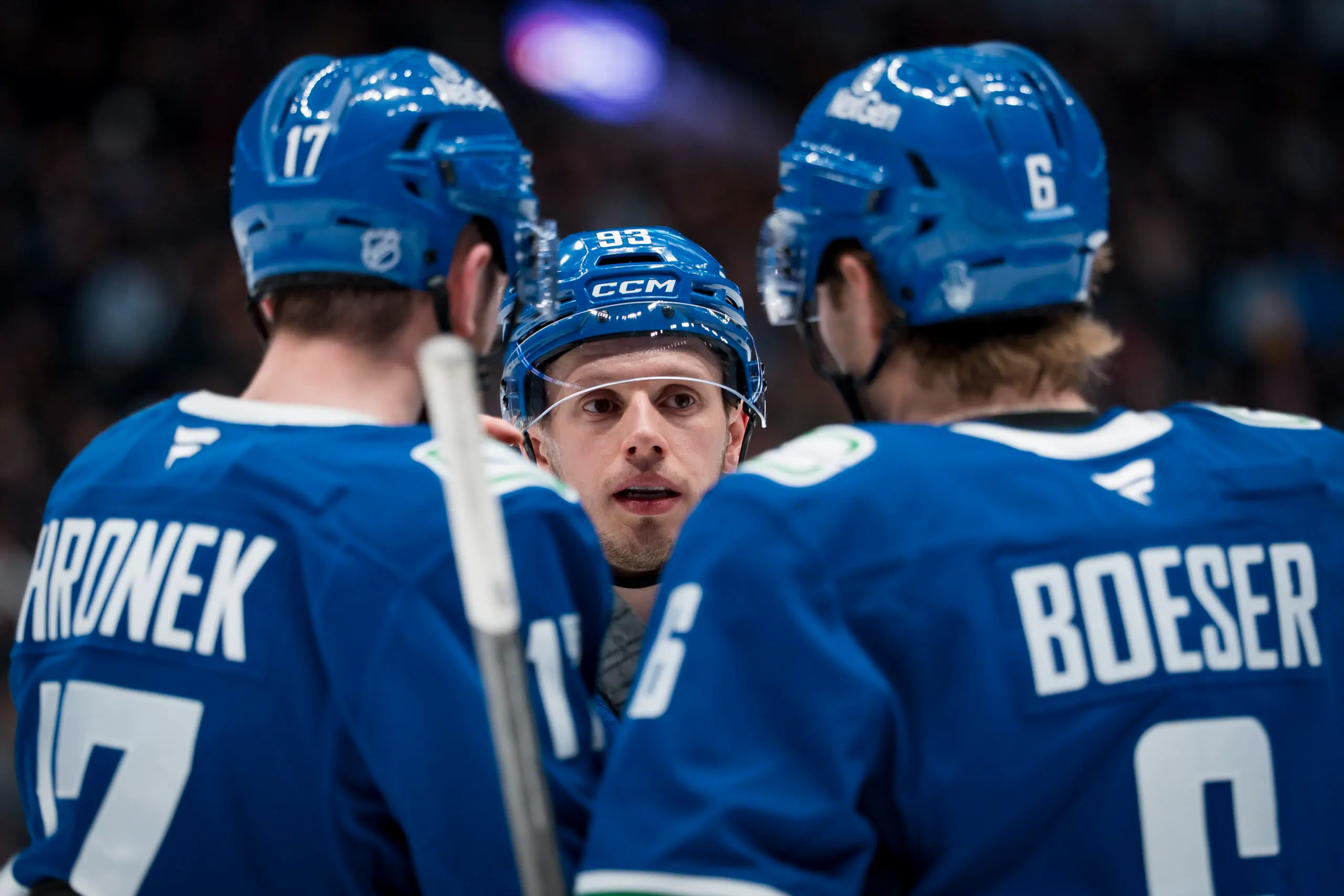
Photo credit: © Bob Frid-Imagn Images

By Jordan Frew
Jul 18, 2026, 15:00 EDTUpdated: Jul 18, 2026, 12:11 EDT


The Vancouver Canucks head into the 2026-27 NHL season in their first full season of the rebuild. They’re not looking to climb the standings, they’re just looking to make a positive change. One of the best ways to set your franchise up for success is through player contracts, and the Cancuks have some pretty solid ones.
There’s a lot to consider when looking at a player’s contract, it’s not just about dollars and length. What does the team need? For the Canucks, it’s currently acquiring strong leadership presence who will support the young players’ growth. How do these contracts look down the line? Can they be easily flipped? The Canucks have some contracts they will struggle to move, but others that should look great at the trade deadline.
Through free-agent signings, trade acquisitions, and their own good signings, the Canucks have contracts that work in their favour in both the short and long term. Here are the four most valuable (non-ELC) contracts on the Canucks’ books.
Brendan Gallagher
For the Canucks, it’s not just about on-ice value. After all the dirty laundry that’s been aired out about Canucks locker room over the past months, it’s clear the Canucks needed to start bringing in guys who could properly lead and support the up-and-coming talent.
On June 29, 2026, the team took that first step when trading for Brendan Gallagher from the Montreal Canadiens. The Canucks will be paying the Delta native $3.25 million for one year of service before he turns into an unrestricted free agent at the end of this season. His contract is worth $6.5 million AAV, but the Canadiens retained half his salary in the trade that got them future considerations in return.
The 34-year-old’s contract has a no-movement clause, which means he can’t be waived or sent down to the minors, but he only has a six-team no-trade clause. This gives the Canucks options come trade deadline.
Gallagher brings the Canucks strong leadership and an example that the young forwards can follow. While his best offensive years may be behind him, the Canucks aren’t necessarily looking for an offensive powerhouse. Gallagher’s upside comes from the 14 seasons of NHL experience he brings to a rebuilding team, one that needs to see what proper mentorship looks like. Paying $3.25 million during the first year of trying to have a cleaner locker room is not a steep price to pay.
As well, Gallagher offers the Canucks an interesting opportunity to flip him at the trade deadline, with the option for double salary retention, which is harder to achieve thanks to new rules surrounding the use of it. This would turn his $3.25 million cap into $1.625 million. Gallagher is a gritty forward who will crash the net and dig for rebounds, and for teams fighting for a playoff spot or looking to go deep, this is the exact forward and cheap price they will want to pay.
Luke Schenn
Flipping the coin from Gallagher to Luke Schenn, he brings similar things to the Canucks: a veteran leader who will help support the young Canucks, instead targeted towards defencemen.
Schenn joined the Canucks for the third time on day one of 2026 Free Agency, signing a one-year $2.25 million deal. While he’s another guy on the decline, getting regularly healthy scratched last season by the Winnipeg Jets and Buffalo Sabres, he has expressed his support of the Canucks future and wants to be a part of the change.
The Canucks are focused on developing the young guys and fitting them into the roster, and Schenn not playing every game supports this. Schenn could slot in on the right of left-handed Elias Pettersson, subbing in and out with Victor Mancini. Pettersson took a step back in his sophomore season, and Mancini is still working to pave his way to an every-night spot. Playing with and receiving guidance from Schenn could prove exactly what the two need to take the next step in their careers.
During the season and offseason, the Canucks also lost two strong veteran presences in Tyler Myers and Marcus Pettersson, shifting a lot of responsibilities to Filip Hronek. Having Schenn around helps to fill this gap, relieving pressure off of Hronek.
The Canucks gave Schenn a full no-movement clause, giving him full control of where he plays this year and whether the Canucks can trade him. Schenn brings lots to any team, and the two-time Stanley Cup Champion experience could elevate a team during the playoffs. The Canucks lost nothing by signing him, but if he applies his NMC, they may miss out on getting anything in return for him at the trade deadline.
In the end, paying Schenn $2.25 million for another year with the club before he becomes a UFA again is a good price for the Canucks to pay, considering all the ways he can positively impact the Canucks.
Filip Hronek
Filip Hronek has established himself as a key leader for the Canucks, there is no doubt about that. After trading captain Quinn Hughes to the Minnesota Wild in December of last year, Hronek has stepped up offensively and in the dressing room.
The Canucks locked him up with an eight-year, $7.25 million AAV deal, which he has five years remaining on. For the next two seasons, he has a full NMC before it turns into a modified no-trade clause, a 15-team no-trade list. There’s lots of talk about the return Hronek could get right now, but he has expressed no interest in waiving and being traded, and it sure seems he wants to be a part of the rebuilding Canucks.
Hughes was traded during Hronek’s fourth season with the Canucks, and since he has been traded, Hronek has stepped up and filled Hughes’ shoes to the best of his ability, even setting a new career-best 49 points last season. Entering this season, Hronek will continue to play big minutes for the team, and his value should stay about the same, if not increase even more.
If Hronek does not waive his NMC for the next two years, the Canucks will receive skill and leadership during the first steps of their rebuild from the 28-year-old. This will only increase his trade value for when his contract turns into a 15-team no-trade list. When that time comes, he will still be under contract for three years at $7.25 million before becoming a UFA. Given the contracts we’re seeing handed out in the rising NHL salary cap environment, there’s no telling just how valuable Hronek’s contract might be at that time.
Marco Rossi
Marco Rossi is a contract the Canucks acquired via the Hughes trade, and it stands out as a positive for the Canucks. Last season, the centreman was in year one of a three-year deal and has two years remaining on his contract at $5 million AAV before becoming an arbitration-eligible restricted free agent at the end of the 2027-28 season.
The Austrian struggled last season with injuries, but he was on par, and slightly above, the Canucks’ other star players, while making much less than them.
When acquired, Rossi slotted into the 2C spot behind Elias Pettersson. Pettersson has struggled offensively, but he has remained reliable on the defensive end of the ice. Last season, Pettersson posted a 0.68 point per game, compared to Rossi’s 0.7 with both the Wild and Canucks, and 0.66 with just the Canucks. Pettersson makes $11.6 million, over double Rossi’s $5 million for similar production.
Brock Boeser is another Canuck who has struggled. Last season, he averaged 0.64 PPG on a $7.25 million contract. While the gap between Rossi and Boeser is significantly less than the gap between Rossi and Pettersson, Rossi is providing more offensively for the Canucks than Boeser currently is, and at a cheaper price.
By the start of the upcoming season, Rossi will have just turned 25, and the Canucks will still have two years with him on his current contract, which, compared to others, sees him make much less for similar production. This gives them time to continue to watch him grow and evaluate his future with the club before they need to re-sign him.
The current cap is set at $104 million, and it is set to jump to $113.5 million in the 2027-28 season. Right now, the Canucks have $17,814,167 in cap space, and as the cap continues to increase significantly and the Canucks either trade players or see short-term deals expire, they will have room to sign players to their franchise who help them continue to grow and improve in the future.
Sponsored by bet365


Breaking News
- ‘It’s on us to prove them wrong’: Cotter embracing critics viewing Canucks as underdogs for 2026-27
- Canucks: Why size and speed matter so much at centre in Manny Malhotra’s system
- Scenes from practice: DeBrusk returns, Canucks shake up D pairs in early skate before long road trip
- Could the Canucks get involved in a Simon Edvinsson trade?
- Jonathan Lekkerimäki’s hot start to Canucks season all the more impressive given the context

Vancouver CanucksTeam Cap Summary

Cap Summary
2026-27
2027-28
Projected Cap Hit
$88,074,947
$71,329,167
Projected Cap Space
$15,925,053
$42,170,833
Current Cap Space
$16,521,178
$42,170,833
Active Players
23/23
13/23
Draft Picks
Round
'27
'28
1
1
1
2
2
2
3
1
1