
CanucksArmy has no direct affiliation to the Vancouver Canucks, Canucks Sports & Entertainment, NHL, or NHLPA
How the Canucks could use double retention to cash in on Brendan Gallagher at the deadline
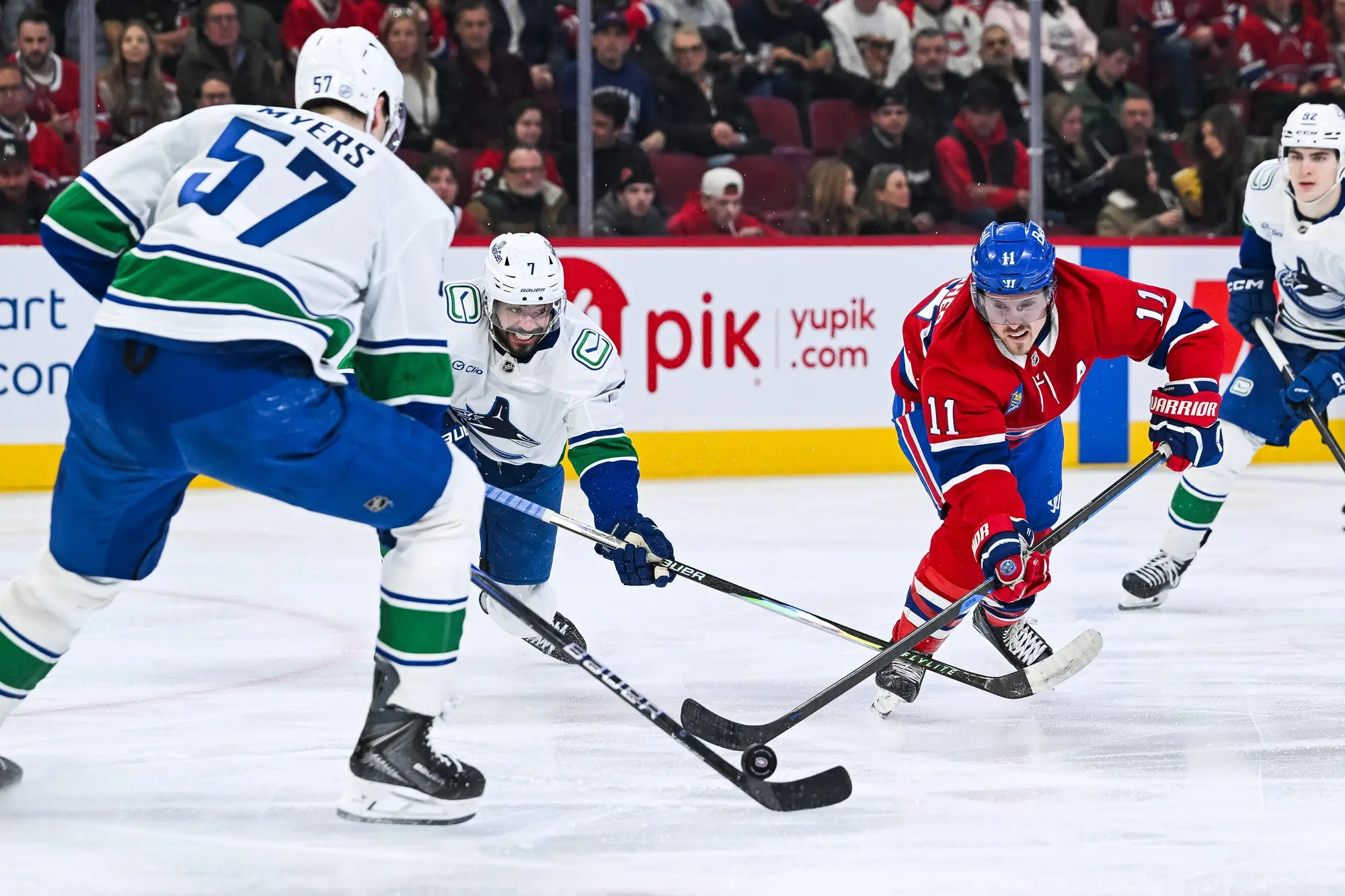
Photo credit: © David Kirouac-Imagn Images

Jul 1, 2026, 11:25 EDTUpdated: Jul 1, 2026, 12:59 EDT


One of the worst-kept secrets in the NHL stopped being a secret earlier this week. The Montreal Canadiens closed a deal with the Vancouver Canucks to send veteran winger Brendan Gallagher back to his BC roots, something that had been rumoured to occur for months now.
It had been somewhat expected that Gallagher would come with some sort of sweetener attached to him in exchange for the Canucks taking on the final year of his $6.5 million AAV contract. In the end, the Canucks got nothing but the proverbial nothing that is “future considerations.” Instead, the ‘sweetening’ came via retention, with the Canadiens agreeing to retain 50% of Gallagher’s final year, bringing his cap hit down to just $3.25 million for the Canucks.
And that act of retention might end up being far more valuable than whatever fourth or fifth rounder would have realistically been attached to his full contract.
What is double salary retention in the NHL?
We’re talking about “double retention” here. The act of having one team retain 50% of a player’s contract once, and then another team retaining another 50% somewhere along the way, before a player reaches their final destination at a total discount of 75% their original cap hit. (With 50% being the maximum amount that can be retained on any one retention case, and a total of two retentions being the maximum on any one contract.)
Double retention trades used to be a Trade Deadline staple. Every year, some of the biggest rental names could almost be guaranteed to stop off at an intermediary team for some extra retention on the way to their ultimate buyer. You may have heard, however, that the NHL recently got rid of double retention trades.
That’s not quite the case. Double retention trades are still possible, they’re just a lot harder to coordinate than they used to be. The specific rule change, which took effect partway through the 2025-26 season, now states that 75 days must pass between the first instance of retention on a contract before that contract can be retained upon again (and, correcting an earlier error on our part, offseason days do not count against that total).
This rule quickly killed the traditional type of double retention transactions, as was its intention. Plenty of players got moved with the standard ol’ 50% singular retention in 2025-26, including the Canucks’ own Tyler Myers in his move to the Dallas Stars, but not one instance of double retention occurred throughout the entire year.
But double retention isn’t necessarily dead. It just needs to be planned and coordinated well in advance. And speaking of well in advance, let’s get back to that acquisition of Gallagher.
The season opens up sometime in October. That’s when the 75-day ticker begins to count. In other words, Gallagher will become eligible for a second round of retention before the new year, and that possibility will remain right through to the Trade Deadline sometime in early March.
So, what the Canucks could now plan to do is utilize Gallagher in a mentorship role throughout most of the 2026-27 season, but also to then flip him at or near the deadline with a further 50% retention.
That would bring Gallagher’s cap hit down from its current $3.25 million to just $1.625 million. And that’s the kind of price tag that a player with Gallagher’s experience and intangibles is usually not available at.
With more minutes and opportunity in Vancouver, some sort of rebound seems likely for Gallagher, who notched just seven goals and 23 points for Montreal last season. But even if that doesn’t come to pass, Gallagher should still have considerable value. He’s got a long enough history of being an absolute warrior, especially in the playoffs, that virtually any contending team would love to add him if they could afford him. And, at a $1.625 million cap hit, who couldn’t afford him?
Gallagher has a full no-movement clause, meaning he cannot be demoted to the minors without his say-so, but he only has a six-team no-trade clause, meaning there are six teams he could block a trade to. When it came to picking he and his family’s next long-term destination, the Canadiens were willing to play ball, essentially allowing him to select Vancouver. That equation probably changes, however, when it’s the Canucks looking to sell Gallagher at the deadline for a month or two of mercenary work.
At that point, the six-team NTC means that the Canucks could shop Gallagher around to pretty much anyone. And, like we said before, pretty much anyone is going to be able to afford him at that 75%-reduced cap hit. It’s a little like the situation the Canucks found themselves in with Kiefer Sherwood last year, where the player’s multifaceted profile and low relative salary meant that nearly every playoff-bound team had at least some interest.
From there, it’s just a question of figuring out the asking price.
Sherwood went for two second round picks. That seems like a lot for Gallagher, who is a full three years older than Sherwood. That said, Gallagher is himself only one year removed from a 21-goal season. With enough of a bounceback, who knows, and who really knows what the state of the rental market will be by the deadline? At least a singular second rounder seems well within reach.
The latest trend has been for not all that many rentals to be available, period. And due to these new rule changes, the amount of rentals that will be available at a double-retained price will be extremely limited. It could even wind up being limited to just Gallagher, specifically.
Suffice it to say, then, that in eschewing a late round pick sweetener for taking back Gallagher, and in asking for salary retention instead, what the Canucks have done is create a unique asset. They’re now free to use that asset however they see fit, but it’s hard to imagine a better outcome than really cashing in at the Trade Deadline.
What they might get back for Gallagher at that point remains to be determined. But we’d bet that it’s more than might have been attached to his full contract by Montreal, and when it comes to acquiring future-based assets for the rebuilding Canucks, more is good.
PRESENTED BY THE DAILY FACEOFF FREE AGENCY SPECIAL
Daily Faceoff is your Free Agency Headquarters! Big moves. Breaking news. Instant analysis. Daily Faceoff is bringing the team together July 1st for a live Free Agency Special featuring Jeff Marek, Tyler Yaremchuk, Carter Hutton, and Dave Pagnotta. Tune in at noon ET on the Daily Faceoff YouTube Channel and socials for full coverage as the NHL landscape changes – with the PuckPedia-powered signing tracker keeping you up to date on every deal as it happens.


Breaking News
- Meet the three men reviving beloved ‘Sports Page’ in an all-new format
- Canucks Game Day: Dealing with the Devils in early Saturday start in New Jersey
- The Canucks have every reason to give Leevi Meriläinen a run of starts
- A look inside the Canucks early-season penalty killing struggles
- ‘Best news ever’: Max Lapierre thrilled to see Canucks put Sedins, Johnson, and Malhotra in charge

Vancouver CanucksTeam Cap Summary

Cap Summary
2026-27
2027-28
Projected Cap Hit
$88,074,947
$71,329,167
Projected Cap Space
$15,925,053
$42,170,833
Current Cap Space
$16,790,545
$42,170,833
Active Players
23/23
13/23
Draft Picks
Round
'27
'28
1
1
1
2
2
2
3
1
1