


Caleb Malhotra is a massive riser. I love his trajectory going from the BCHL to a key player on the top team in the OHL. Very detailed player with good size and soft hands. Excels in front of the net and at feeding passes in front. He's pushing hard for a top 10 spot.

CanucksArmy has no direct affiliation to the Vancouver Canucks, Canucks Sports & Entertainment, NHL, or NHLPA
The dilemma the Canucks face at the 2026 NHL Draft if they select 3rd
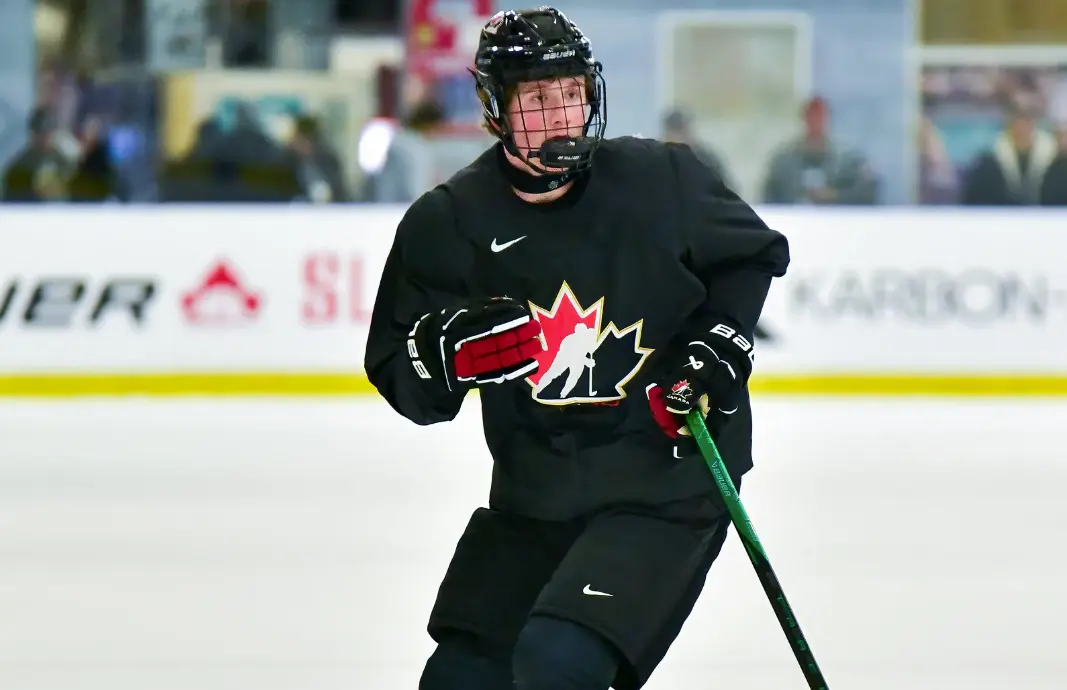
Photo credit: © Steven Ellis/The Nation Network
We’re just a few short weeks away from the February Olympic break. With roughly 30 games remaining on the NHL schedule, the runway to cover ground is shrinking by the day. And sitting dead last with a healthy cushion in the NHL standings, there is a very real chance the Vancouver Canucks will arrive in Buffalo this June holding a premium draft selection.
The centre question in the first round of the 2026 NHL Draft and the decision facing the Vancouver Canucks
According to MoneyPuck, the Canucks currently carry a 20.5% chance of winning the first overall pick. Of course, lottery math only tells part of the story. History, and a fan base that is all too familiar with it, suggests that sliding down the board is an unfortunate, but very real possibility.
The good news is that as long as the Canucks stay within the range they are in today, they are poised to pick in the top three in a draft with a comfortable consensus. So, operating under the assumption that Vancouver selects somewhere inside the top three, what are the realistic scenarios at play?
The good news is that there is a clean, uncomplicated version of the Canucks’ 2026 NHL Draft plan.
If they select inside the top two, the organization doesn’t overthink it. Although it may not address a glaring organizational need down the middle, Vancouver takes one of the two elite forwards who have separated themselves at the top of the class — Gavin McKenna or Ivar Stenberg — and moves forward with a player capable of reshaping the forward group’s trajectory overnight.
The complexity begins if they don’t.
Should the Canucks slide to third overall, the draft quickly shifts from a straightforward selection to a true decision-making exercise. With a cluster of comparable talent available, Vancouver would be forced to weigh positional value, organizational need, and asset management — all within a draft class that lacks a clear-cut answer at centre.
Pick 3: Where the draft gets murky
If Vancouver finds itself selecting third, the draft board sings a much different tune.
From a pure best-player-available perspective, the next name in line is likely defenceman Keaton Verhoeff — a right-shot defender with a safe, projectable profile and top-pairing upside. For many teams, that would be an easy call. For the Canucks, it’s not so simple.
With a growing pipeline of young defencemen already in place, the question becomes whether using such a premium pick on another blue-liner best serves the organization’s long-term needs. For some, the answer is unequivocally yes. But that uncertainty naturally redirects attention back to the centre, which remains a position Vancouver still lacks depth in and is in desperate need of accumulating through the draft.
The problem? This isn’t a draft with an obvious answer. Instead, it’s a centre class defined by questions, not certainty.
In a perfect world, the 2026 draft features a franchise-altering top centre a la Macklin Celebrini circa 2024. Simple, right? Unfortunately, this centre group does not feature a consensus top pivot. Instead, it offers a collection of players with different strengths, ceilings, and levels of projection — each appealing in its own way and carrying varying degrees of risk.
The shifting dynamic: Tynan Lawrence vs. Caleb Malhotra
Earlier in the season, Tynan Lawrence was widely viewed as the safest bet among centres and a near lock for top-5 discussion. However, as will happen throughout any draft season, that discussion has drastically changed over the last few weeks.
His draft-eligible season has been unique, one full of twists and turns. Due to an injury sustained in preseason, Lawrence missed the majority of the first half and returned to the USHL in late October, where he put up strong numbers as captain of theMuskegon Lumberjacks (17 points in 13 games). Over the holidays, he decided to pivot mid-season and commit to Boston University, effective immediately.
With just one goal through six games, his transition to the NCAA has been a key evaluation point. Facing older, stronger competition has tested his processing speed and ability to assert himself. While the foundation remains solid, questions linger about how much offensive separation he can ultimately create.
When playing to his strengths, Lawrence’s game is built on pace, competitiveness, and structure. He pressures pucks, stays involved away from the puck, and plays a style that translates cleanly to the professional level as a foundational two-way pivot.
Caleb Malhotra, meanwhile, has steadily pushed himself into the conversation. At 6-foot-2 with room to add strength (182 pounds), he already carries an NHL frame, and his early OHL production, which has him third among all skaters with 59 points in 43 games, has backed up the projection. The puck follows him, and he has shown an ability to create offence without sacrificing structure.
The contrast between the two is subtle but important. Lawrence offers tempo and competitiveness. Malhotra brings a bit more size, poise, and tangible offensive results. Depending on what Vancouver prioritizes, either could be in play — but neither represents a slam-dunk selection at third overall.
The momentum play: Viggo Björck
Few players in this class have generated more upward momentum than Viggo Björck. Thanks to a strong Gold Medal performance at this year’s World Juniors, his draft stock has shot up through the roof recently. And rightfully so.
His calling card is intelligence. Björck processes the game quickly, anticipates pressure, and consistently finds solutions before lanes close. Whether deployed at centre or on the wing, he brings a playmaker’s mindset and a strong sense of timing in all three zones.
Björck earns his coach’s trust through detail, pace, decision-making, and an ability to support play away from the puck — all traits that allow his skill to shine in meaningful situations. At just 17, he’s already enjoying reps as a top-line centre at the SHL level. He plays on both special teams units, takes faceoffs and plays in all situations for Djurgårdens. Simply put, he just feels like an NHL player.
The lingering question revolves around long-term position. His size (5-foot-10, 172 pounds) means he’ll always need to win with angles, anticipation, and puck protection rather than brute force. If he continues to do that effectively, his upside as a top-six NHL forward is very real, regardless of whether he ultimately settles at centre.
All three players — Lawrence, Malhotra and Björck — are projected to go within the top-10. Or, close to that benchmark. But what about the players available in that next phase of the first round? Those in the 15-25 range for trading to accumulate more assets.
The safe floor: Oliver Suvanto
If there is a stabilizing option among this group, it’s Oliver Suvanto.
Already playing in Finland’s Liiga, Suvanto has gained experience against men and excels in the lower tiers. That background is evident in his composure, positioning, and defensive awareness. At 6-foot-3 and over 200 pounds, he brings a frame that allows him to protect pucks and manage space effectively. He’s willing to drive to the net and play in the dirty areas, and while his offensive output may not be eye-catching at this stage, his habits project cleanly to the NHL level.
Suvanto may not become a dynamic offensive driver, but his floor as a dependable, reliable NHL centre is among the strongest in the class — particularly in the 10–15 range. No, you may not jump up to take him with a top-10 pick, but if the scenario plays out where the Canucks hold a mid-round pick, he’s as solid a bet as you can make in this draft.
The projection bets: Ilia Morozov vs. Yegor Shilov
Ilia Morozov may be the most intriguing long-term play among these centres.
As one of the youngest players in NCAA hockey, he’s already holding his own against older competition and has produced 14 points in 24 games. Though, admittedly, his production has tapered off quite substantially in the second half. Beyond the numbers, his game is built on awareness, positioning, and a calm approach through the middle of the ice.
Morozov combines a pro-sized, 6-foot-3, 205-pound frame with responsible habits, making him effective in all three zones. The next step will be asserting himself offensively with greater consistency and pushing the game at a higher pace. If that progression arrives, his stock could rise quickly. At his best, Morozov projects as a two-way NHL centre capable of contributing in all situations and should be available somewhere in the mushy middle of the first round, if not a little later.
Over in the QMJHL, Yegor Shilov is one of the more intriguing offensive centre options in the 2026 draft class, largely because he sits at the intersection of size, skill, and projection.
A Russian-born centre playing major junior in Victoriaville, Shilov is sitting top-10 in points with 53 in 40 games and has shown the upside to place him into the first round conversation. The tools are evident, but the polish is still coming. At his best, Shilov shows a blend of offensive instincts that are difficult to ignore. He has the hands to create in tight, the vision to distribute effectively, and enough shooting ability to blow past netminders.
Physically, he already carries a relatively pro-ready frame (6-foot-1, 181 pounds), which gives him a solid foundation. Where his game still needs growth is in leveraging that size and playing on both sides of the puck. Too often, puck battles fall through the cracks rather than wins, and separation doesn’t always come as cleanly as it should, given his build.
If Shilov learns to consistently win 50/50 battles, Shilov profiles as a potential middle-six NHL centre with scoring upside. He’s not a finished product, but he’s the type of bet teams consider once the top tier is off the board.
The bigger question: Reach, rebalance, or reallocate?
If the Canucks pick third, the decision isn’t simply which centre to take.
Do they select the next best player available and trust development to sort out positional balance? Do they reach for a centre in a class without a clear top option? Or do they explore a trade-down scenario, leveraging that pick to accumulate additional first-round capital and attack the draft more broadly?
Given how evenly the centre talent spreads across the middle of the first round, trading down could allow Vancouver to secure one of these pivots while also adding another high-end prospect — spreading risk rather than concentrating it.
Don’t forget, there’s still a second first-round pick and a high second-round pick that could easily come into play. Of course, we will continue our draft coverage here at CanucksArmy and highlight many more options as the season progresses.
PRESENTED BY VIVID SEATS



Breaking News
- 3 Canucks Stars of the Week: Jonathan Lekkerimäki a bright spot amid losing streak
- Abbotsford Weekly: Hats fly for newcomer Jacob Quillan as Canucks sweep Wranglers
- Scenes from practice: Malhotra hauls out line blender in attempt to help Canucks snap 10-game losing skid
- Canucks’ Jack Thompson clears NHL waivers, will report to AHL Abbotsford
- JPat’s Monday Mailbag: Canucks chemistry lessons, a hot dog feast and press box bingo

Vancouver CanucksTeam Cap Summary

Cap Summary
2026-27
2027-28
Projected Cap Hit
$87,295,050
$71,329,167
Projected Cap Space
$16,704,950
$42,170,833
Current Cap Space
$19,405,750
$42,170,833
Active Players
23/23
13/23
Draft Picks
Round
'27
'28
1
1
1
2
2
2
3
1
1