
CanucksArmy has no direct affiliation to the Vancouver Canucks, Canucks Sports & Entertainment, NHL, or NHLPA
Kiefer Sherwood: How the value of the two seconds the Canucks returned compare to a first-round pick
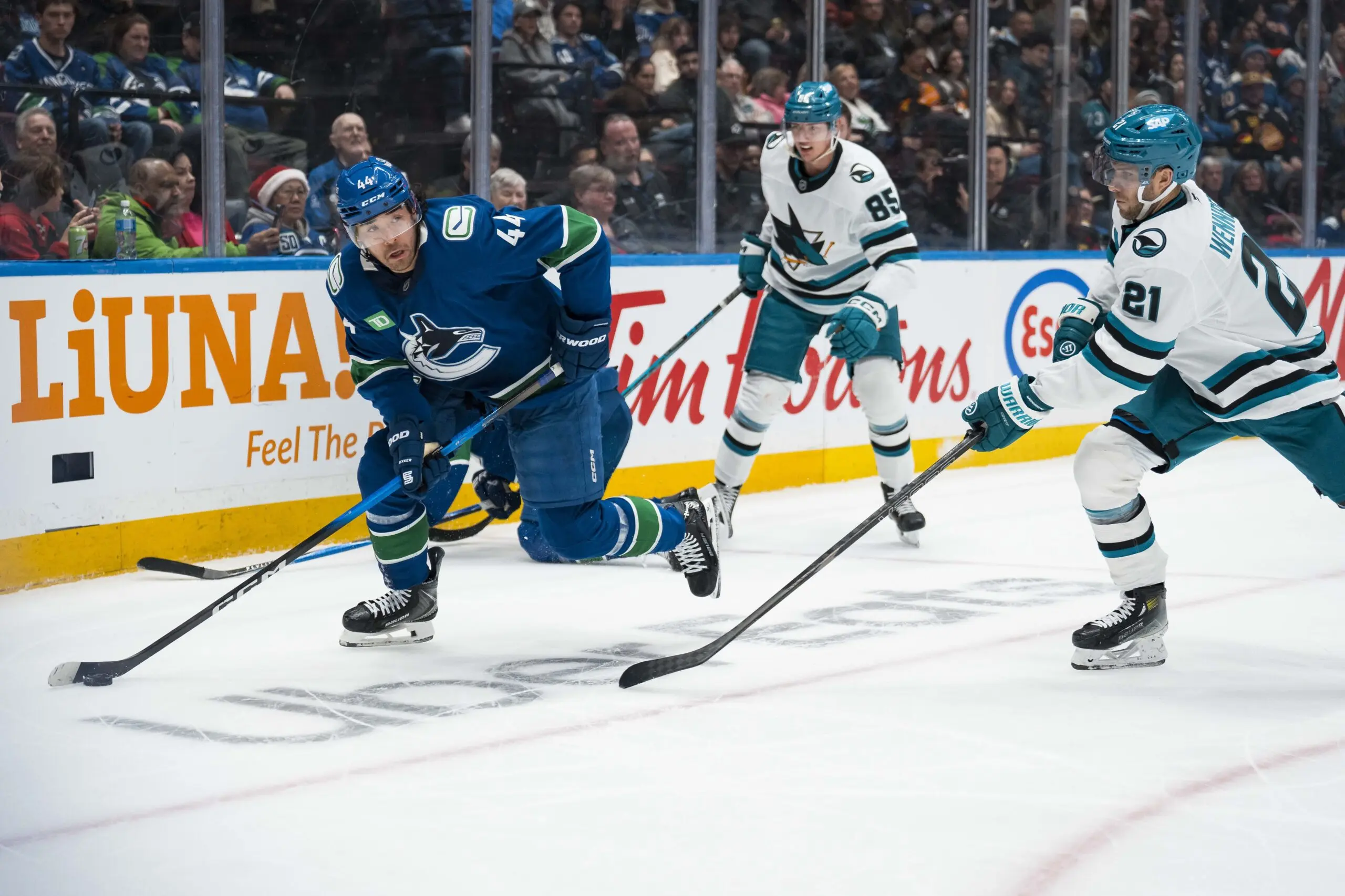
Photo credit: © Bob Frid-Imagn Images

Jan 20, 2026, 15:00 ESTUpdated: Jan 20, 2026, 14:09 EST


The Kiefer Sherwood Era is over in Vancouver. He was, fittingly enough, a big hit for the Canucks. In just a season-and-a-half, Sherwood proved incredibly popular. Few fan favourites have ever fan-favoured harder for this franchise. But now he’s got a new set of fans to enamour.
No one can claim that Monday’s trade, which sent Sherwood to the San Jose Sharks, came as a surprise. But it was still a disappointment for many. Disappointment that Sherwood won’t be a Canuck any longer. And, for some, disappointment at the size of the return.
There had been an awful lot of talk all season long about Sherwood and his value, and that talk often involved a first-round pick. On the surface of it, it seemed logical enough. In a dry UFA rental market, Sherwood stood out as one of the few potential difference-makers available. He was up to 17 goals by the halfway mark of the season, was still hitting as much as anyone in hockey, and carried with him a miniscule $1.5 million cap hit. There were a lot of teams interested in Sherwood’s services, as there should have been, and that led to hopes of a bidding war pushing things into the first round, and maybe beyond.
In the end, however, the Canucks walked away with two second-round picks – San Jose’s own in the 2026 and 2027 drafts – and minor league defender Cole Clayton.
Anytime one expects a first and ends up with a second, there’s bound to be disappointment. That’s just basic math. But how does the value of two second-round picks compare to that of a single first? It might be closer than one thinks at first, depending on where those picks fall within each round.
Over the years, there have been many attempts made to quantify the value of a draft pick. No longer does it suffice to just talk about picks as fixed assets, as if one first is equivalent to any other first. We all know there’s a difference between the first overall pick and the 32nd overall pick, yet both are first-rounders. We also all know that, when it comes down to it, there’s a difference between the 14th overall pick and the 17th. The history and track record of each individual pick range has been analyzed, and several individuals have tried to crunch it all down into a number.
Matt Perri, a former Director of Analytics for the Arizona Coyotes, makes one such attempt. With his Perri Pick Value Calculator, Perri gives each and every draft slot a numerical value, based on both the history and precedence of the players selected with those picks, and how they’ve been valued in pick-for-pick trades on the draft floor. It values picks based on what those picks have traditionally done and how NHL GMs have typically valued them. It’s an inexact science, perhaps, but it’s a science all the same.
Our friends at Puckpedia now host the Perri Pick Value Calculator, where anyone can go in and plug in any number of draft selections to gauge their value against one another.
Which brings us back to the Sherwood trade, and the rough value of the picks the Canucks brought back in that trade.
As of now, those picks are undetermined, as the 2025-26 regular season isn’t anywhere near over yet, and one of those picks isn’t until 2027, anyway. But if we based it just on today’s standings, the Sharks are currently in 19th overall in the NHL. That would have their second-round pick slot at 49th overall in the 2026 draft (one spot higher due to the forfeited Ottawa first-round pick this year) and at 50th overall in the 2027 draft. And with those numbers in hand, we can calculate the pick value.
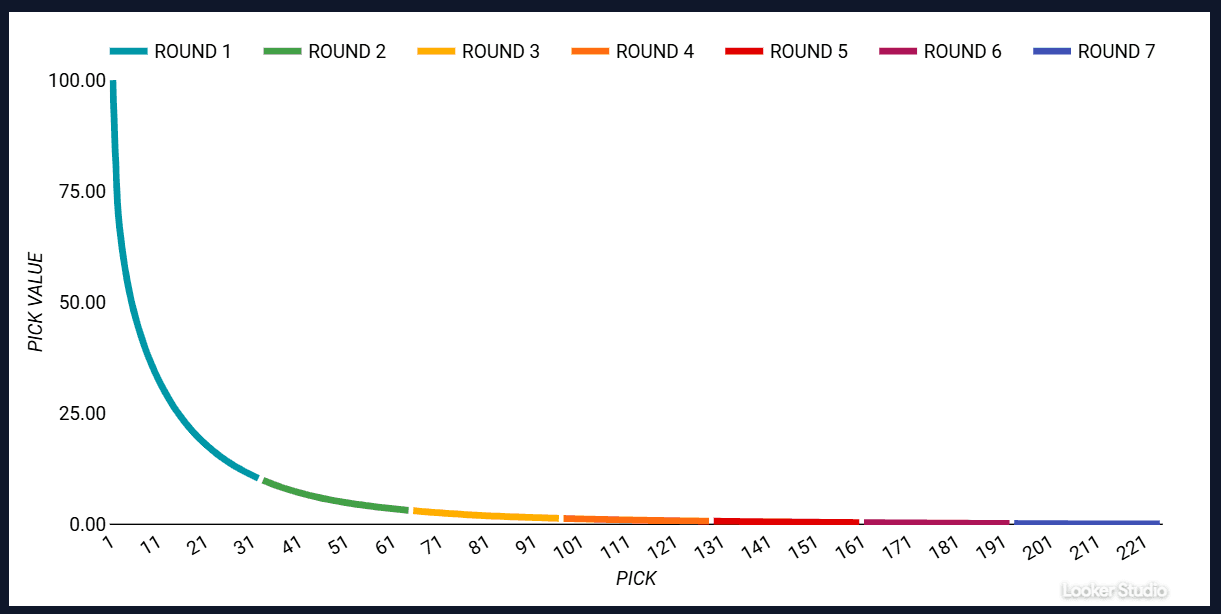
From Matt Perri, hosted by Puckpedia
At first, the distinctions are sharp. The value of the first overall pick is set at 100, and by pick two, we’re down to 72.69, and by pick three, down to 62.07. But the curve smooths out eventually. As one can see, there’s a noticeable tapering off of value that occurs toward the end of the first round and into the beginning of the second round. A flattening, or plateauing, if one will.
If we punch the Canucks’ two second-rounders from the Sharks into the Pick Calculator as currently slotted (49th and 50th overall selections), we find they have values of 5.19 and 5.00, respectively. Now, those numbers don’t mean a whole heck of a lot, besides being approximately 1/20th the value of the first overall. But let’s apply some context.
If we plug in the Sharks’ first-rounder, say, currently slotted at 19th overall, we get a value of 19.81. That’s a lot more than either second rounder, and is in fact more than both of them combined. By that measure, we can say that two Sharks’ seconds does not equate the value of a single Sharks first.
But the 19th overall was probably never on the table for Sherwood. In fact, if we’re to believe the reporting around the trade, no first-round pick was ever on the table. But let’s imagine, as some suggest, that had the Canucks waited long enough, a late first would have become available closer to the Trade Deadline.
If we plug in the 32nd overall pick, better known as the last pick of the first round (in years where the Senators are not left out), we get a value of just 10.38. Which is, more or less, the equivalent value of the two second-round picks put together.
By that measure, what the Canucks brought in was about as valuable as a very late first would have been. According to the calculator, anyway, which means according to the precedent.
This all tracks logically, too. Draft picks are lottery tickets, anyway, and more tickets mean more chances of one of them being a winner.
Historically, the player selected 32nd overall has a higher chance of success than the player picked 49th. But not so much more as to outweigh the benefit of getting to make two selections in that range. The Canucks will get two chances to pick a player with these picks, instead of one, and the odds say they’re about as likely to come out of it with someone useful as they would have been with a single pick placed a bit higher in the draft.
The Pick Calculator also implies that, should the Canucks prefer a prospect ranked a little higher in the draft, they should be able to acquire a late first for about the value of those two seconds, via trade. Such deals happen all the time.
All of which goes toward saying that the Sherwood trade may have sounded like a let-down at first, and specifically because a ‘first’ wasn’t included. But it’s never good practice to get too caught up on specifics. The Canucks got the rough equivalent value of a late first back for a player they invested a little less than $3 million into, and it’s hard to call that anything but a long-term win for a franchise that needs as many of those as it can get right now.
Sponsored by bet365


Breaking News
- Former Canucks captain Quinn Hughes speaks ahead of return to Vancouver
- How Canucks’ Cootes is doing compared to other 2025 first-round picks playing in the AHL
- Scenes from practice: Pettersson and Boeser reunited as Canucks skate at UBC on Saturday
- Abbotsford Canucks preview: Players to watch in weekend rematch with the Wranglers
- How the Canucks can fix their early-season defensive breakdowns

Vancouver CanucksTeam Cap Summary

Cap Summary
2026-27
2027-28
Projected Cap Hit
$87,295,050
$71,329,167
Projected Cap Space
$16,704,950
$42,170,833
Current Cap Space
$19,176,096
$42,170,833
Active Players
23/23
13/23
Draft Picks
Round
'27
'28
1
1
1
2
2
2
3
1
1