
CanucksArmy has no direct affiliation to the Vancouver Canucks, Canucks Sports & Entertainment, NHL, or NHLPA
5 things the Canucks can learn from the last time they were ‘open for business’
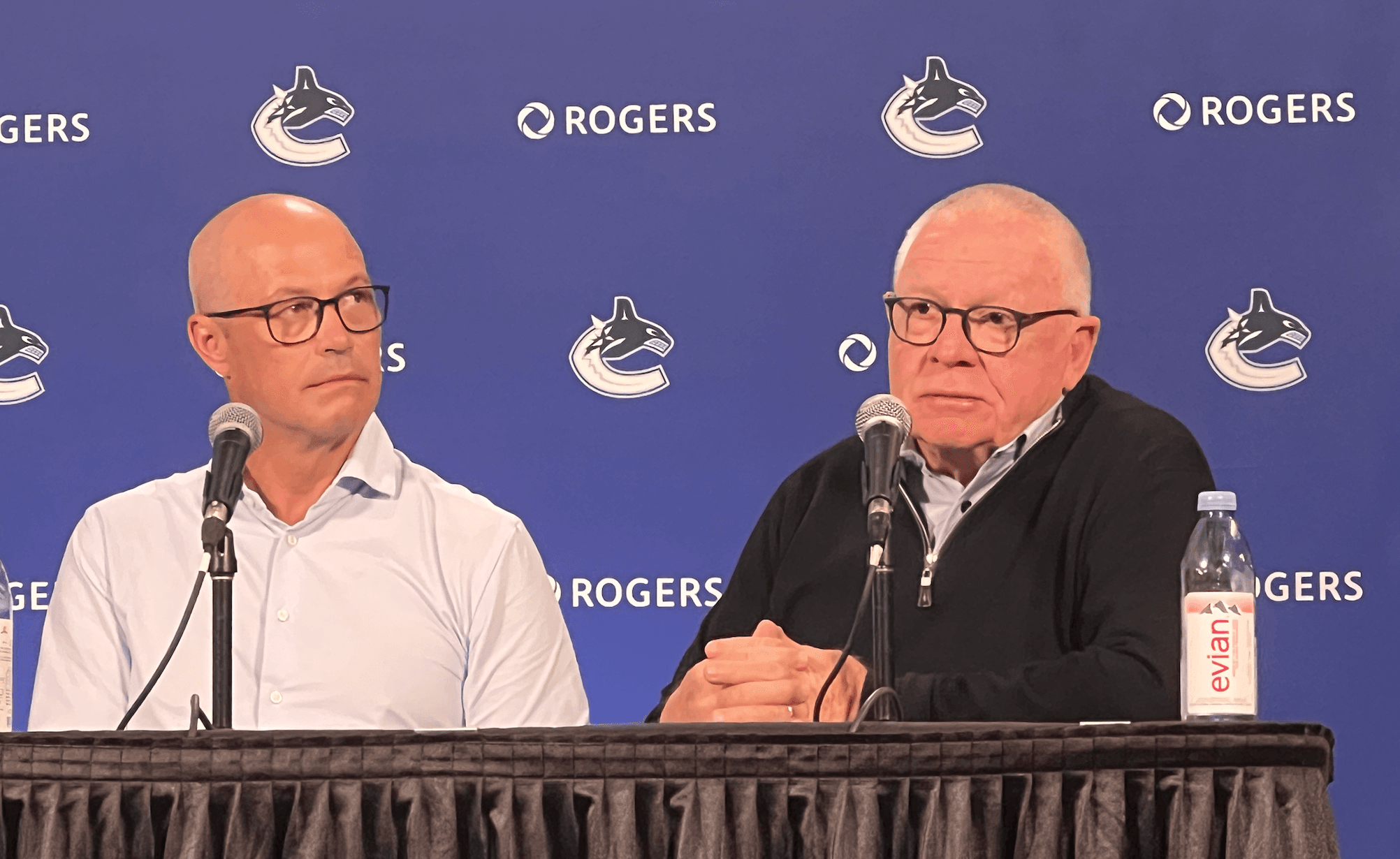
Photo credit: CanucksArmy

Nov 28, 2025, 13:00 ESTUpdated: Nov 28, 2025, 12:34 EST


The Vancouver Canucks are open for business. Maybe it’s not the term they would use, but it’s the one that’s been on the minds of Canucks fans this week.
According to a report from Sportsnet’s Elliotte Friedman on Monday night, the Canucks have indicated to the other 31 NHL teams that they are willing to listen to offers on their veteran players.
This was all but confirmed a day later when Canucks President of Hockey Operations Jim Rutherford sat down for an exclusive interview with Patrick Johnston of The Province:
“The position of the team is that you would be willing to talk about the unrestricted free agents that would be talked about closer to the trade deadline,” he said.“This isn’t about just looking at trading everybody. There are a number of veterans who have played very well, so this isn’t about clumping everybody together. It’s more about accelerating the obvious (moves) that could be made two months down the road.”
The Canucks currently have five NHL regulars on expiring contracts: Kiefer Sherwood, Evander Kane, Teddy Blueger, David Kämpf, and Derek Forbort. For the moment, they appear prepared to deal all five.
This isn’t something that happens very often. The Canucks are a notoriously shortsighted franchise, which has traditionally kept them out of the seller’s market until days before the NHL trade deadline. But a wise man once said that time is a flat circle, so I thought I’d look back at the last time something like this happened.
Longtime fans will likely remember the infamous 2016 trade deadline, when the team failed to get deals done on two high-level contributors on expiring contracts in Dan Hamhuis and Radim Vrbata. But before they were ready to officially pull the chute on their season, then-Canucks GM Jim Benning announced to the rest of the league that they were listening to offers on seven of their players in similar fashion to what we saw from Jim Rutherford and Patrik Allvin earlier this week.
The group of players was jokingly dubbed “The Garage Sale Seven” by the late, great Jason Botchford and expanded upon in several issues of The Provies, his legendary post-game report. Unfortunately, most of The Provies have been lost to time, but he gave the basic rundown in an article for The Province published on February 25th, 2016:
The Canucks claim they were prepped for the overwhelming negative backlash. I have my doubts.The season of despair was pushed another step toward its inevitable conclusion Wednesday when the Canucks yard sale went public.A list of seven players was outed by TSN. This was both good and bad. The good, the Canucks are committed to being sellers with a few days left before the deadline. Just sell, baby.The bad, six of the seven players on it were either acquired last summer or signed by the current management team to significant raises…it’s quite a list, including Linden Vey, Matt Bartkowski, Ronalds Kenins, Adam Cracknell, Chris Higgins, Brandon Prust and Yannick Weber.Two of them are in the minors, and four of them have already cleared waivers this season.As far as yard sales go, it reminded me of my mother-in-law. She recently had one. She made a bunch of flyers up. She put out some old clothes, an ironing board, and a computer desk. No one showed up. Not one person.At the very least, the Canucks can do better than that.
As it turns out, they could not do better. Or at least they didn’t. The Canucks failed to get any return for The Garage Sale Seven, in addition to bungling the Hamhuis and Vrbata negotiations.
The Canucks’ early-season collapse feels startlingly familiar to many fans, who have watched the team squander virtually every opportunity to meaningfully improve their chances of one day winning the Stanley Cup. But if they really are interested in doing major surgery, or even conducting a fire sale, there are lessons to be learned from the last time they put so many players on the trade block.
Timing is everything
This one may seem obvious, but sometimes you need to make a move before you’re comfortable to get the best value.
In the aftermath of the 2016 trade deadline, the perception was that the Canucks dithered in their attempt to trade Radim Vrbata, whose limited no-trade clause made him difficult to move at the low ebb of his productivity despite his status as a recently productive scorer on an expiring deal. This was especially disappointing given that Vrbata had just come off a 35-goal season and likely could have fetched a first-round pick at the very least had the Canucks been proactive about shopping him in the offseason.
What happened with Vrbata is instructive when it comes to the question of what the Canucks should do with Kiefer Sherwood, the most appealing of their expiring contracts. At the moment, Sherwood is the team’s leading goal-scorer and a top-30 goal-scorer in the league. His unique physical profile and expiring deal make him a potentially invaluable trade asset in a league where Tanner Jeannot can fetch an entire draft class.
At 30 years old, Sherwood likely doesn’t figure into the club’s long-term plans, and the organization doesn’t have an abundance of high-value expiring contracts. It’s a move the Canucks can’t afford to get wrong.
By the same token, getting the timing right on dealing some of their depth players is important, too, because…
Nobody wants your garbage
It may seem hard to believe now, but most of the Garage Sale Seven had value at one time or another.
Yannick Weber was coming off an 11-goal campaign as a defenceman, thanks in large part to a strong showing manning the point on the Canucks’ power play. Ronalds Kenins came out of nowhere to notch 12 points in 30 games playing alongside Bo Horvat and Jannik Hansen as the Canucks made a run for the 2015 playoffs. Chris Higgins and Brandon Prust were once traded for each other, funnily enough, and were both valuable bottom-six contributors on good teams in very recent memory.
Even Linden Vey was a productive young player on a good Manchester Monarchs team in the AHL. Unfortunately, the Canucks paid a second-rounder for the privilege of determining that he was not an everyday NHL player.
Sometimes, one man’s trash is another man’s treasure. Other times, one man’s trash is also another man’s trash. That was the case for the Garage Sale Seven, all of whom would leave the organization in the off-season with nothing coming back in return.
The reality is, there usually isn’t much of a market for depth players on bad teams. Contenders generally tend to go for players who, at the bare minimum, have a recent track record of sticking at the NHL level. They have a lot less of an appetite for guys who are only playing because an organization lacks everyday NHLers, or guys who can’t even crack a bad roster.
The Canucks may be open for business on several of their veteran players, but interest in those players will vary. Even if there’s significant interest in some of their depth players, the return likely won’t move the needle for such an asset-poor organization. So they’ll need to prioritize.
Get the big deals done first
The Jim Benning-era Canucks often struggled to get their business done on time, and this was never more apparent than at the 2016 NHL trade deadline.
The team failed to get any meaningful work done on any of their players, but their handling of then-pending unrestricted free agent Dan Hamhuis was particularly egregious.
The team waited until the week before the deadline to ask Hamhuis to waive his no-trade clause, then failed to get a deal done in time. Steve Ewen reviewed the whole saga for the Province earlier this year when Hamhuis was inducted into the BC Sports Hall of Fame:
Benning said on free agency day the summer that followed: “We tried our best and it didn’t work out. It would have been nice to get a draft pick, but at the end of the day the offers weren’t there to complete any sort of deal.”Whether Benning and Co. already knew that they weren’t bringing Hamhuis back at the trade deadline and failed to get anything at all for him in trade remains one of those great Canuck questions.
We’ve seen similar events play out more recently with Brock Boeser and Pius Suter, but the Canucks were at least able to retain Boeser this time around. They might not be so lucky next time.
Historically, this team has spent too much time trimming along the margins to ever make the kind of long-term franchise-altering moves they’ve needed to build a consistent contender. If they’re serious about performing major surgery, they should get started now.
Don’t fall in love with your own players
Part of the reason the Canucks so often end up dealing players at the low ebb of their value is because of something called the endowment effect: the principle that people are more likely to retain an asset they own than acquire the same asset when they do not own it. In other words, humans tend to overvalue things they themselves own relative to things that are owned by others.
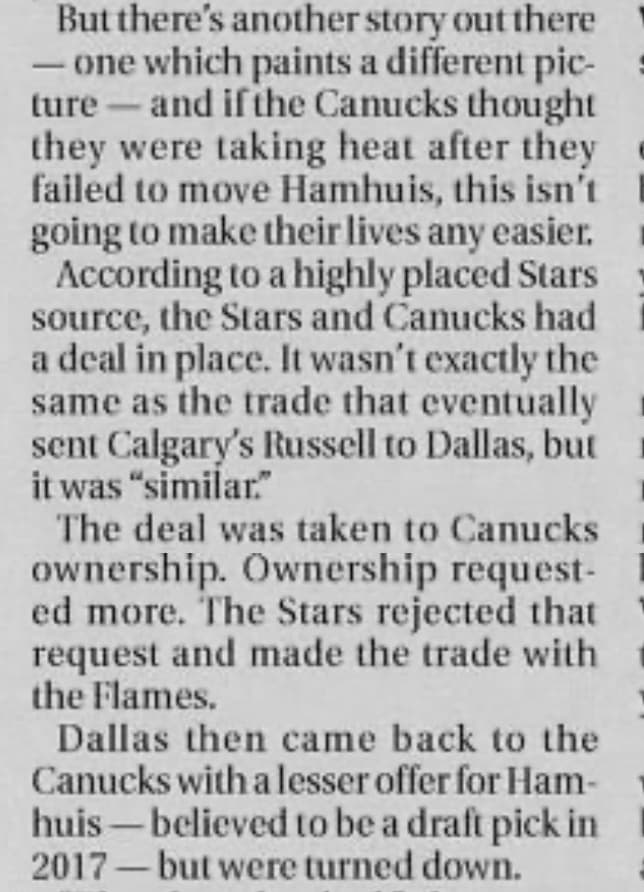
Historically, the Canucks have often faced this problem. Among other reasons, the Canucks failed to get a return on Hamhuis because the team wasn’t impressed with the offer they received from the Dallas Stars. When they asked for more, it backfired, and they ended up with nothing, as explained in a contemporaneous article by Ed Willes of the Province:
This may seem obvious, but it bears repeating, seeing as how the Canucks seem to keep on making the same mistake: If you have a player who is not going to re-sign, getting something for an expiring asset is generally better than getting nothing.
With consumer confidence already dwindling, the team can’t go into another offseason having missed the playoffs and failed to get any serious return on their expiring free agents.
Take the best deal, even if it doesn’t help you meet your short-term goals
This brings us to the final lesson of the whole Hamhuis/Vrbata/Garage Sale Seven fiasco. One of the biggest reasons the Canucks failed to get anything of value the last time they tried to conduct a fire sale is because they were myopically focused on “hockey trades”, as Jason Botchford elucidated in his article on the whole affair:

This ended up being an indefensible position. The Canucks wouldn’t make the playoffs again until 2019. By that point, the best player on the team was not a player who was on the roster in 2016. Whether you believe Quinn Hughes, Elias Pettersson, or JT Miller was the star of the show that season, all three players were acquired well after 2016. Pettersson and Hughes were drafted in 2017 and 2018, respectively, and Miller was acquired via trade in 2019. The Canucks turned down several opportunities to augment the quality of that group of players for the benefit of a team that ended up finishing 28th of 30.
The reality for the Canucks right now is that, particularly if Quinn Hughes leaves, the bulk of the next great Canucks team is most likely to be made up of players who are not currently on the roster. Bolstering the roster of the next great Canucks team may have to come at the expense of right now. And seeing as how the Canucks are currently closer to the Gavin McKenna sweepstakes than they are to a playoff spot, the future is more important.
If they can get their business done early, stay focused on getting the best possible return for their group of players, and be honest in their assessments of the players on their roster, this could finally be the season where the Canucks finally get on the path towards real contention.
The Canucks have an opportunity to learn from the mistakes of the past. The only question is whether or not they will take it.
Sponsored by bet365


Breaking News
- The Stanchies: Despite growing pains on defence, Canucks battle valiantly in 3-2 loss to Islanders
- Instant Reaction: Leevi Meriläinen stands out in Canucks’ 3-2 loss to Islanders
- NHL Notebook: Bedard returns for Chicago, and is Rick Tocchet on the hot seat?
- Demotion to third defensive pair for Canucks’ Buium ‘not a step backward’ according to Malhotra
- Scenes from morning skate: Canucks shake up D pairs and power play units vs. Islanders

Vancouver CanucksTeam Cap Summary

Cap Summary
2026-27
2027-28
Projected Cap Hit
$88,074,947
$71,329,167
Projected Cap Space
$15,925,053
$42,170,833
Current Cap Space
$17,163,668
$42,170,833
Active Players
23/23
13/23
Draft Picks
Round
'27
'28
1
1
1
2
2
2
3
1
1