
CanucksArmy has no direct affiliation to the Vancouver Canucks, Canucks Sports & Entertainment, NHL, or NHLPA
What happened the last time the Canucks finished dead last in the NHL?
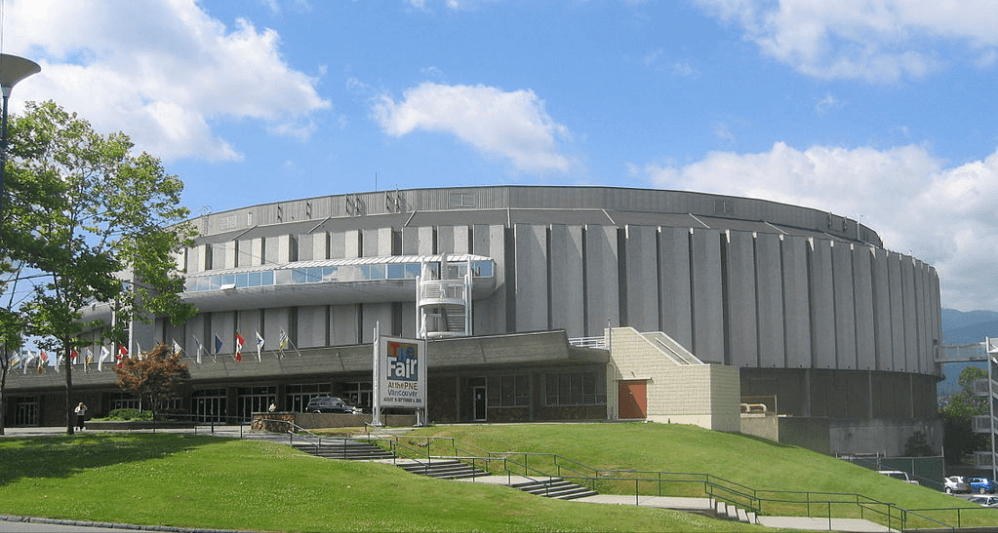
Photo credit: Arnold C

Feb 17, 2026, 12:00 ESTUpdated: Feb 17, 2026, 11:59 EST


As the NHL hits pause on what will certainly be another lost season for the Vancouver Canucks, the eyes of fans are fixed firmly on the future. The team currently sits in sole possession of last place in the NHL, and doesn’t appear to have many competitors for the dubious distinction of being named the NHL’s worst team of 2025-26.
Predicting the future is a tall ask, especially in a league as prone to randomness as the NHL. All one can do is look to the past in an attempt to emulate successes and learn from mistakes. And there just happens to be one other time that the Canucks finished last in the NHL, as they look poised to do right now.
The absence of NHL or Canucks’ hockey on the docket for the next two weeks or so makes this the perfect time to revisit the story of the 1971-72 Canucks, the worst team in franchise history.
Background
Vancouver had been floated as a potential expansion destination throughout the 1960s, but speculation kicked into high gear with the construction of the Pacific Coliseum in 1966. A group led by former Vancouver mayor and WHL Canucks owner Fred Hume filed an application to be one of the six expansion franchises to join the team in 1967, but was denied amid speculation that Toronto Maple Leafs president Stafford Smythe colluded with the Montreal Canadiens to scrap the deal in an attempt to keep from splitting CBC hockey revenue three ways.
Another attempt was made to relocate the floundering Oakland Seals franchise to Vancouver, but was vetoed by the league, who did not want to relocate an expansion franchise so soon after its introduction. To avoid a lawsuit, the NHL promised to grant Vancouver a team the next time they expanded. In 1970, a group led by Minnesota businessman Tom Scallen was awarded an expansion team for $6 million. Scallen would subsequently purchase the WHL Canucks, bringing the NHL to Vancouver in the form we see today.
The Canucks went on to lose the draft lottery to the Buffalo Sabres and select defenceman Dale Tallon second overall at the 1970 NHL Amateur Draft. In their inaugural season, they finished 12 of 14, and were set to make the third overall pick at the draft in Montreal on June 10, 1971.
Pre-season and regular season
The Canucks drafted offensive defenceman Jocelyn Guevremont with their first overall selection in 1971. Guevremont went on to have a decent career, but his selection was tainted by the fact that the Sabres selected winger Rick Martin two spots later. Martin would go on to score a then-NHL-record 44 goals as a rookie. They also passed over Bruins enforcer Terry O’Reilly, thereby preventing a timeline where Happy Gilmore wears a 1970s stick-and-rink jersey.
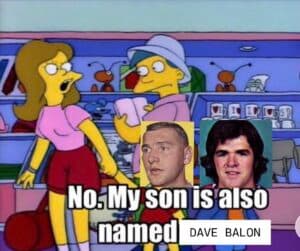
Alongside the rookie Guevremont, the team was led offensively by Andre Boudrias, the most talented and well-known forward of the early Canucks, as well as captain Orland Kurtenbach, the feisty Wayne Maki, with first-ever draft pick Dale Tallon rounding out the top five. I will also note that their sixth-highest scorer was a guy named Dave Balon, in what has to be one of the most “My son is also named Bort”-style roster oddities in NHL history.
As one might expect, the last-place Canucks failed to produce much in the way of milestones over the course of the season. They were shut out for the first time on October 20th, 1970, in a 7-0 drubbing at the hands of the Minnesota North Stars. They also recorded the first shutout of their own when Dunc Wilson stopped 34 shots in a 0-0 tie against the Maple Leafs a week later.
Despite finishing in sole possession of last place with 48 points, the 1971-72 Canucks were not as bad relative to the rest of the league as their current incarnation. They had four more wins than the Buffalo Sabres, allowed fewer goals than the Los Angeles Kings, and scored at a higher rate than both the Philadelphia Flyers and the Sabres. Their highest scorers, Boudrias and Kurtenbach, finished around 30th in NHL scoring. In contrast, the 2025-26 Canucks are in sole possession of the league’s worst win and goals against totals, while their leading scorer, Elias Pettersson, sits around 134th overall in league scoring.
While their Canucks’ season was obviously disappointing, it surprised few. The team had been given very unfavourable conditions in the 1970 expansion draft, and weren’t expected to compete. This is detailed succinctly, and colourfully, by sportswriter Jim Taylor in a 1972 article for the Vancouver Sun:
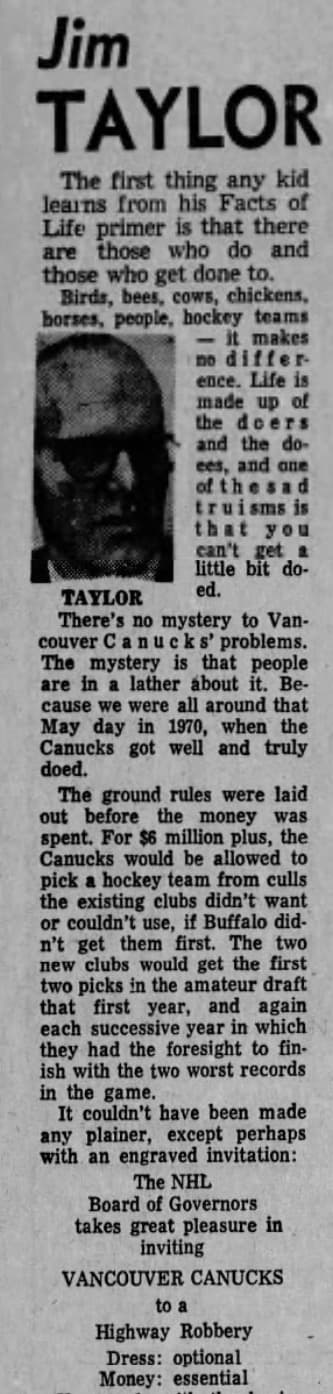
The Vancouver Sun, 03/21/1972
Aftermath
In typical Canucks fashion, their reward for finishing dead last ended up being the third overall pick in the 1972 NHL Amateur Draft. They selected Niagara Falls Flyers centre Don Lever over future Hall-of-Famers Steve Shutt and Bill Barber, but they still made out better than most of their rivals. Lever would go on to be one of the better players in a weak draft, becoming one of the team’s leading scorers throughout the mid-to-late 1970s, and eventually serving as captain from 1977 to 1979.
The Canucks would sputter for the next few years as the organization was beset by tragedy and scandal. In December 1972, one of the team’s earliest stars in Wayne Maki was diagnosed with brain cancer and eventually passed away on May 12, 1974 at the age of 29.
In 1973, owner Tom Scallen was arrested for securities fraud and served 9 months in prison, forcing a sale to Frank Griffiths the following season.
Coach Hal Laycoe was promoted to general manager for the 1972-73 season and replaced behind the bench by Vic Stasiuk. Both would be gone by 1974, replaced by Phil Maloney in a dual-coach/GM role.
By the time the team won its first division title in 1975, only three players from 1971-72 remained: Andre Boudrias, Dennis Kearns, and Bobby Lalonde.
Fans didn’t know it yet, but Orland Kurtenbach, the team’s first captain, had reached the end of his effectiveness. He would play parts of two more seasons for the Canucks before retiring in 1974. The once-promising rookie Guevremont was traded to the Sabres in 1975 as they made a run to the Cup Final.
Dale Tallon failed to live up to expectations in Vancouver and was traded in 1973 to the Chicago Blackhawks for a package that included Gary Smith, in what ended up being a pivotal deal for the mid-70s Canucks. Smith would lead the team to their first-ever playoff appearance in 1975, while facing and stopping more shots than any goalie in the league aside from Tony Esposito.
The Canucks returned to the playoffs in 1976, and despite their Cinderella run to the 1982 Stanley Cup Final, it would be the last time the Canucks ended a season with a winning record until 1992.
What we can learn
The 2025-26 Canucks find themselves in a similar position to their 1971-72 counterparts, with a mix of aging vets and developing young players, and a general sense of disarray in the front office. The 1971-72 Canucks bore very little resemblance to the team that would eventually return to the playoffs in 1975, and that’s likely to be the same for this Canucks roster.
It’s also entirely possible that the reward for finishing last this season could be to fall to third overall and select a Don Lever-level contributor rather than a future superstar. Fortunately, scouting has come a long way since the 1970s, so the Canucks ought to be able to take advantage of the unique talent-harvesting opportunity presented by the modern NHL Entry Draft in a way that was impossible in the 1970s.
By the same token, Vancouver also has more advantages when it comes to retaining and signing high-level contributors than it had in 1972. The city is now world-renowned for its natural beauty and standard of living, especially for high earners, and has produced a previously unprecedented number of star players who will be set to hit free agency in the coming years.
The invention of the salary cap has also levelled the playing field from where it was in the 1970s, and with the cap projected to pass the $100 million-mark in the near future, the Canucks are poised to be one of an elite minority of organizations willing to spend to its upper limit.
With that in mind, the Canucks should be able to turn things around in a healthy amount of time, provided they acquire a sufficient level of young talent through the draft and trading away some of their remaining veterans.
If not, things could go the way they did for the Hughes-era Canucks, or worse.
The 1970s Canucks had an entirely different set of incentives than we see today. The modern Canucks are an institution in Vancouver that sells out games and rakes in money even when the team is awful, and blows the absolute lights out in terms of profit when they’re good enough to consistently make the playoffs. The 1970s Canucks, in contrast, were mostly just trying to keep the lights on.
Unfortunately, we’ve seen this ownership group continue to behave like a backwater small-market franchise, buying short-term wins in meaningless seasons at the expense of future success. As a business decision, it was perhaps defensible from an expansion franchise in the 1970s, but it’s unacceptable from an organization that was among the best in the NHL from the aughts into the early 2010s.
They can get back to those heights again, but it will take a different approach from what they’ve done in the past.
The events of 1971-72 eventually set in motion the franchise’s first taste of success in 1975 and 1976. After that, it would be another 15 years before they’d have another winning season.
If the present-day Canucks continue to take shortcuts, it could very well be the same outcome this time around.
Sponsored by bet365


Breaking News
- Could the Vancouver Canucks and Ottawa Senators hook up on an in-season forward trade?
- The Statsies: Canucks dominated at 5v5 in 4-2 loss to Lightning
- The Stanchies: Prime Lankinen returns, Canucks still go winless on road trip with 4-2 loss to Lightning
- Instant Reaction: Canucks give up four unanswered goals in 4-2 loss to Lightning
- Canucks: D Elias Pettersson’s impressive start is more than just passing the eye test

Vancouver CanucksTeam Cap Summary

Cap Summary
2026-27
2027-28
Projected Cap Hit
$87,295,050
$71,329,167
Projected Cap Space
$16,704,950
$42,170,833
Current Cap Space
$18,413,411
$42,170,833
Active Players
23/23
13/23
Draft Picks
Round
'27
'28
1
1
1
2
2
2
3
1
1