
CanucksArmy has no direct affiliation to the Vancouver Canucks, Canucks Sports & Entertainment, NHL, or NHLPA
Max Lapierre talks 2011 Canucks’ core, his new podcast, and more: Canucks Conversation
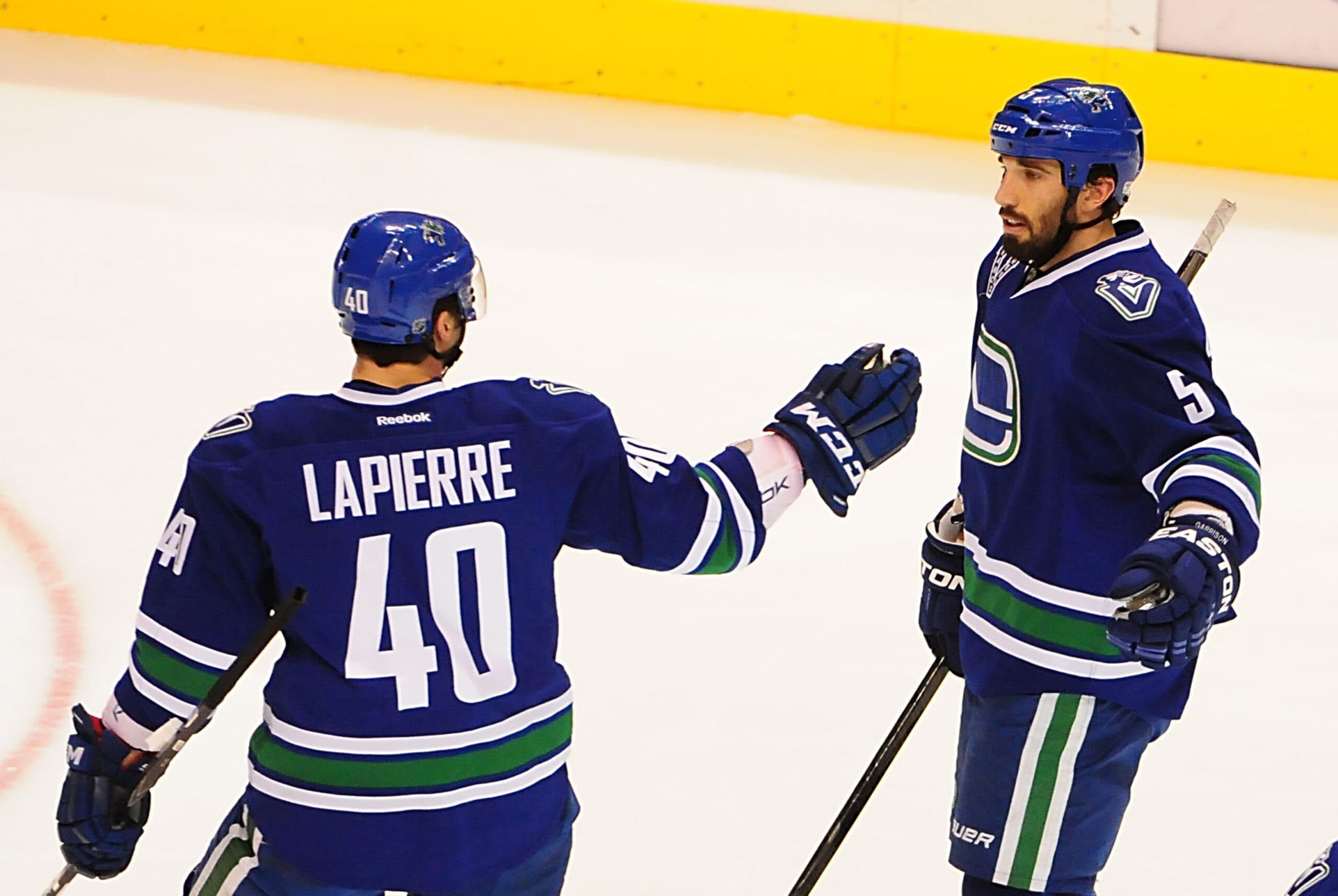
Photo credit: © Anne-Marie Sorvin-Imagn Images

Mar 11, 2026, 12:45 EDTUpdated: Mar 11, 2026, 12:46 EDT


On Tuesday’s episode of Canucks Conversation, former Canuck Max Lapierre joined the show to reflect on the culture of the 2011 Vancouver team, the leadership within that dressing room, and the launch of his new English-language hockey podcast.
Lapierre began by describing what it was like walking into one of the most talented rosters in franchise history during a turbulent season in his own career. At the time, he had already been moved twice and was searching for stability.
“Every single player on this team was a leader. They made me feel like I was part of a family from the first day I walked in with my bag and sticks to the dressing room,” Lapierre said. “It was a tough year for me – I got traded from Montreal to Anaheim right before. Within four months I played for three teams, and it was a tough spot in my career, but as soon as I talked with guys like Bieksa, the Sedins, Burrows, Raymond, Luongo – these are great guys. They made me feel like, ‘Hey man, you’re a good hockey player. It doesn’t matter if you had a tough stretch. Now you’re part of the group and we need you.’”
There was also immediate familiarity behind the bench.
“It was a quick turnaround with Alain Vigneault, who was my coach in juniors,” Lapierre explained. “So it was familiar to play with a coach who liked me. I grew a lot as a player to see how professional the guys on this team were. All respectful, all well-mannered, well-trained. Every detail was so important and it really helped me in my career.”
Lapierre emphasized how the culture of the team made every role feel meaningful.
“Every role was important. I’ve played on teams where superstars look at the fourth liner like they’re in their way. The Sedins took it to another level on the opposite side. They would come to the fourth line after every game and say, ‘Thank you so much for what you do for the team.’ The first time I thought they were joking, but then you realize they’re just the best guys in the history of the NHL.”
For Lapierre, the Sedins’ leadership went far beyond their skill.
“What a duo. They were so good on the ice but as humans, the Sedins are on another level. I’ve never seen people achieve so much off the ice as superstars.”
He also highlighted another veteran who played a massive role in shaping that team’s preparation and attention to detail: Manny Malhotra.
“He’s a student of the game,” Lapierre said. “He wouldn’t accept just finishing the game and going home – he’d look at the clips for what he could improve and what his line could improve. Some guys arrive at the rink two hours ahead of time ready to play their game. With Manny, it was always a good long discussion after morning skate to plan for the game – which faceoff plays we’ll use, what to do if your stick breaks in the defensive zone – every single detail was discussed as a line. Then you’d go on the ice and everyone would be on the same page. Those little things take you to the next level.”
Lapierre also said he hopes for Canucks fans that Malhotra is the next head coach to lead the rebuilding Canucks behind the bench.
“I don’t want to disrespect anyone right now, because everyone in the NHL belongs in the NHL, especially ex-players in Vancouver, they had great careers… but at some point they’re going to need to make some changes, and I feel like it’s time to bring back those guys. The guys that had really good performances on the ice as Canucks players that love the team, love the city, but also have that special side in their mind that they see the game differently. They can coach, they can manage… I think the Canucks would be in really good hands.”
Lapierre also said the type of culture the Canucks had in 2011 begins at the top with management and ownership.
“I think it starts with the management, the owners, and the coaches. Like, do they tolerate 1% not good enough? I feel like that was the difference in Vancouver. It was always brought up very positively, it was always a nice discussion about who we are as a team and what we need to do to improve, it was never yelling at us, but it was always about our standards. It wasn’t acceptable to be one percent less the next day. It was always perfect in practice, perfect during games, this is what we’re expecting from ourselves.”
Later in the conversation, Lapierre also spoke about his newest project: launching an English version of his long-running hockey podcast.
“We just love hockey. As many shows as we can every week – whether it’s the Canucks, the Canadiens — it’s always fun to talk about hockey,” he said. “I’ve been doing it in French for the last seven seasons, La Poche Bleue it’s called. Now we feel like we need a new challenge, so tomorrow night we’re starting in English.”
The new format will include postgame reaction shows and interviews with a wide range of former players.
“We’re going to have an English postgame, and it’s fun to speak right after the game when you have emotion,” Lapierre said. “For tomorrow’s show, Kevin Bieksa, Pascal Leclaire, Mathieu Dandenault, P.K. Subban, Scott Gomez, J.S. Giguere, Rick Nash – it’s a big party for the first show.”
Check out the full interview with Lapierre below!
Sponsored by bet365


Breaking News
- What’s behind ex-Canuck Conor Garland’s struggles in Columbus?
- NHL Notebook: Senators fans ruthless and creative in Brady Tkachuk’s return to Ottawa
- Scenes from morning skate: Signs point to Öhgren as a possible scratch for Canucks vs. Red Wings
- 3 ways the Canucks can get more out of their power play
- WDYTT: How do you want to see the Canucks handle their goaltending moving forward?

Vancouver CanucksTeam Cap Summary

Cap Summary
2026-27
2027-28
Projected Cap Hit
$87,295,050
$71,329,167
Projected Cap Space
$16,704,950
$42,170,833
Current Cap Space
$18,841,630
$42,170,833
Active Players
23/23
13/23
Draft Picks
Round
'27
'28
1
1
1
2
2
2
3
1
1