
CanucksArmy has no direct affiliation to the Vancouver Canucks, Canucks Sports & Entertainment, NHL, or NHLPA
Canucks: How often has a team finished last in the NHL two years in a row?
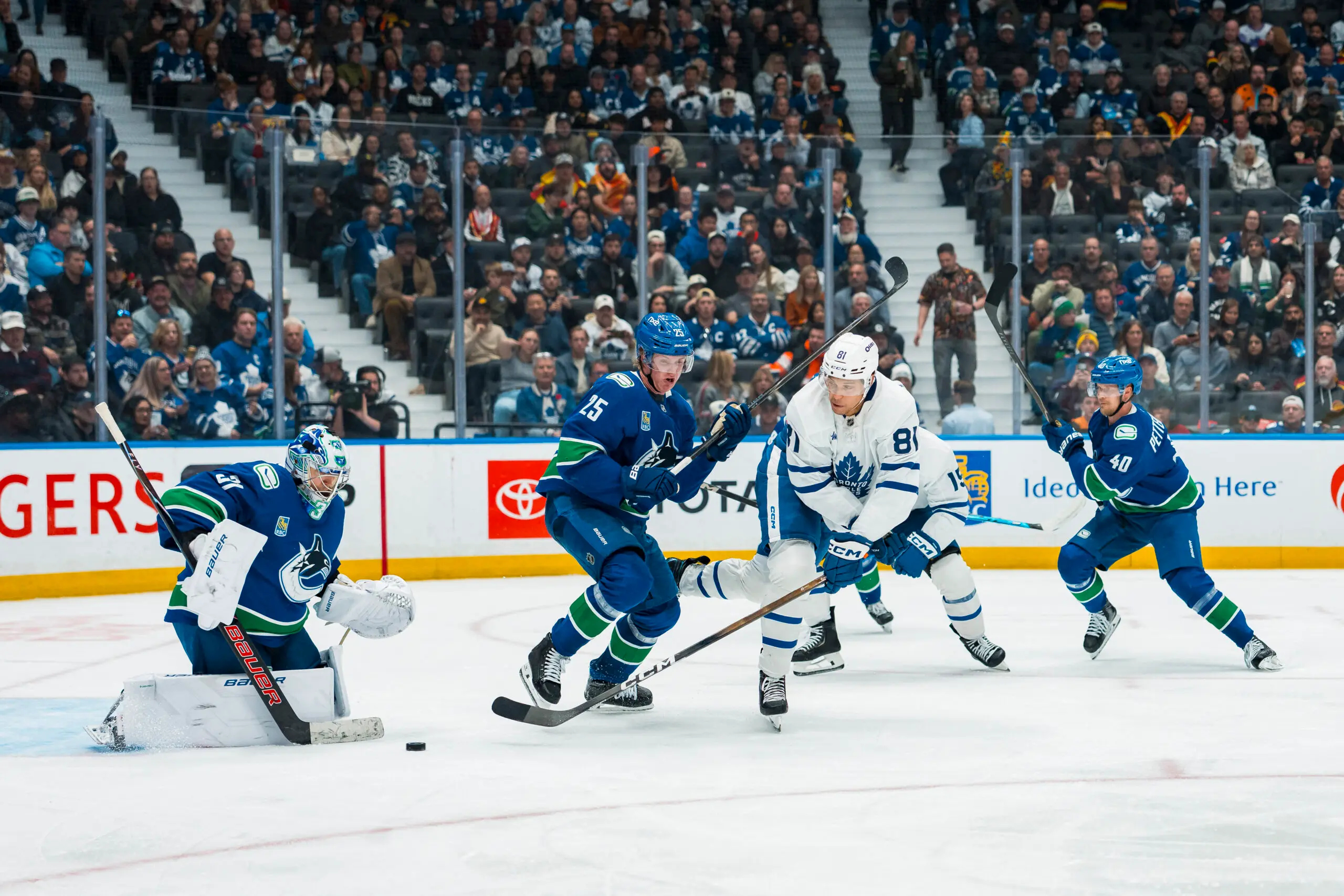
Photo credit: Bob Frid for IMAGN IMAGES via Reuters Connect

Nov 2, 2026, 12:15 ESTUpdated: Nov 2, 2026, 12:16 EST


The Vancouver Canucks finished last in the league in the 2025-26 NHL season, and by a considerable margin of 14 points. Fans and media alike knew the 2026-27 season would be much the same, but some weren’t sure how likely it was that the Canucks would sink this low again.
Well, 16 games into the season, and the Canucks are not just in last place again, but have already built up a ‘lead.’ It’s true that they’ve only got a two-point gap on the second-last place team for the moment, but the Canucks have also played the most games in the NHL. Their point-percentage of .219 is quite a bit lower than Chicago’s next-worst at .321.
That means that the odds are the Canucks will wind up being a two-time consecutive last-place finisher. Which would be an accomplishment, because that’s what most folks wanted out of this season. And it might also be an accomplishment, because two-time consecutive last-place finishes don’t just happen every day.
How rare is it? Put it this way: in the Canucks’ 56-year history of existence, it’s only happened nine other times (with one of those instances actually being three-time consecutive last-place finishes, and another being a four-time consecutive last-place finish).
That’s worth talking about for a couple of reasons. The first is the ability to put the Canucks’ current state of existence in the correct historical context. Another is the potential to look at what happened to each of these franchises afterward, so as to chart out a path for where the Canucks themselves might go from here.
To start with, here are all the other times a team finished last in the NHL at least two seasons in a row since the Canucks themselves joined the league in 1970.
1974/75 (21 points) and 1975/76 (32) Washington Capitals
The earliest days of the Washington Capitals were some of the hardest days ever faced by any franchise, expansion or no. Their inaugural season of 21 points is the worst ever by an NHL team, and their follow-up wasn’t much better.
It would take the Capitals a full nine seasons to make it to the playoffs, but they at least started to climb out of the basement after these two years.
The Caps didn’t really get much out of these drafts, either. They traded the first overall pick in 1975 to the Philadelphia Flyers for Bill Clement, Don McLean, and the 18th overall. The next year, they kept their first overall and used it on Rick Green, who had a decent but unspectacular 845-game career as a D.
1978/79 (42) and 1979/80 (51) Colorado Rockies
It was the third and fourth years of existence (of six total) that proved the worst for the Colorado Rockies, who had been the Kansas City Scouts prior and would become the New Jersey Devils thereafter. They wouldn’t make the playoffs again until six years after the move to Jersey.
At least the Rockies got some draft reward for their foibles. They picked Rob Ramage at first overall in 1979, and he’d go on to play more than 1000 NHL games. But they had already traded the right to swap first round picks in 1980 with the Montreal Canadiens back in 1976. The Canadiens exercised that option here, selecting Doug Wickenheiser at first overall while the Rockies were left with Paul Gagne at 19th overall.
1982/83 (45) and 1983/84 (38) Pittsburgh Penguins
The Penguins got two vastly different results out of these two years at the bottom of the standings. In 1983, they dealt away the first overall pick in a trade that got them back Anders Hakansson, Ron Meighan, and the 15th overall pick, which they used on Bob Errey.
But the Penguins arguably straight up tanked for first overall in ’84, and they had no intentions of trading that pick. They used it on Mario Lemieux, and the rest is quite literally championship history. Led by Lemieux, the Penguins would be back in the playoffs by 1989 and Cup champs by 1991.
1988/89 (61), 1989/90 (32), and 1990/91 (46) Quebec Nordiques
The Nordiques are the first team in the modern era to finish last three times in a row. On the upside, these losing seasons helped pave the way to a championship team. On the downside, that championship team was located in Colorado, and these seasons were also a death knell for the NHL in Quebec. They’d return to the playoffs for ’93 and ’95, but it was too little too late.
Still, the draft pick bounty was considerable. Three consecutive first overalls were spent on Mats Sundin, Owen Nolan, and Eric Lindros. That’s two Hall of Famers and another who belongs in the Hall of Very Good. And sure, the whole Lindros thing didn’t work out directly for the Nordiques, but even he was turned into an enormous package that included Peter Forsberg, perhaps the best player of the bunch.
1992/93 (24), 1993/94 (37), 1994/95 (23), and 1995/96 Ottawa Senators
The only two three-time last-place consecutive finishes in modern NHL history happened nearly back to back, and both involved Canadian franchises at a time when the Canadian dollar was a bit of an issue, which is probably not a coincidence.
Either way, these were the first three years of existence for the Senators, and they were ugly in ways not seen since the early days of the Capitals.
The Senators were not rewarded nearly as heavily as were the Nordiques, either. They famously blew the 1993 first overall pick on Alexandre Daigle. Then they didn’t even get to draft first in 1994, as the first two spots went to expansion franchises in Florida and Anaheim. Instead, Ottawa got Radek Bonk at third overall. Then they were back at first overall for 1995, where they picked Bryan Berard, who suffered a serious eye injury that hampered his development as a prospect.
Tough luck all over for the Senators, who would somewhat miraculously make the playoffs by 1997 all the same.
1997/98 (44) and 1998/99 (47) Tampa Bay Lightning
The Lightning hit the skids a half-decade into their existence, but it turned out to be at an opportune time. Despite the draft lottery existing at this point, they still won first overall in 1998, selecting Vincent Lecavalier, who’d wind up being their 1C on their first Stanley Cup-winning roster. Can’t complain about that.
The Lightning would not keep their 1999 pick, however. They dealt it for the fourth overall and two third-round picks as part of the series of exchanges that would end with the Canucks drafting Daniel and Henrik Sedin at second and third overall. They then traded the fourth overall for Dan Cloutier, Niklas Sundstrom, and a first and third in the 2000 draft. They blew that first on Nikita Alexeev at eighth overall, but it was no matter. The Lightning were back in the playoffs by 2003 and champions by 2004.
2009/10 (62) and 2010/11 (62) Edmonton Oilers
Now we arrive at more familiar territory. Despite it feeling like the Oilers tanked for a decade, they only ever finished in last consecutively once. They won the draft lottery each time, selecting Taylor Hall at first overall in 2010 and Ryan Nugent-Hopkins in 2011. Those picks didn’t exactly turn the Oilers right around, and it’d take until 2017 – and one more big first overall – before they’d make a return to the playoffs.
2013/14 (52) and 2014/15 (54) Buffalo Sabres
The Sabres offer a sharp contrast in luck to the Oilers. The Sabres lost two consecutive draft lotteries here, missing out on Aaron Ekblad in 2014, which was no big deal, and Connor McDavid in 2015, which is a franchise-altering big deal.
Instead, they got Sam Reinhart and Jack Eichel. Which would have been two fine consolation prizes if they had stayed and thrived in Buffalo. Alas…
It would be more than a decade after this before the Sabres returned to the Stanley Cup Playoffs.
2023/24 and 2024/25 San Jose Sharks
Here we arrive at the modern day. The Sharks finished last overall in 2024 and 2025, and for their troubles, they were rewarded mightily. They won the lottery in 2024 and got Macklin Celebrini, the NHL’s next best player. They landed second overall in 2025, and got Michael Misa. Then, because that wasn’t enough good luck, they moved way up in the 2026 lottery and got Ivar Stenberg at second overall.
The Canucks could definitely use some of that same luck as they pick up the consecutive last-place torch themselves.
Sponsored by bet365


Breaking News
- Canucks: How often has a team finished last in the NHL two years in a row?
- Canucks unveil new Hometown Remix alternate jersey: Schedule, details, and more
- JPat’s Monday Mailbag: One month in, how is the market handling the early stages of the Canucks’ rebuild?
- WATCH: Canucks prospects Caleb Malhotra and Adam Novotný score incredible overtime winners
- Abbotsford Weekly: Riley Patterson continues to shine as Canucks extend win streak to seven

Vancouver CanucksTeam Cap Summary

Cap Summary
2026-27
2027-28
Projected Cap Hit
$87,993,412
$71,329,167
Projected Cap Space
$16,006,588
$42,170,833
Current Cap Space
$19,287,441
$42,170,833
Active Players
23/23
13/23
Draft Picks
Round
'27
'28
1
1
1
2
2
2
3
1
1