
CanucksArmy has no direct affiliation to the Vancouver Canucks, Canucks Sports & Entertainment, NHL, or NHLPA
Why did Canucks fans rate Aatu Räty higher than the rest of the league?
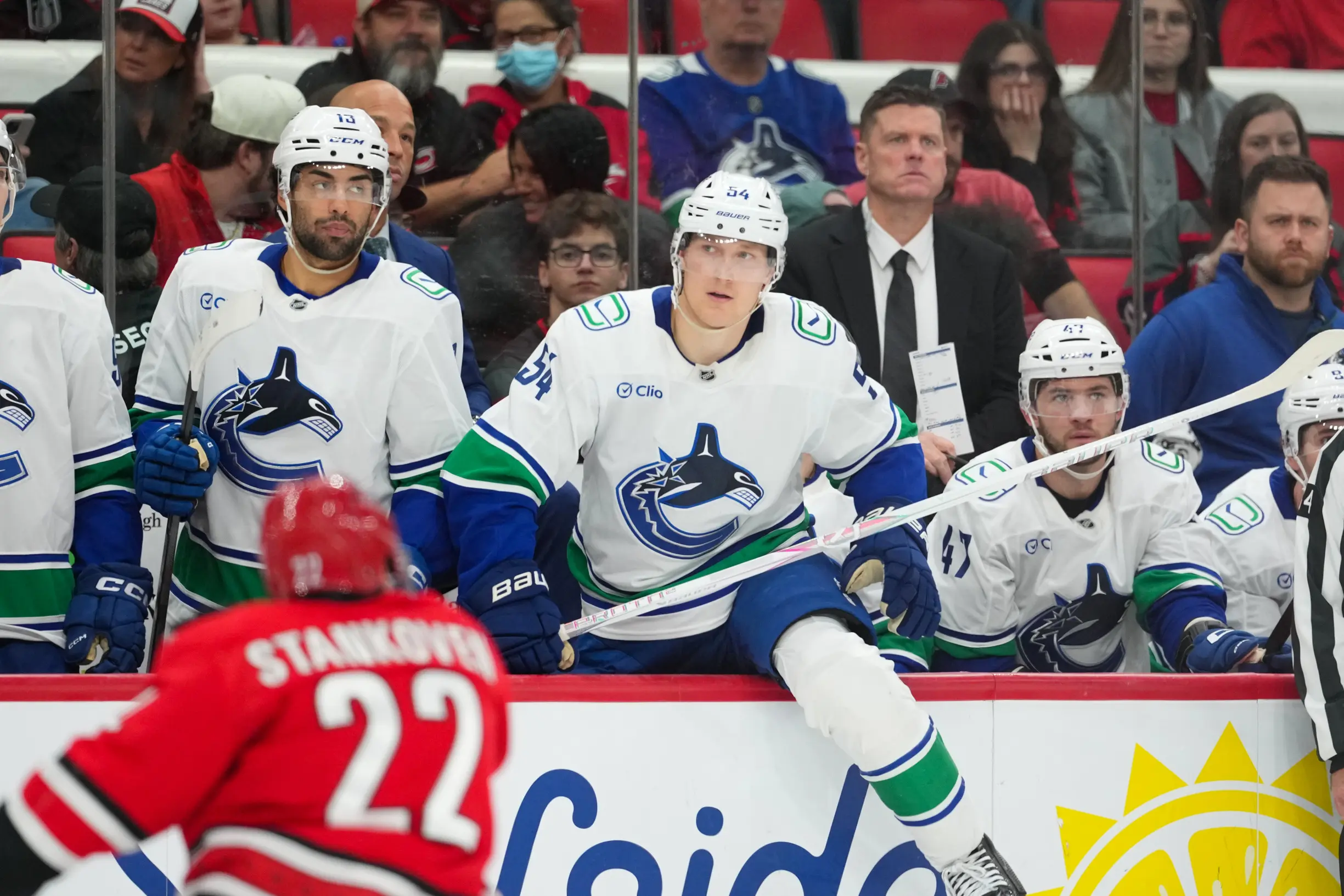
Photo credit: James Guillory for IMAGN IMAGES via Reuters Connect

Oct 16, 2026, 15:30 EDTUpdated: Oct 16, 2026, 15:22 EDT


When it comes to Aatu Räty and the Vancouver Canucks, the writing has been on the wall for a while. He received a fairly limited look in the preseason this year. Then, he was made a healthy scratch in four of the Canucks’ first eight games of the season. By the end, coach Manny Malhotra was playing at least two non-centres, Paul Cotter and Drew O’Connor, at centre ahead of Räty, not to mention Max Sasson, who many believe had converted to the wing last season.
That’s why it came as relatively little surprise when the Canucks placed Räty on waivers on Wednesday. Clearly, his time being valued by the organization had come to an end.
What was a little more surprising, however, was the fact that Räty passed through waivers unclaimed. That means that all other 31 NHL teams had a chance to pick him up for free, and chose not to. And what that means is that as highly as Canucks fans (and many members of the local media) have rated Räty recently, that high opinion is not shared by the majority of the league.
That’s also evident by the fact that, if we go back to Räty’s Islander days, this is the third front office and the fifth head coach that has struggled to find Räty a place in their lineup.
To be clear, Räty obviously holds some value, as the Toronto Maple Leafs traded for him moments after he cleared waivers. But in order to do so, they gave up two minor league assets in Jacob Quillan and Brandon Buhr. That a team was only willing to take Räty if it came with extra roster and contract space says it all. His value had become incredibly minimal. This, from a player that many fans and media members claimed the Canucks would regret if they didn’t give him his fair chance at the lineup.
So, why the discrepancy?
It’s not simply a case of fans overrating their own players. That happens universally across the board, but not quite like this. In fact, Canucks fans are somewhat notorious for losing faith in their young players when they struggle. For evidence of that, let’s take a comparative look at Jonathan Lekkerimäki. At 22, Lekkerimäki is a year younger than Räty and, if we’re being honest, had already flashed more potential at both the NHL and AHL levels of late. And yet, many fans had lost faith in Lekkerimäki heading into this season, up until he broke out into a top line role.
For the most part, the faith in Räty remained strong. Why him?
The answer lies in emotional appeal. Hockey is an emotional sport with emotional fans, and due to a handful of somewhat unique factors, Räty was essentially “Emotional Appeal: The Player.”
The first factor was Räty’s pre-draft hype. Those who follow prospects will probably remember first hearing Räty’s name in the mid-2010s, when he was a young teenager in Finland being talked about as a potential “next one.” Right up to his draft year, Räty was considered a good bet to go first overall. Then a major draft-year slide occurred, and Räty wound up being selected at 52nd overall.
Still, it’s hard to let go of that hype. With a former phenom, there’s always going to be that tantalizing appeal to finally unlocking their potential. The Canucks have experienced this phenom-phenomenon before, with prospects like Yann Sauve. In the end, such pre-draft hype almost never pans out, especially not when the player has already lost a considerable amount of that shine by the time they get drafted. But it’s fun to hope all the same.
The second factor was the trade that brought Räty to Vancouver. The Canucks traded not just a star centre, but their captain and one of their most popular players, Bo Horvat, for Räty, Anthony Beauvillier, and a first-round pick. Beauvillier was gone within a year, and Räty is gone now. The Canucks were able to convert that first-round pick (plus a second) into Filip Hronek, and few will complain about the impact Hronek has made. But Hronek was already 25 when the Canucks acquired him, and he’ll be turning 29 shortly.
Räty was really the only true “future” piece that came directly out of the Horvat deal, and for a team that has now fully embraced the rebuild, that’s something of an increasing performance. Räty not working out means a big piece of the Horvat return didn’t work out, and that’s a little tough to swallow after watching Horvat go on to play the best hockey of his career on Long Island, where he’s recently been named captain.
Part of hoping for Räty to turn it around was hoping the Canucks got more back for Horvat.
The third factor here is faceoffs, otherwise known as Räty’s predominant NHL trait. And here, there’s no real ambiguity – Räty isn’t just good at faceoffs; he’s historically good. He currently sits at fourth all-time in faceoff winning percentage at 59.09%, trailing only Yanic Perreault, Zenon Konopka, and Joe Nieuwendyk.
But faceoffs are a funny thing. Statistically speaking, they’re overrated. As in, winning faceoffs tends to not correlate very closely to winning hockey games. But then, faceoffs hold a much greater emotional importance than that. Stats won’t tell you that almost every late-game tying goal starts with a faceoff win. So many moments within individual games come down to a faceoff that it’s hard not to place an excess of importance on them.
And so, it makes sense that a player whose top skill is winning faceoffs might tend to get overrated in terms of their potential impact on a team, as it seems Räty was.
So, in the end, were Canucks fans wrong to rate Räty so highly? That’s probably objectively true. But it doesn’t necessarily mean they were unreasonable. Räty was a fairly unique player who came with a unique history and a unique set of circumstances, and it made plenty of sense for fans to hope for more out of him.
After all, an emotional appeal is still an appeal.
Sponsored by bet365


Breaking News
- Why did Canucks fans rate Aatu Räty higher than the rest of the league?
- What the Canucks are getting in new trade acquisitions Jacob Quillan and Brandon Buhr
- The Statsies: Tom Willander leads Canucks in xGF in overtime loss to Panthers
- The Stanchies: Brady Tkachuk’s natural hat trick extends Canucks losing streak to 6 in OT loss to Panthers
- Instant Reaction: Brady Tkachuk scores late hat trick in Canucks’ overtime loss to Florida

Vancouver CanucksTeam Cap Summary

Cap Summary
2026-27
2027-28
Projected Cap Hit
$87,295,050
$71,329,167
Projected Cap Space
$16,704,950
$42,170,833
Current Cap Space
$18,206,519
$42,170,833
Active Players
23/23
13/23
Draft Picks
Round
'27
'28
1
1
1
2
2
2
3
1
1