
CanucksArmy has no direct affiliation to the Vancouver Canucks, Canucks Sports & Entertainment, NHL, or NHLPA
Which veteran Canucks stand to increase their trade value in 2026-27?
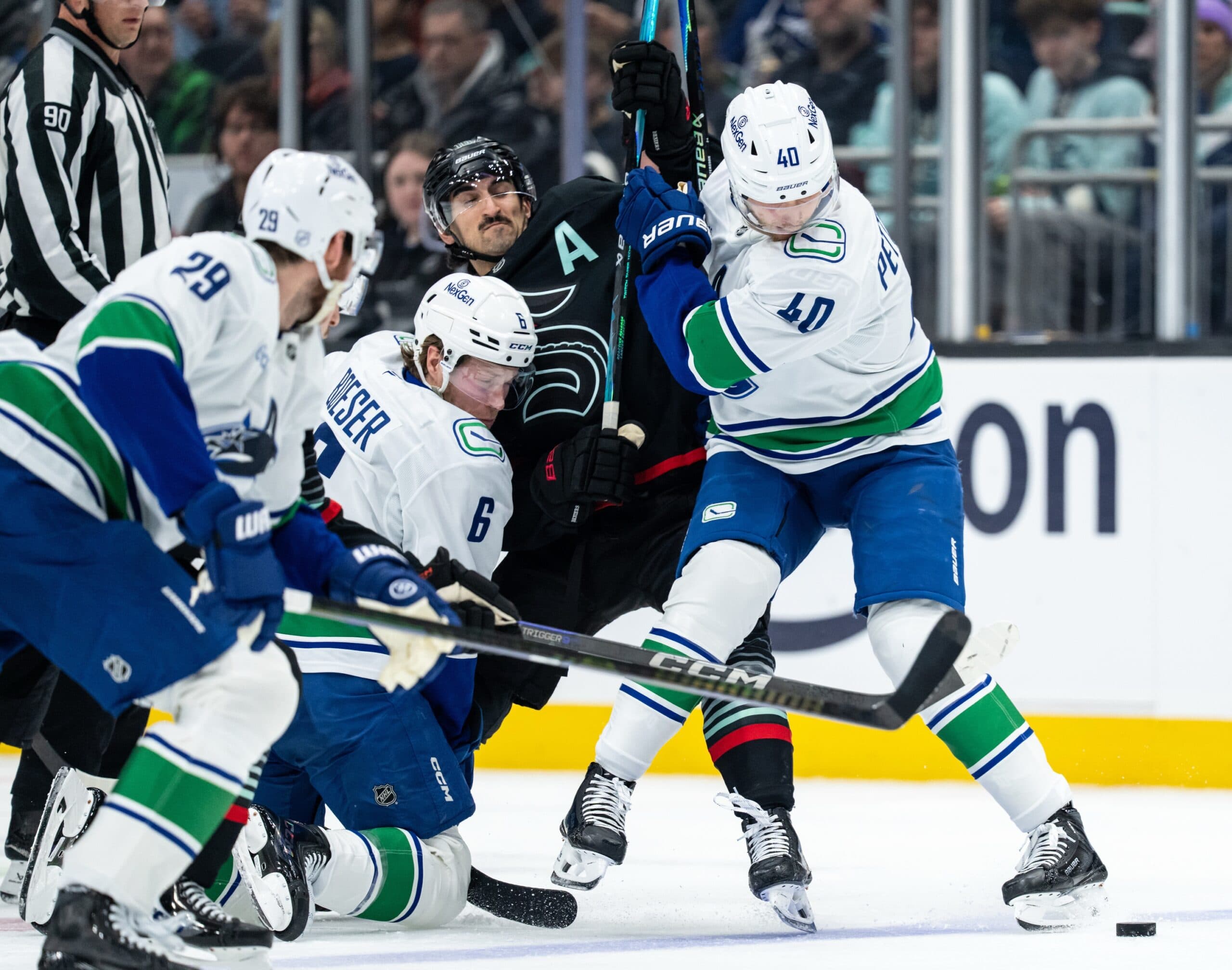
Photo credit: © Stephen Brashear-Imagn Images

Jun 7, 2026, 16:05 EDT


A famous philosopher and chicken entrepreneur once mused that “You got to know when to hold them, [and] know when to fold them.” That rings true about any form of gambling, and what is hockey management but one of the most expensive forms of gambling out there?
The Vancouver Canucks have a lot of decisions to make over the coming weeks, months, and years of this rebuild. Almost all of these decisions will involve some risk-reward trade-off and thus be gambles. And there’s a very direct element of holding and folding at play as the newest Canucks front office attempts to reshape the roster toward a more youth-oriented plan.
It’s no secret that the Canucks are going to be dealing away some more veterans, both in the immediate future and into the more medium term. But the exact timing of those transactions is tricky.
The Vancouver Canucks bottomed out as a franchise in 2025-26, and the respective values of many of their veteran players similarly tanked as a result. But bottoming out doesn’t always equate to staying bottomed out. The balance that GM Ryan Johnson and Co. have to strike is figuring out which veterans have truly reached the basement of their tradeable value – those would be the ones to ‘fold’ on, or trade, right now – and those who have a real chance of rebounding to a higher value. Those would be the ones to ‘hold,’ so to speak, at least for a portion of the 2026-27.
It’s a little tempting to say that any veteran could regain some trade value with a good enough 2026-27 season, because that’s technically true. But we’re looking at more likelihoods and practicalities here, and those swings in trade value that might actually matter.
Jake DeBrusk, for example, is a veteran who many expect to be traded this offseason. He actually had a pretty solid 2025-26, scoring 23 goals. But in DeBrusk’s nine-year NHL career to date, he’s scored at least 19 goals seven times. He’s a very established, if streaky, quantity at this level. Another 20+-goal campaign isn’t going to move DeBrusk’s trade value up much, if any. A bad season, conversely, could drop his value, and so it makes sense for the Canucks to trade him sooner, rather than later – so long as DeBrusk is as willing to waive his no-movement clause as he sounds to be.
Filip Hronek also probably falls into this category. At this point, he’s fairly established as a top-pairing right-shot defender, and that gives him an inherent and immense trade value. Another year of leading the Vancouver blueline isn’t going to do much to change that. Hronek’s value should remain fairly steady, though we’re not so sure that means the Canucks should trade him quite yet.
On the other end of the spectrum might lie Brock Boeser. He and his contract are firmly into ‘it is what it is’ territory. Boeser can be expected to produce as he has throughout his career, but he is at the age where the returns will continue to diminish, especially in other areas of the game. Even if Boeser has a good 2026-27 and pops in, say, 30 goals again, it won’t do too much to add value.
Today, we’re looking for those with more potential to swing, and a real chance to increase their trade values and the returns the Canucks should expect back for them, so long as the Canucks ‘hold’ onto them for at least the first few months of the 2026-27 season.
Marcus Pettersson
You knew a Pettersson was going to be first on this list; it was just a matter of which one. We went with Marcus because of his 10 years of fairly consistent top-four-quality play prior to the 2025-26 season. Having hit the age of 30, it’s possible that Pettersson is just getting older, but given that the entire Vancouver blueline appeared to suffer under Adam Foote this past year, it’s easy enough to lay the majority of the blame on coaching.
Pettersson doesn’t need to rebound that much under Manny Malhotra to start looking like a sharp, reliable LD addition for a contending team looking to add experience. In short, 2026-27 was by far the worst season of his career, and a considerable rebound seems incredibly likely. A few extra points, and some better defensive analytics, and Pettersson might not be back in “first round pick” territory, but he will have regained positive trade value.
Elias Pettersson
The numbers might not be back, but Pettersson did look a little less lost out there at times in 2025-26. The new regime seems like it will be more patient with him than the last one. If that translates into even a slight uptick in production while still maintaining his usual level of defensive play, then Pettersson will start to look more and more like an intriguing acquisition from another team.
There is a risk factor here. Any further deterioration in his play would take whatever value he has now and put it through a wood chipper. But there won’t be many other centres stealing ice-time away from Pettersson in 2026-27, and so he should get his opportunities. Getting up from his current 0.75 PPG rate to something closer to 0.90 would go a long way. And it’s worth mentioning that a lot of big contracts are going to be signed this offseason, and as they do, Pettersson’s $11.6 million cap hit is going to start looking more swallowable. It’ll still be too big, but less standout-ishly so, and that will have to help his comparative value.
We’d go so far as to say that even if Pettersson doesn’t increase his play quality much at all, but merely maintains it, in 2026-27, that probably helps his trade value. The more the memory fades and the less we’re all able to compare Pettersson to his past self, the better other teams will be able to judge his remaining positive qualities for themselves.
Thatcher Demko
Right now, we’d argue that Demko’s trade value is well into the negatives. An $8 million cap hit is already a pretty sizeable one for a starting goaltender, and it’s not clear whether or not Demko will ever be healthy enough to be a regular NHL goaltender again, never mind a starting one. Nobody, and we mean nobody, is going to take a gamble so large on an asset so expensive for a position so important.
But Demko is going to make a run at a return all the same, and the Canucks should let him and hope for the best. In a worst-case scenario, Demko gets injured again, and the Canucks are right back where they started, just with one year burned off that three-year extension. No big deal.
If Demko manages to maintain any real level of healthiness throughout 2026-27, then the phones should start ringing again. There is a dearth of goaltending talent in the league right now. Demko might not need to show all that many signs of a comeback before somebody becomes willing to roll the dice on him, and it could even happen within the next season itself if he stays off the LTIR until then.
Linus Karlsson
Right off the bat, we’ll admit that Karlsson isn’t a “veteran,” exactly, but he is 26 and does fit this article’s premise. Karlsson led the Canucks in even-strength production this year. But how many times have we seen a player peak with their rookie campaign, and then fade back into obscurity?
Doing it again would go a long way toward solidifying Karlsson as someone with a longer-term NHL future, and would make his two-year, $2.25 million extension look like a potential bargain worth trading for.
We wouldn’t go as far as to say that Karlsson needs to lead the Canucks in any statistical categories next year for this to be the case. So long as he continues to get regular minutes in the top nine, and so long as he manages a second consecutive 30ish-point season, he’ll turn that contract into something with surplus value, and thus turn himself into someone with genuine market value around the rest of the NHL.
Marco Rossi
Rossi has shown well throughout his NHL career, with career highs of 24 goals and 60 points at age 24. But he’s also been beset by illness and injury, and that’s led to some question marks about the kind of player he’ll be at the end of it all.
A foot injury hampered Rossi’s time in Vancouver, and he still managed 22 points in 33 games. He’ll go into 2026-27 pencilled in as at least the 2C, and probably on the PP1, too. If he just manages to stay healthy throughout, he’ll rapidly gain value in an absolutely centre-starved market, and he could quickly become one of the Canucks’ most valuable trade chips – unless they decide he’s worth keeping for themselves at that point.
Nils Höglander
Our recent piece suggesting that the Canucks were best off moving on from Höglander was met with some controversy, most of it related to this notion. After all, Höglander scored just five points last year. That’s got to be a case of ‘nowhere to go but up,’ right?
We’re still a little skeptical about Höglander turning it around in Vancouver ourselves. But many prefer to see if he can regain a little of that 2023-24 magic under a new coaching staff, and to then decide on whether he’s still young and talented enough to be part of the rebuild, or whether it’s time to cash in on him for as high a draft pick as is available.
Heck, with as low as his numbers got last year, all it would really take is a good week from Höglander to surpass them and start building his way back toward a positive trade value.
Sponsored by bet365


Breaking News
- 3 Canucks Stars of the Week: Jonathan Lekkerimäki a bright spot amid losing streak
- Abbotsford Weekly: Hats fly for newcomer Jacob Quillan as Canucks sweep Wranglers
- Scenes from practice: Malhotra hauls out line blender in attempt to help Canucks snap 10-game losing skid
- Canucks’ Jack Thompson clears NHL waivers, will report to AHL Abbotsford
- JPat’s Monday Mailbag: Canucks chemistry lessons, a hot dog feast and press box bingo

Vancouver CanucksTeam Cap Summary

Cap Summary
2026-27
2027-28
Projected Cap Hit
$87,295,050
$71,329,167
Projected Cap Space
$16,704,950
$42,170,833
Current Cap Space
$19,290,240
$42,170,833
Active Players
23/23
13/23
Draft Picks
Round
'27
'28
1
1
1
2
2
2
3
1
1