
CanucksArmy has no direct affiliation to the Vancouver Canucks, Canucks Sports & Entertainment, NHL, or NHLPA
What has actually happened to the Canucks’ penalty kill in 2025-26?
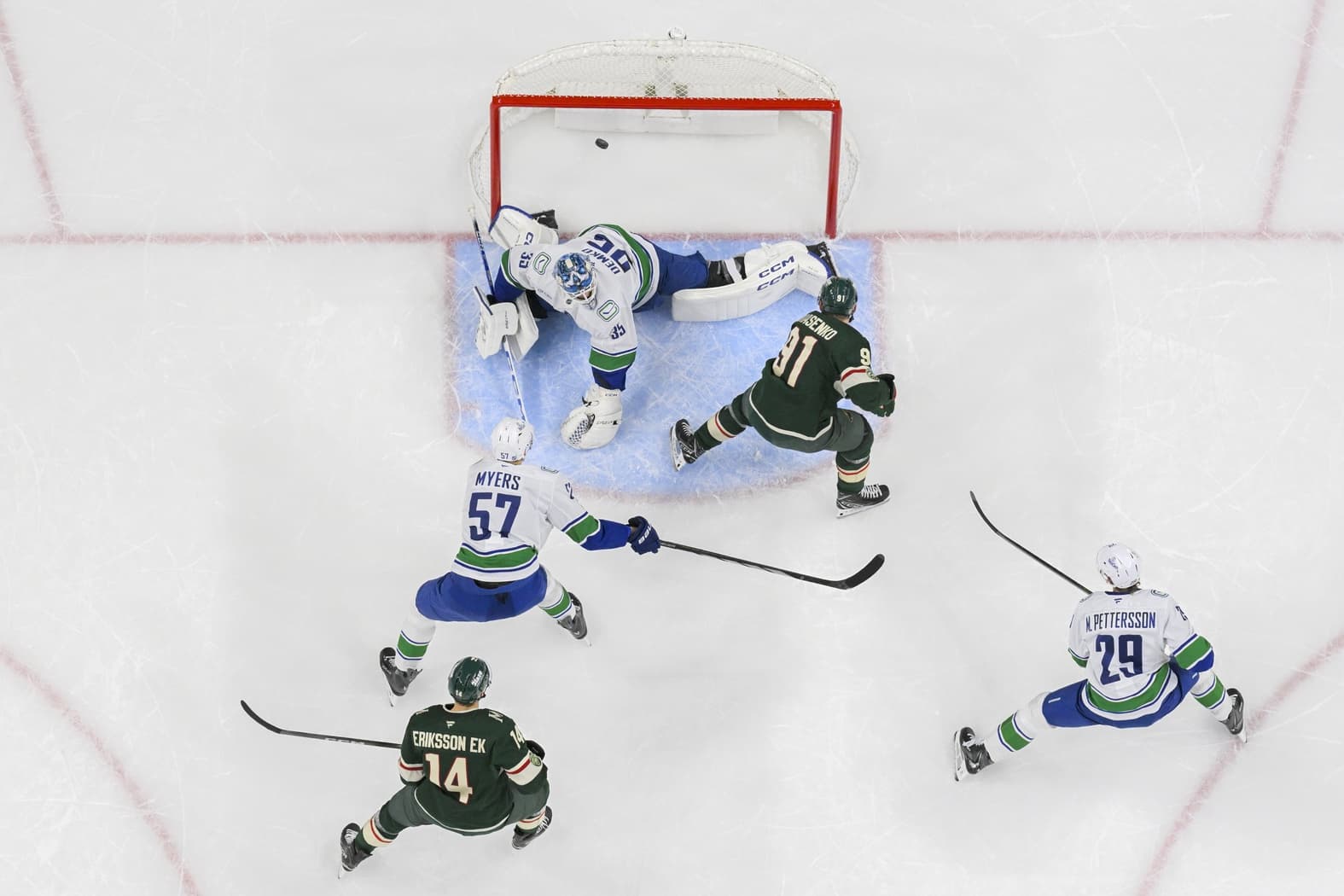
Photo credit: © Nick Wosika-Imagn Images

Nov 11, 2025, 12:00 ESTUpdated: Nov 11, 2025, 23:25 EST


They don’t call it the penalty kill because it kills your chances of making the playoffs. But for the 2025-26 Vancouver Canucks, that might as well be the case.
The PK unit was one of the lone bright spots last season as the 2024-25 fell apart and failed to make the postseason. After a bit of a slow start, the Vancouver PK finished with the third-best record in the league at 82.7%. From January through to the end of the season, the Canucks had the best penalty kill in the league, period.
Flash-forward to today. As of this Tuesday morning writing, the 2025-26 Canucks have come full circle in the worst way possible and now have the second-worst penalty kill results in the entire NHL. Currently, they’re sitting with a putrid 67.9% rate, ahead of just the Ottawa Senators and their 67.4%.
What happened?
It’s easy enough to point to personnel and coaching changes, and those are both absolutely a factor here. The Vancouver penalty kill lost its top minute-man from 2024-25 in Pius Suter via free agency. They’ve also lost two of their other key PKers to injury, with Teddy Blueger and Derek Forbort both limited to just two games each on the season thus far.
Adam Foote has taken over as head coach for Rick Tocchet, and brought with him a new slate of assistants.
But the shift in coaching style has not been that extreme. And while Suter, Blueger, and Forbort have been missed, there are still plenty of leading contributors from the 2024-25 PK units around and active, including Marcus Pettersson, Tyler Myers, Kiefer Sherwood, and Drew O’Connor.
That leads us to wanting to look at what’s actually happening on the ice, as opposed to who is on the ice. Clearly, something different is happening out there. We turn to HockeyViz.com, and Micah Blake McCurdy’s colourful charts that track a number of things, with shorthanded defence being among them.
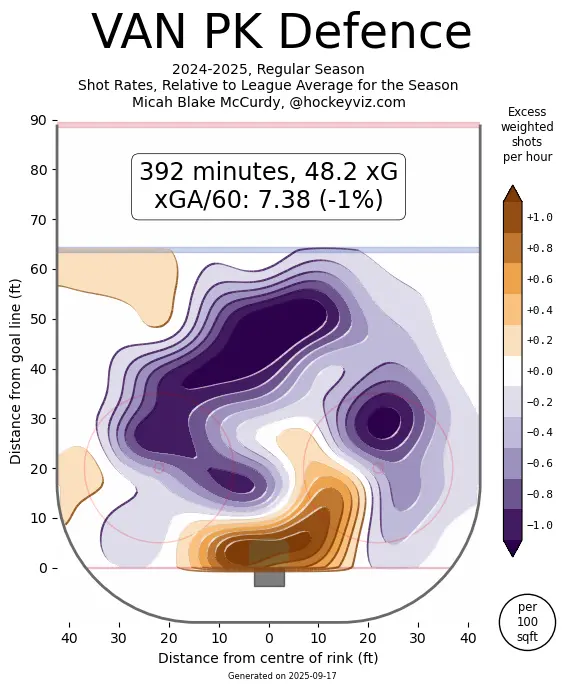
Take a gander at the Canucks’ PK results from last year, when they rose to the top of the league rankings:
 HockeyViz.com
From HockeyViz.com
The 2024-25 Canucks did a great job of limiting shorthanded chances and shots in general, and specifically in the high-danger area known more commonly as the slot. Almost all of the shooting against the 2024-25 Canucks PK had to come from directly around the crease, which played into the strengths of Vancouver’s larger defenders like Forbort, Pettersson, and Myers.
Meanwhile, the speedy and dangerous PKing forwards kept opposing power play bluelines honest, and used their sticks and skates to create some large dead-zones in the middle of the ice. The 2024-25 Canucks PK controlled, directed, and then neutralized the opposition in what is now a visibly tidy fashion.
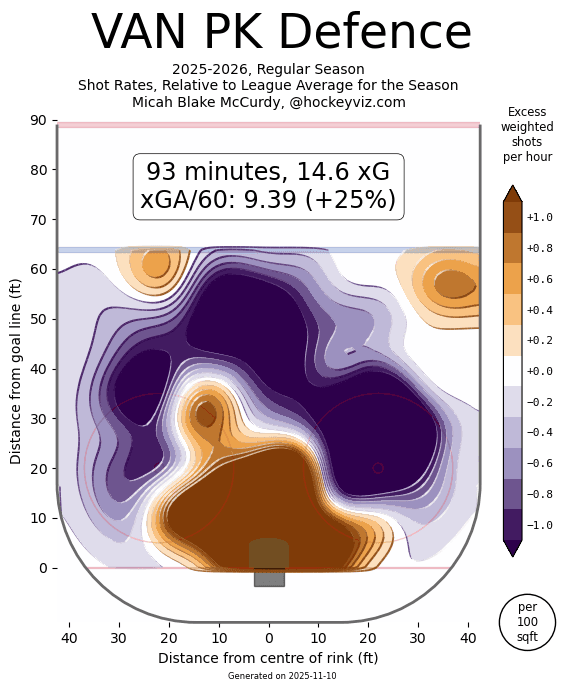
Compare that to the results thus far on the 2025-26 season:
 HockeyViz.com
From HockeyViz.com
Large brown stains are almost never good news, and this is certainly no exception. The 2025-26 Canucks would seem to have ceded the entire slot area to become an open shooting gallery, and are quite literally bleeding chances against from the most dangerous zone on the ice.
The zone-of-frequent-shots-against stretches all the way up to the top left of the faceoff dot, essentially covering all the prime shooting areas available. This problem, in general, does seem to lean more heavily on the Canucks’ left side, which matches what the eye test has said: Forbort has missed games, and Marcus Pettersson hasn’t been as good of a PKer as he was last year.
The absence of Suter and Blueger can also be seen fairly directly on this chart. Their contributions have been replaced, in part, by some players who are a little less fleet of foot, like Elias Pettersson and Aatu Räty. As a result, opposing bluelines are getting in far more uncontested point-shots, with each side having carved out their own little brown circles on either point. Combine that with the lack of control in the slot, and it’s not hard to see why so many power play goals against are occurring.
The numbers really speak for themselves. In terms of Expected Goals Against, the Canucks’ PK is allowing more than two full expected goals against per 60 minutes than the 2024-25 PK.
In terms of actual goals against, it’s somehow worse than that. The 2024-25 Canucks gave up just 39 power play goals against through 82 games, for a rate of 0.48 per game. The 2025-26 Canucks have already given up 18 power play goals against in just 17 games, for a rate of 1.06 per game.
That’s right, the Canucks are not just giving up double the PP goals as they did last season…they’re giving up more than double. And by looking at those charts, we can tell that’s not an anomaly. They’re giving up more ice, more shots, more chances, and as a direct result, more goals against.
Is there hope for an improvement? The returns of Forbort and Blueger will no doubt help. But two players cannot singlehandedly give the Canucks back control of the centre of their PK zone, and two players cannot singlehandedly cut the team’s power play goals against in half.
The results here speak fairly loudly to the need to go back to the drawing board, to take a hard look at what has shifted and slipped from 2024-25 to now, and to try to put some more of what worked last year back into play this year.
But that will take dedicated practice time, and the Canucks are set to spend six of their next nine games on the road to close out November. In other words, it might be a while before they can really set aside some time to fix this – so it might be getting worse before it gets better.
Watch out, Ottawa Senators!
Sponsored by bet365


Breaking News
- 10 statistics that stand out from the first 10 Canucks games
- Could the Vancouver Canucks and Ottawa Senators hook up on an in-season forward trade?
- The Statsies: Canucks dominated at 5v5 in 4-2 loss to Lightning
- The Stanchies: Prime Lankinen returns, Canucks still go winless on road trip with 4-2 loss to Lightning
- Instant Reaction: Canucks give up four unanswered goals in 4-2 loss to Lightning

Vancouver CanucksTeam Cap Summary

Cap Summary
2026-27
2027-28
Projected Cap Hit
$87,295,050
$71,329,167
Projected Cap Space
$16,704,950
$42,170,833
Current Cap Space
$18,518,630
$42,170,833
Active Players
23/23
13/23
Draft Picks
Round
'27
'28
1
1
1
2
2
2
3
1
1