
CanucksArmy has no direct affiliation to the Vancouver Canucks, Canucks Sports & Entertainment, NHL, or NHLPA
Which Canucks’ “stocks” went up or down the most in 2025-26?
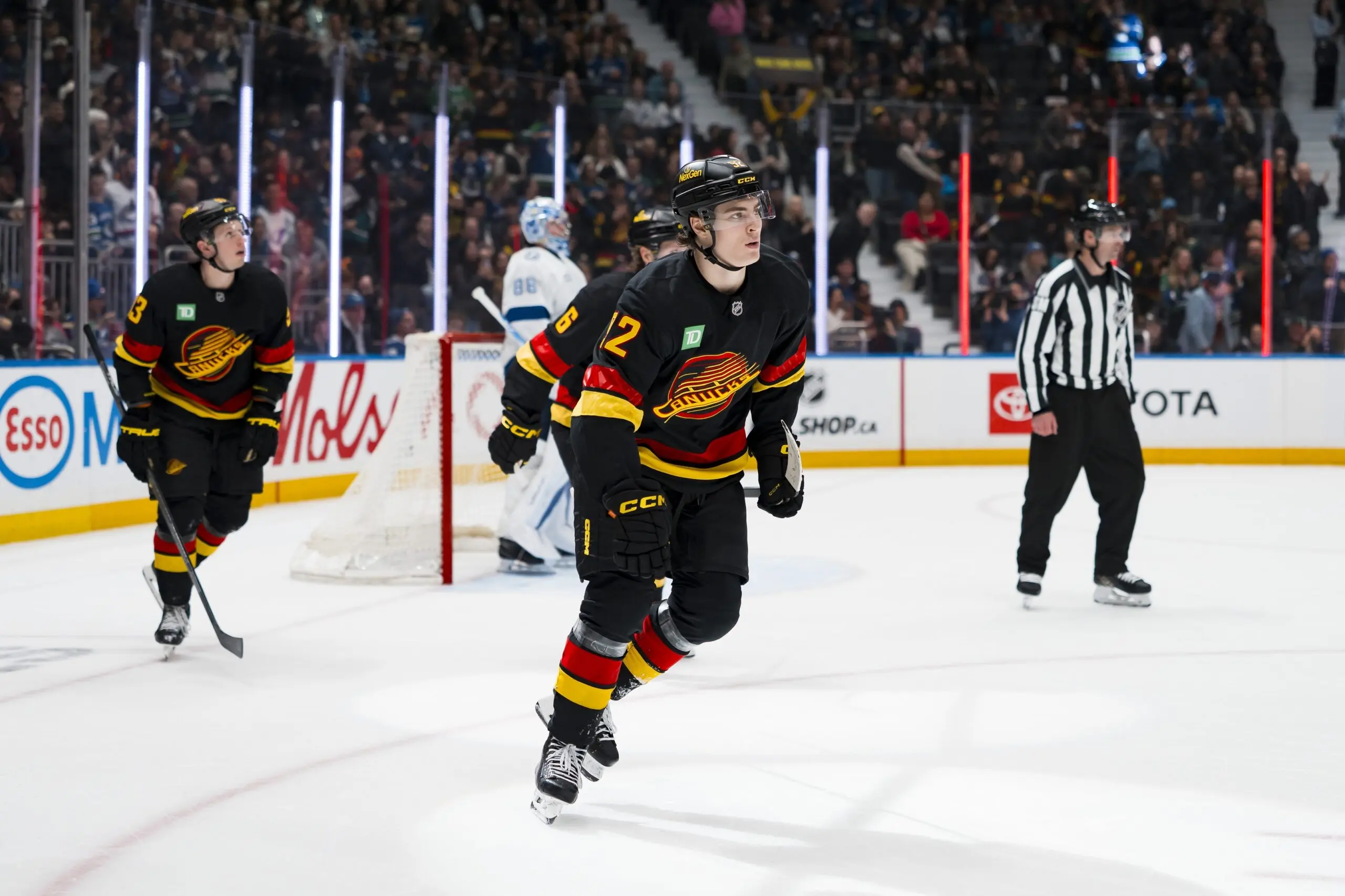
Photo credit: © Bob Frid-Imagn Images

Apr 28, 2026, 13:00 EDTUpdated: Apr 28, 2026, 13:03 EDT


There’s been plenty of talk about the traditional type of hockey trading as it pertains to the Vancouver Canucks throughout this 2025-26 campaign, and such talk will undoubtedly continue for the foreseeable future. But it’s not the only kind of trading we can talk about. If we’re willing to get metaphorical, we can also talk about the more financial variety of trading, as in stocks.
Hockey players are a lot like stocks, in that their value goes up and down all of the time, and can sometimes fluctuate quite wildly. And it’s been a particularly volatile year on the Vancouver Canucks Market.
As we continue to dissect the year that just was, we’re taking a look at which Canucks’ stocks went up or down the most in the wake of 2025-26 – and it’s not quite as bleak an outlook as one might expect!
Stock Up: Linus Karlsson
It wasn’t that long ago that Karlsson’s window to become a full-time NHLer was thought to be more-or-less closed. Prospects don’t typically get too much in the way of a shot after they’ve passed the age of about 24. But as a 26-year-old rookie, Karlsson really made a name for himself. He notched 35 points in 79 games, 31 of which were at even-strength, making Karlsson the team’s top even-strength scorer. Nobody, and we mean nobody, predicted that outcome at the season’s outset.
It’s been a quick climb for Karlsson, from cast-off to AHL champion to, arguably, the Canucks’ best overall forward this past season. He earned himself a two-year contract extension at a significant raise along the way, and now looks both like an asset that would attract some trade attention if put on the market, but also someone who could reasonably play a role in the Canucks’ long-term rebuild plans moving forward.
Stock Down: Elias Pettersson
Let’s get the obvious out of the way early on here. On the whole, it wasn’t that much worse of a season for Pettersson than the last one. His PPG was 0.70 in 2024-25, and it was 0.69 this year (on a much lower-scoring team).
But it’s all about the narrative for Pettersson, and that narrative says that every year that passes between Pettersson and his former glory days of 100 points – now three years in the rear-view mirror – the less likely it is that he ever bounces back in any way, shape, or form.
But it’s all about the narrative for Pettersson, and that narrative says that every year that passes between Pettersson and his former glory days of 100 points – now three years in the rear-view mirror – the less likely it is that he ever bounces back in any way, shape, or form.
Most folks now seem to be accepting Pettersson as a truly diminished asset, one better suited for 2C duties moving forward than the former elite status that was once granted to him. He’s still probably tradeable this summer, and there’s still a role to be played by him in a prospective rebuild if he’s not traded, but no one can deny that Pettersson stocks have continued their steady plummet in 2025-26.
Stock Down: Brock Boeser
We’ve got more stocks down than up this year, so let’s continue with the obvious ones here. Just one year ago, Boeser was a UFA with a multitude of suitors. And while all of the offers made to him will never be publicly known, we do know that at least one team thought he was worth a seven-year, $7.25 million AAV deal – the Vancouver Canucks, who signed him to it.
Suffice it to say that, a year later, no one, including the Canucks, would be offering that same deal. Boeser’s status as a complementary player became all too clear with little for him to complement on the ice in 2025-26, and holes started to appear all over his performance, especially on the defensive end.
Boeser did get it together down the stretch and wound up with 22 goals and 48 assists, which is not terribly far off his typical scoring pace. But none can deny that his stocks are down, and the fall from high-ranked UFA to maybe untradeable has been a harsh and steep one.
Stock Up: Drew O’Connor
The book on O’Connor when the Canucks acquired him from Pittsburgh was that he was a frustrating player. The kind whose feet gave him all sorts of opportunities that his hands quickly squandered. This year, however, he seemed to really put it all together, scoring a career-high 17 goals, and at one point was pacing for even higher.
O’Connor flashed some clutch, became a more focal penalty killer, and saw time in the top-six in 2025-26. These are all welcome traits on any NHL roster, and they’ve combined to turn O’Connor into one of the most tradeable assets the Canucks currently have. There’s plenty of interest from the fanbase in keeping him around as a good example, but the new management might have a hard time turning down the temptation of cashing in his big year on a decent draft pick.
Stock Down: Thatcher Demko
Might as well complete our tour of disappointing long-time Canucks. Two years ago, Demko was getting nominated for the Vezina Trophy. A year ago, he signed a three-year, $8.5 million AAV extension (one that won’t actually start until July 1). Today, he’s an absolutely untradeable asset whose future as an NHL goaltender of any variety, never mind as a starter, is in question after a litany of injuries and surgeries.
Demko believes this latest procedure has put him back on track to sustainable health, and most are pulling for him. But it’s a real “believe it when we see it” situation for Demko and being healthy, and until that comes to pass, he’s about as distressed an asset as the Canucks own.
Stock Up: Liam Öhgren
When folks said the Canucks got the equivalent of four first round picks back for Quinn Hughes, they were being a little technical on Öhgren. True, he was drafted at 19th overall back in 2022, but he’d spent the interim struggling to break through with the Wild and stagnating at the AHL level.
But a happy landing in Vancouver really restored that lost value quickly. Öhgren didn’t really even end up with an impressive statline – just 18 points in 51 games as a Canuck – but he looked like a much more serious and dangerous forward prospect than he ever did in Minnesota. Now he’s being talked about like a real part of the core moving forward, and someone who might just turn into a genuine top-six talent in the long-run.
He’s gone from a veritable throw-in to being perhaps the second-most important asset from that trade, after Zeev Buium, and he’s done it pretty quickly.
Stock Down: Aatu Räty
Räty is used to seeing his stock tank. He was once promised to be the first overall pick in his draft year, and then fell all the way to the late second round. He rebuilt that value a bit more with the Islanders before being traded to Vancouver as part of the Bo Horvat deal, where he was seen as the rough equivalent of a high second round pick.
Now, there’s some talk that the Canucks might as well ship him off for a mid-round pick, because he just can’t seem to find a permanent spot in Vancouver. Despite some positive early returns, Räty could not win the confidence of head coach Adam Foote, and found himself in and out of the lineup and almost always as the centre with the lowest ice-time.
Räty still has an NHL future due to his faceoff skills, but the possibility of him turning into something more than a depth piece seem to be dwindling with each passing year, and especially this past one.
Stock Up: Teddy Blueger
No one was ever really down on Blueger. He’s been seen as a rock-solid bottom-six centre for a long while, and that hasn’t changed. But Blueger somehow produced at the highest rate of his career while playing on the lowest-scoring team of his career. And he went from someone who was almost certainly going to be cast off by a rebuilding team, to someone who is being outright called a “culture carrier” and someone to keep around as a positive example for the youth.
Blueger stocks are up, way up, and that’s true whether he actually sticks around or hits the UFA market in a couple of months.
Stock Down: Marcus Pettersson
Just over a year ago, the Canucks traded the unprotected New York first they got back for JT Miller – which ultimately slotted in at 12th overall – for a package that included Pettersson.
Even at the time, the trade was controversial. Many wanted to hang onto that pick, but the prevailing thought at the time was that if it had to be exchanged for a veteran defender, then Pettersson was probably the best the Canucks could do. And, indeed, Pettersson played extremely well post-trade.
Then the 2025-26 season hit, and while the whole team fell apart, Pettersson fell apart even harder than most. No other blueliner seemed to be the most directly and negatively impacted by Foote’s system, and Pettersson spent the year alternating between a non-factor and an active on-ice detriment at various points.
Forget recouping that first round pick. Now there are questions to be asked about whether Pettersson would return so much as a second if he hit the trade market – which is something the Canucks will have to consider doing anyway.
Stock Up: Sawyer Mynio
We’re now getting into a younger set of players, and so we’ll start with a general message that the careers of young players are naturally indeterminate, and so everything we mention here can be seen as both less conclusive and less consequential than anything we’ve said about any of the veterans.
That said, Mynio had a remarkable rookie pro campaign. It’s often said that the transition from junior to pro is the most important, and a great indicator of how a prospect will progress from there. Mynio, for his part, stepped right into the AHL and quickly became Abbotsford’s most trusted overall defender at the age of 20. This, a year after unexpectedly cracking Team Canada at the World Juniors. It’s all a great sign that his development curve has an upward trend, and that he’ll be ready for NHL action sooner rather than later.
Stock Down: Arshdeep Bains
Our own Jeff Paterson recently reminded us that Bains played a third of this past season in the NHL, but that’s still hard to believe. Of Abbotsford’s championship top line of 2024-25, Linus Karlsson established himself as a genuine middle-six talent, Max Sasson showed he can be a long-term fourth liner, and Bains fell right out of the NHL picture. Having now passed through waivers unclaimed, Bains has a lot of work to do to get himself back on the big league radar, and it’s hard to believe that chance will come in Vancouver, where he’s about to be leapfrogged by so much younger talent.
Stock Down: Victor Mancini
There was perhaps not enough discussion of Mancini’s difficult year. He broke camp with the New York Rangers as a rookie last season, and did so again this season with Vancouver, but that was a real peak for him. He was back down in Abbotsford soon enough, having been firmly surpassed by Tom Willander. Where, unfortunately, Mancini struggled to find consistency, and was often passed up for opportunity by other, less notable prospects, like the incoming Jack Thompson.
When those NHL opportunities opened up later in the year, Mancini failed to do much with them. Someone who was once looking like a sure thing now has a bunch of question marks about his NHL future, and an awful lot to prove in his third NHL training camp.
Stock Down: Aleksei Medvedev
Okay, we’ve really got to caveat hard here, because we are talking about someone who is still 18 years old, and won’t turn 19 until September. Medvedev is an extremely raw prospect, and still has loads of potential, but that can’t change that this was a disappointing year for him. He lost his OHL crease to an older, undrafted veteran, and that’s never a great thing for a goalie’s development.
When Medvedev was drafted high in the second round, there was a lot of talk about the Canucks having secured their “goalie of the future.” That talk has quieted down after Medvedev’s Draft+1 campaign, and he’s got a bit of work to do next year to restore that faith.
Stock Up: Braeden Cootes
In many ways, Cootes’ stock has been on a steady rise since he was drafted at 15th overall last June. He was not expected to make the Canucks’ team out of camp. He did that. He was not expected to make Team Canada at the World Juniors. He did that.
Along the way, the expectations for Cootes has climbed, too. He was talked about as a potential quality middle-six centre with a great work ethic at the time of his draft. Now, he’s showing signs that he could be a real top-six talent in a few years time. That’s some terrific upside on a mid-first round pick of only a year ago, and the exact sort of immediate draft success story the rebuilding Canucks need more of.
Sponsored by bet365


Breaking News
- 3 Canucks Stars of the Week: Jonathan Lekkerimäki a bright spot amid losing streak
- Abbotsford Weekly: Hats fly for newcomer Jacob Quillan as Canucks sweep Wranglers
- Scenes from practice: Malhotra hauls out line blender in attempt to help Canucks snap 10-game losing skid
- Canucks’ Jack Thompson clears NHL waivers, will report to AHL Abbotsford
- JPat’s Monday Mailbag: Canucks chemistry lessons, a hot dog feast and press box bingo

Vancouver CanucksTeam Cap Summary

Cap Summary
2026-27
2027-28
Projected Cap Hit
$87,295,050
$71,329,167
Projected Cap Space
$16,704,950
$42,170,833
Current Cap Space
$19,405,750
$42,170,833
Active Players
23/23
13/23
Draft Picks
Round
'27
'28
1
1
1
2
2
2
3
1
1