
CanucksArmy has no direct affiliation to the Vancouver Canucks, Canucks Sports & Entertainment, NHL, or NHLPA
Why the safest play for the Canucks’ rebuild is still keeping Elias Pettersson
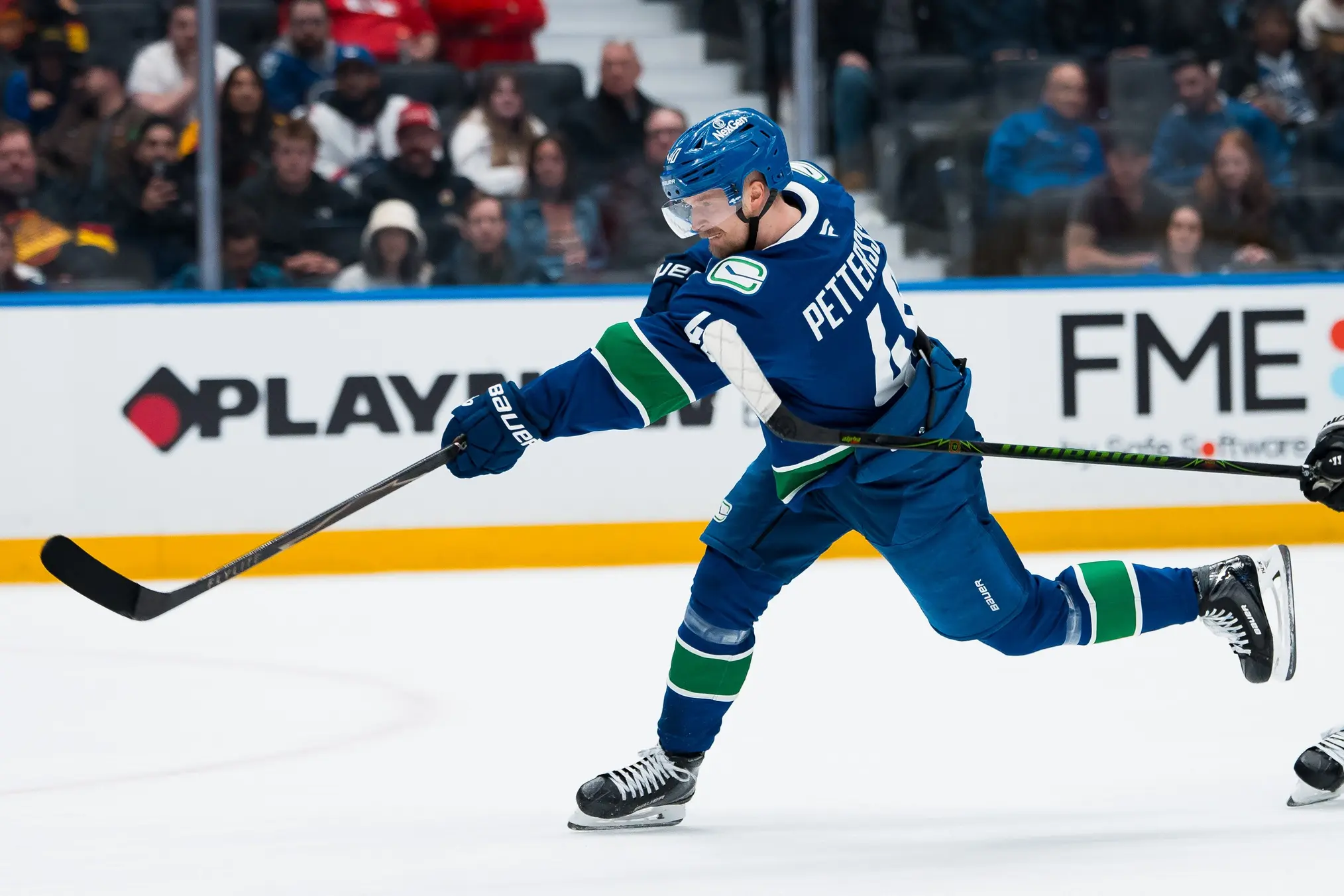
Photo credit: © Bob Frid-Imagn Images

Apr 20, 2026, 12:00 EDTUpdated: Apr 20, 2026, 12:02 EDT


The offseason of change has already begun for the Vancouver Canucks, and it’s not anywhere near over. Fewer than 24 hours after the conclusion of the 2025-26 regular season, Jim Rutherford was meeting with the press to go over the firing of GM Patrik Allvin. But while Allvin was the designated topic of the day, another Swedish name came up just as frequently in Rutherford’s comments: that of the elder Elias Pettersson.
As he has countless times in the past, Rutherford took this opportunity to call Pettersson out, this time for what he perceived as a lack of preparation. “I think there’s a lot of good things he did,” said Rutherford, “He tried to become a two-way player. He’s tried to do the things that it ultimately takes to win as a team. But his production has been down so much, it’s difficult. I believe that if he puts the work in in the summer, it’s the same as anything people do in life – preparation is the key to success – and I don’t believe he’s put enough preparation in at this point to be the player he needs to be.”
As we talk about change, one of the largest changes that the Canucks could take in this 2026 offseason is the trading of Pettersson, and it’s been the subject of debate all season long, and beyond. But in listening to Rutherford’s comments closely, he still sounds like someone who might just plan on having Pettersson around with the Canucks a while longer.
“I do feel confident that Petey has the ability that he can bounce back,” concluded Rutherford, “And he doesn’t have to be a guy that gets 110 points. Even a point a game will be enough as this team grows and becomes a better team. It’ll be enough for this team to be successful, but he’s got to get to that, and he’s got to work at it.”
That sounds like a President of Hockey Operations who is planning to hold on Pettersson, rather than cashing out. And while that will no doubt prove a controversial decision, once made, it also remains the safest path forward for this Canucks rebuild already in progress.
Put as simply as possible, the Vancouver rebuild is going to need a first line centre eventually, and if this is going to be a truly successful rebuild, that 1C is going to need to be of a high quality. At this point, the odds of Pettersson rebounding all the way to being that contender-quality 1C seem low. But he can still play a role in the acquisition and especially the development of said 1C all the same.
Obviously, the most direct method here would be to trade Pettersson for a 1C or a 1C-in-the-making. But we can also probably dispense with that notion right away. For one, because 1Cs of any variety are almost impossible to trade for in any scenario. And for two, because goods as damaged as Pettersson is right now could never bring back such a blue-chip return.
In fact, we’d go as far as to say that, barring some untouchable pieces of the rebuild – like a Zeev Buium, for example, or one of the Canucks’ own firsts – there aren’t any assets within this franchise right now that could reasonably be exchanged for any form of 1C.
And so, the likeliest solution here, by far, is that the next Vancouver 1C comes out of the draft. That almost certainly won’t be the 2026 Draft, either, where the Canucks are set to select either one of two top-line wingers or a highly-touted defender, depending on the lottery results. A 1C is probably going to have to come out of the 2027 Draft, or perhaps even later, and that reality should impact the Canucks short- and long-term approach to roster planning.
What the Canucks will want to avoid most is having their new core bogged down by too much responsibility too soon. Many have already mentioned the possibility of having a Gavin McKenna or an Ivar Stenberg line up with a centre like Pettersson in their rookie campaign, and the appeal there is obvious enough – and certainly a superior option to putting them with someone like Marco Rossi, better suited for 2C duties.
But it also goes beyond next year, and into the support system needed for whoever that next 1C is going to be. The Canucks ideally don’t want that new centre to come into a situation where they need to develop directly into a first line centre ASAP, because otherwise there’s no one else driving the bus.
A situation where a new, potential top line centre hits the roster in, say, 2027/28 and only has the likes of Rossi and a sophomore Braeden Cootes to insulate them is far from ideal. But a more positive insulator is already both available and already in hand in the form of Pettersson.
Forget that $11.6 million cap hit for a moment – tall order, we know – and realize that, minus that, Pettersson actually looks like a near-perfect centre for the transitional job we’ve outlined here:
-He has already demonstrated an ability to provide at least bare minimal coverage at the 1C position without necessarily raising the team any in the standings while doing so (see the 2025-26 season as evidence), which avoids threatening the continued tank.
-He makes for a fine first linemate for a McKenna or a Stenberg, and certainly compares more favourably to the kinds of centres that, say, Connor Bedard has to play with in his rookie campaign, even at his current output.
-He is, specifically, still very good defensively, which is the area where young offensive talents usually need the most support.
-He still has at least some signs of offensive life left in him, and trended more positively in this direction as the 2025-26 season wore on.
-It’s a role Pettersson would apparently welcome, as he told the year-end media that “This feels like home. I signed here for a reason. We are in a tough spot, none of us are happy with the season… We’ve got good pieces here, so we’re just trying to build it into a good team.”
Put it all together, and it’s not too hard to see the vision that Rutherford might be seeing here. Pettersson could play a somewhat unique role as a dual-insulator. First, as a star rookie winger’s first linemate, covering the centre of the ice defensively and distributing the puck so as to create as much room as possible for that winger’s game to develop and thrive.
Then, as a transitional piece, covering the 1C position in a temporary fashion until a new 1C can be drafted and developed to the point that they’re ready to take over. Having Pettersson in that role for the time being takes pressure off the new draftee both offensively and, perhaps more crucially, defensively, especially in terms of the difficult matchups that Pettersson will presumably continue to eat.
Over time, that new draftee becomes the 1C at their own pace, and if Pettersson sticks around that long, at that point he becomes a good quality 2C.
The plan sounds find on paper, but that last point brings us to one of our two major stumbling blocks: Pettersson’s cap hit.
We asked you to forget about the $11.6 million for a bit, but we’re willing to bet that some of you were unable. Which is fair, as it’s an extremely large ticket. But in the immortal words of Tony Soprano, we’re going to have to get over it. The contract is signed, the money is on the books, and the Canucks don’t have a lot of other things to spend it on right now, anyway.
Whoever the team drafts this year, assuming they make the NHL roster right away, will have their entry-level contract go from 2026 to 2029. Whoever they draft the next year, assuming they also make the NHL roster right away, will have their entry-level contract go from 2027 to 2030.
Pettersson’s contract runs until 2032. So, already, a large portion of his remaining overpayment will be covered by the natural underpayment that comes with those ELCs.
In the end, if this sort of plan is seen all the way through, then Pettersson would end up as an $11.6 million second line centre. No matter the circumstances, that will be a little tough to swallow. But by the time that comes to pass, the continued raising of the NHL cap ceiling should make it at least a little easier to swallow.
Especially if, in the meantime, Pettersson has assisted in the development of the next core.
The other stumbling block comes in giving up on any theoretical trade return that might be brought back for Pettersson. But here, we return to our original point. What would Pettersson realistically bring back in a trade – especially if retention were fully off the table, as it has been rumoured to be? Even the most optimistic projections probably top out at a first round pick and a decent, but not blue-chip, prospect.
And, really, what’s more valuable to the Canucks in the long-run? Some more mid- to low-end future assets, or the ability to insulate and be patient with a couple of their truly high-end future assets? It is those players picked high in 2026 and 2027, and maybe 2028, too, that will truly determine the success of the Vancouver rebuild. Whatever it takes to ensure that those players find individual success is worthwhile, and for right now, the safest way to ensure that is to just hang on to Elias Pettersson.
Sponsored by bet365


Breaking News
- The Stanchies: Prime Lankinen returns, Canucks still go winless on road trip with 4-2 loss to Lightning
- Instant Reaction: Canucks give up four unanswered goals in 4-2 loss to Lightning
- Canucks: D Elias Pettersson’s impressive start is more than just passing the eye test
- What’s behind Marco Rossi’s seven-game scoring drought for the Canucks?
- Canucks Game Day: Looking to close out lengthy road trip with a win vs. Lightning

Vancouver CanucksTeam Cap Summary

Cap Summary
2026-27
2027-28
Projected Cap Hit
$87,295,050
$71,329,167
Projected Cap Space
$16,704,950
$42,170,833
Current Cap Space
$18,413,411
$42,170,833
Active Players
23/23
13/23
Draft Picks
Round
'27
'28
1
1
1
2
2
2
3
1
1