
CanucksArmy has no direct affiliation to the Vancouver Canucks, Canucks Sports & Entertainment, NHL, or NHLPA
The Canucks shouldn’t really get to use the injury excuse as much as they have been
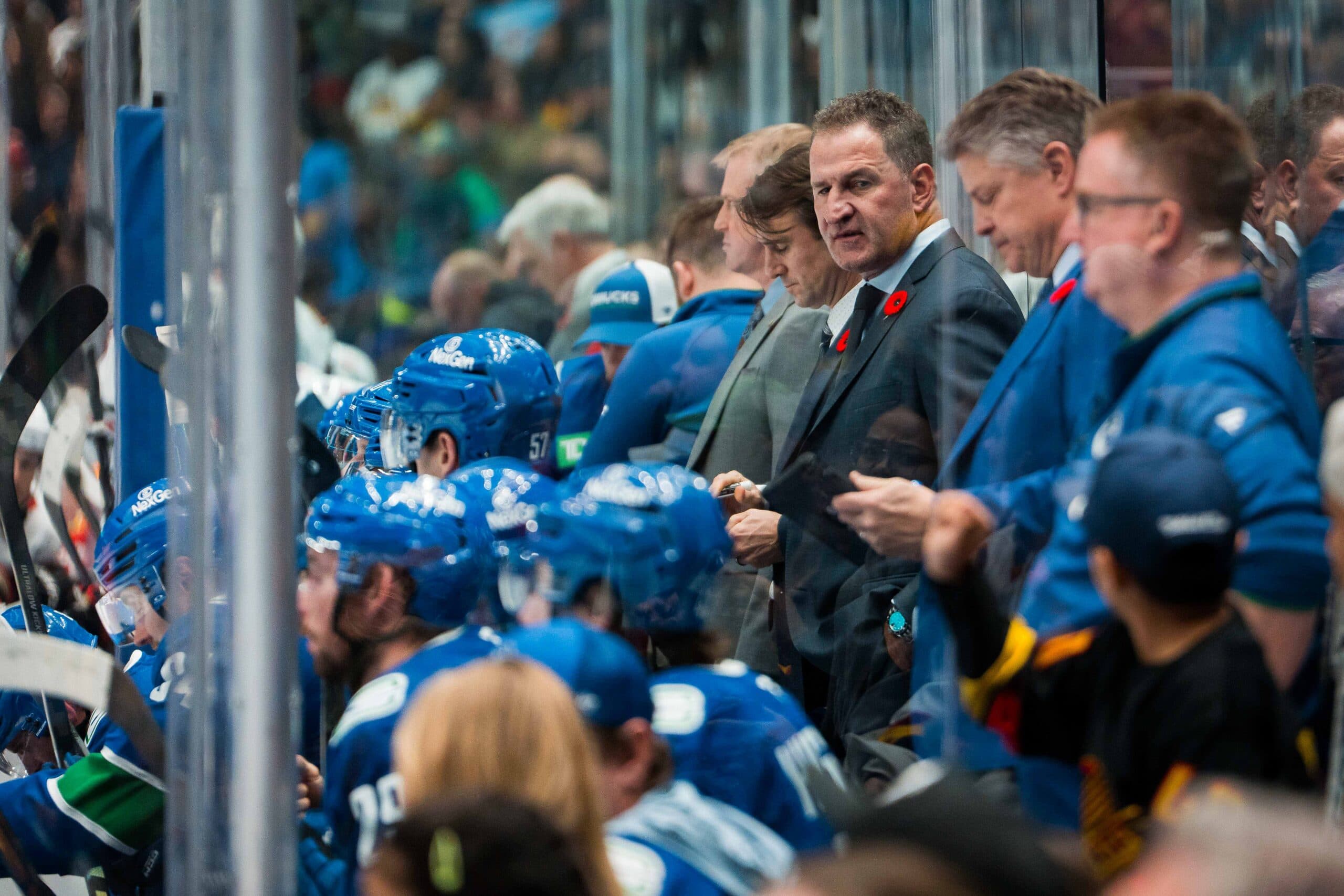
Photo credit: © Bob Frid-Imagn Images

By Tyson Cole
Nov 26, 2025, 11:23 ESTUpdated: Nov 26, 2025, 17:55 EST


We are now over a quarter of the way into Adam Foote’s tenure, and we’re starting to get a good read on the type of coach he is for the Vancouver Canucks.
He’s very supportive of his players, often being cautious not to pile on the team after losses. Instead, he will highlight positive things he liked about the game and mention that the team is very young and that he’s doing his best to teach them along the way – oftentimes adding that they are doing a great job.
However, that hasn’t really been the case.
Once regarded as one of the NHL’s best defensive defencemen, the Foote-led Canucks have allowed the second-most goals against (86), and their 9-12-2 record has them 30th in league standings.
Now, to be fair, with a new head coach comes a new defensive system and structure for the players to learn. After two years under Rick Tocchet’s zone defence, which emphasized protecting the middle of the ice, Foote has the Canucks running more of an aggressive man-on-man defence, where two players pressure the puck carrier when it’s moved below the hash marks.
Canucks forward Brock Boeser spoke about the defensive zone structure, admitting there is some confusion in switching to the new system, but is confident that after they iron out the kinks, they’ll get better:
“I think there’s some kinks we’re working out in our defensive zone coverage right now,” Boeser told CanucksArmy. “I think once we get those kinks out and have a little more clarification on stuff, then we should be good. There’s different scenarios where we’re good at shutting plays down, and there’s other scenarios where we can maybe get a little confused, and we accidentally double up on a guy, and then we leave a guy open. Like [against Calgary], in front of the net, we gave up some rebounds and some goals. Like, we got to make sure that we have those guys boxed out, and each guy has a guy.
“We have some young guys and guys that are doing everything they can. I think our system’s a little different than last year. And I think that’s where the confusion comes from. I think there’s times where we’ve done the other system for a bit, so we kind of think naturally to do that, where we don’t have to do it. Whether we’re switching when we don’t need to, like, if a guy’s on a guy, we want to go kill the play. So I think that’s a little different this year.”
The eye test shows the team isn’t used to playing this type of defensive coverage, and it’s leading to confusion on the ice, which often results in blown coverage and the puck in the back of their net.
Now, this isn’t to say Foote’s systems are poor. While most teams certainly lean toward a more zone approach, playing an aggressive man-to-man defence can completely suffocate your opposition: ie the Carolina Hurricanes. So, it can work. However, it takes a specific type of defensive personnel in order to pull that off. And now, after a quarter of the season, it’s clear that his team is not that.
Again, that’s not Foote’s fault. He’s doing his best with the players he has. Does there come a point where he should realize the message isn’t exactly reaching his players, and they shift back to something they’re more comfortable in? We might not be far away from that point.
We would be remiss if we did not at least mention the laundry list of injuries Foote has had to deal with. That much roster turnover, having to try and find different line combinations that work to get the most out of his roster, must be tough to deal with.
That said, using injuries as an excuse for the team’s poor play is starting to run dry.
With players returning to the Winter Olympics come February, the Canucks are feeling the effects of the condensed schedule. And while the injury bug may feel like it’s hitting the Canucks the hardest in sheer volume, all 31 other teams are going through the same schedule, limited practice time, and are suffering injuries of their own.
We asked Foote after Monday’s practice about how the strengths of this team coming into the year were viewed as defence and goaltending. Yet, they had allowed the most goals against (at the time of the question) in the entire NHL.
His response: “You already know. That’s our injuries. It’s just that simple. Like, it’s logical, right? So, you know, I can’t just fire something out there to change the facts. And you know, we’ll continue to teach until these guys keep getting it and get the reps, and we’ll get guys back.”
But for the most part, the Canucks’ main skaters have stayed relatively healthy. Quinn Hughes (five games) and Conor Garland (four games) missed some time with injuries, sure. Brock Boeser was absent for two games due to personal reasons. Other than that, Elias Pettersson, Jake DeBrusk, Kiefer Sherwood, Evander Kane, Filip Hronek, Marcus Pettersson and Tyler Myers have played in all 23 games this season.
Of course, the depth of the lineup has suffered the most. Teddy Blueger, Derek Forbort, Jonathan Lekkerimäki, and Victor Mancini missed significant time. However, if those four missing big chunks of time is what really derailed the start of the season to the point the Canucks have given up more goals against than any other team, then maybe the ambitions were set too high for this club heading into the year.
And no, we did not forget about the injuries to Filip Chytil and Thatcher Demko.
Coming into the year, the Canucks were asking big things of Chytil that he hadn’t done yet in his career: take on the second line centre role. While he looked good to start the season, the lack of a contingency plan if Chytil, who has dealt with numerous concussion issues throughout his career, were to get injured, is what is costing this team the most right now.
Let me take you back a few months to the end-of-season media availability. In regards to finding a second line centre, Jim Rutherford said: “It’ll be expensive, but it’ll also be very expensive not to get one. So we’re going to be open to do whatever it takes and probably on the trade market to get that player. It depends what level the player is at.”
Not only did they not find that second line centre, but they didn’t bring any centreman who could step in if an injury were to occur down the middle of the ice. They allowed Pius Suter to walk in free agency, electing to give up a draft pick to bring winger Evander Kane instead. With Demko’s injury history, the team protected itself by re-signing Kevin Lankinen. And that’s worked out, as Lankinen has carried the load in goal with Demko out.
But handing an injury-prone goaltender an extension before seeing if he can bounce back and stay healthy is just another example of poor roster construction that has Foote and the rest of the team suffering because of it. Demko and Chytil’s injuries didn’t exactly fall out of the clear blue sky, is what we’re saying. And we haven’t even mentioned the fact that the Canucks are far from the only team dealing with injuries, as many NHL teams are feeling the effects of the condensed schedule. The Carolina Hurricanes, for example, have gotten just two games from their top blueliner Jaccob Slavin, and they sit first in the Metropolitan Division.
So when Foote blames injuries and injuries alone for why his team has given up the most goals in the league, paying fans have every right to be frustrated with him and a Canucks team that has just three wins on home ice this season.
Sponsored by bet365


Breaking News
- The Stanchies: Canucks serve up defensive zone breakdowns in Thanksgiving loss to Rangers
- Instant Reaction: Canucks struggle defending off the rush in 6-2 loss to Rangers
- Abbotsford weekly: Cootes and Lind tally 3 points each in Canucks’ first win of the season
- NHL fines Devils’ Evan Rodrigues $5,000 for high-sticking Canucks’ Marco Rossi in the neck
- Canucks Game Day: Desperate to shore up the penalty kill against the Rangers

Vancouver CanucksTeam Cap Summary

Cap Summary
2026-27
2027-28
Projected Cap Hit
$88,074,947
$71,329,167
Projected Cap Space
$15,925,053
$42,170,833
Current Cap Space
$16,975,056
$42,170,833
Active Players
23/23
13/23
Draft Picks
Round
'27
'28
1
1
1
2
2
2
3
1
1