
CanucksArmy has no direct affiliation to the Vancouver Canucks, Canucks Sports & Entertainment, NHL, or NHLPA
Is the Canucks’ awful penalty kill hurting their ability to play tough?
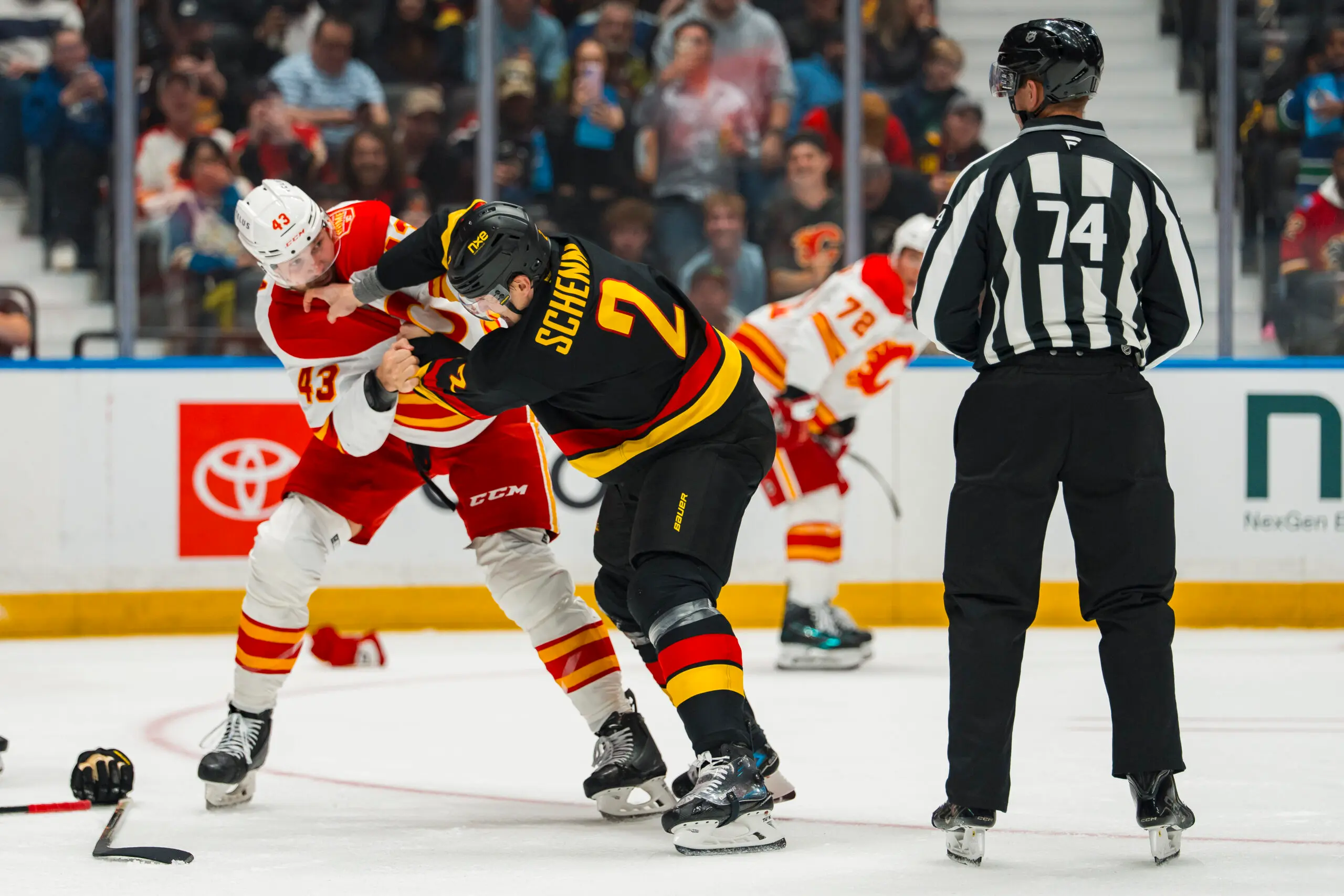
Photo credit: Bob Frid for IMAGN IMAGES via Reuters Connect

Oct 15, 2026, 10:00 EDTUpdated: Oct 14, 2026, 19:02 EDT


The Vancouver Canucks set out this offseason to become both a tougher team and a tougher team to play against. They brought in Luke Schenn, Jamie Oleksiak, Paul Cotter, and Brendan Gallagher to help facilitate that. They emphasized sticking up for one another, carrying on a trend that began at the tail-end of the 2025-26 season. They asked their players to up the physicality, and those players have responded, especially the Elias Petterssons on the roster.
But one thing the Canucks did not set out to do this offseason was put together one of the worst penalty kills in league history. But so far, that’s what they’ve done, too. And those two things are already running in obvious contrast through the early going of the 2026-27 campaign.
That the Canucks’ PK is awful is an outright objective truth. After Tuesday’s matchup with the Islanders, the Canucks sat at a 57.1% success rate. That means that, more or less, every time the Canucks take a penalty, it’s a coin-flip as to whether or not they get scored on.
Were the Canucks to maintain a PK like this all season long, it wouldn’t just be the worst in league history, but the worst by a considerable measure. The all-time worst PK record in a season belonged to the 1979-80 Los Angeles Kings with 68.2%, which is still more than 10% higher than what the Canucks have right now.
Of course, that’s over a full season, and to give context, they’re not the only team currently operating under the all-time-worst threshold. Those same Kings (57.9%), Buffalo Sabres (60.9%), Columbus Blue Jackets (61.1%), and Detroit Red Wings (66.7%) are all off to dreadful starts of their own.
But the Canucks are the worst of the bunch, and given their stated approach to the season, they might also reasonably be called the team that is suffering the most consequences as a result of their PK woes.
In the biggest of pictures, it’s not a problem. The Canucks have more or less acknowledged that this will be a losing season, and most fans have their hearts set on last place, or as close to it as the Canucks can muster. Giving up goals helps with that, and the Canucks have certainly given up goals on the penalty kill; in fact, almost half of their 26 goals against (11) have come while shorthanded.
But there are also morale-related factors to consider. The Canucks are rebuilding, and sometimes we lose focus on the “building” part of that word. Getting caved in this hard on the PK has to be demoralizing, and probably in some specific ways that clash with the team’s desire to play tougher out there on the ice.
It’s not just about the penalty killing itself. On that front, the Canucks are short on veteran PKers and are essentially attempting to give as many players the opportunity to grow in that capacity as possible. That’s all part of the plan, as are the growing pains that come with it, and those can be lived with.
It’s more about the relationship between a player taking a penalty and then having it directly cost their team. In the case of the Canucks, it’s about the relationship between a player taking a penalty and then having it directly cost their team approximately 50% of the time. That has to weigh on a player’s mind at all times, including as they consider exactly how physical and pugilistic to be out there.
In this regard, the fact that the Canucks are ‘tanking’ is almost a non-factor. Individual players will never tank, because they’ve all got careers on the line. And that’s perhaps especially true with the Canucks, who have so many players either working on making their reputations at the NHL level or working to prove they’re not on their last legs. Individually, the Canucks have a lot to play for.
Goals against are one thing, and for them, the blame can usually be spread around, as it has been plenty throughout this young 2026-27 season. But goals against as a result of penalties taken always place some extra degree of blame on the penalty-taker.
Essentially, the question we’re raising here is if the Canucks’ abysmal PK is going to have or might already be having, an impact on their players’ decision-making on the ice as it pertains to getting physically involved. And we think that it probably is.
It seemed to be a factor against the Islanders. After the Canucks made it close, the Islanders seemed to really turn up the physicality on their end. This included a lot of late hits, shots from behind, and other questionable acts. And, if we’re being entirely honest, the officials proved relatively ineffective in curbing that, missing a number of calls that could have been made.
But the Canucks also seemed ineffective in curbing it themselves. One could sense a lot of hesitancy in their response to the physicality. We saw a number of players approach Emil Heineman after he drove Linus Karlsson into the boards from behind, but no one ever directly engaged. This was partly due to the closeness of the score, which is understandable, but it can’t all be blamed on that – it certainly didn’t seem to slow the Islanders down at all. But then, the Islanders have a perfectly decent 82.6% record on the PK. Potentially taking a penalty thus looks very different to an Islander than it does to a Canuck.
Every time an Islander took a liberty on a Canuck on Tuesday, any potentially responding Canucks had to consider that, if they took a penalty on the play, there was an almost 50% chance it resulted in a goal against, and that could mean the blame for an entire loss laid upon their head.
Back on the weekend, we saw something similar play out as the Canucks had a fairly muted response to one of their players literally getting jabbed in the neck with a stick, something that the officials themselves again failed to address correctly.
That’s a tough decision-making spot to put a young player trying to establish themselves as a full-time NHLer, or a veteran trying to avoid a healthy scratch.
It could be that we’re putting the cart before the horse on this one. The Canucks’ PK is bad for this reason. It’s also just bad and something that needs to improve for a multitude of reasons. But getting the Canucks’ PK to where it needs to be for them to compete is a long-term proposition that will probably take years to accomplish.
Getting the Canucks’ PK to a point where players don’t have to outright fear taking a penalty, on the other hand, has to be a shorter-term goal. It’s something that pretty much has to happen within this 2026-27 season if the Canucks want the freedom to initiate physicality and stand up for one another as much as they plainly want to do.
And as a result of that, when the Canucks get home from this road trip and get into some dedicated practice time, we imagine this will be made an immediate focus.
Sponsored by bet365


Breaking News
- Is the Canucks’ awful penalty kill hurting their ability to play tough?
- How the Canucks compare to other NHL basement dwellers three weeks into the season
- JPat: A word on Aatu Räty’s past, present, and future as Canucks place young centre on waivers
- Canucks place Aatu Räty on NHL waivers
- WWYDW: Who or what has most surprised you through 10% of the Canucks’ season?

Vancouver CanucksTeam Cap Summary

Cap Summary
2026-27
2027-28
Projected Cap Hit
$88,074,947
$71,329,167
Projected Cap Space
$15,925,053
$42,170,833
Current Cap Space
$17,259,555
$42,170,833
Active Players
23/23
13/23
Draft Picks
Round
'27
'28
1
1
1
2
2
2
3
1
1