
CanucksArmy has no direct affiliation to the Vancouver Canucks, Canucks Sports & Entertainment, NHL, or NHLPA
Increasing shot volume should be main goal for Brock Boeser in 2026-27
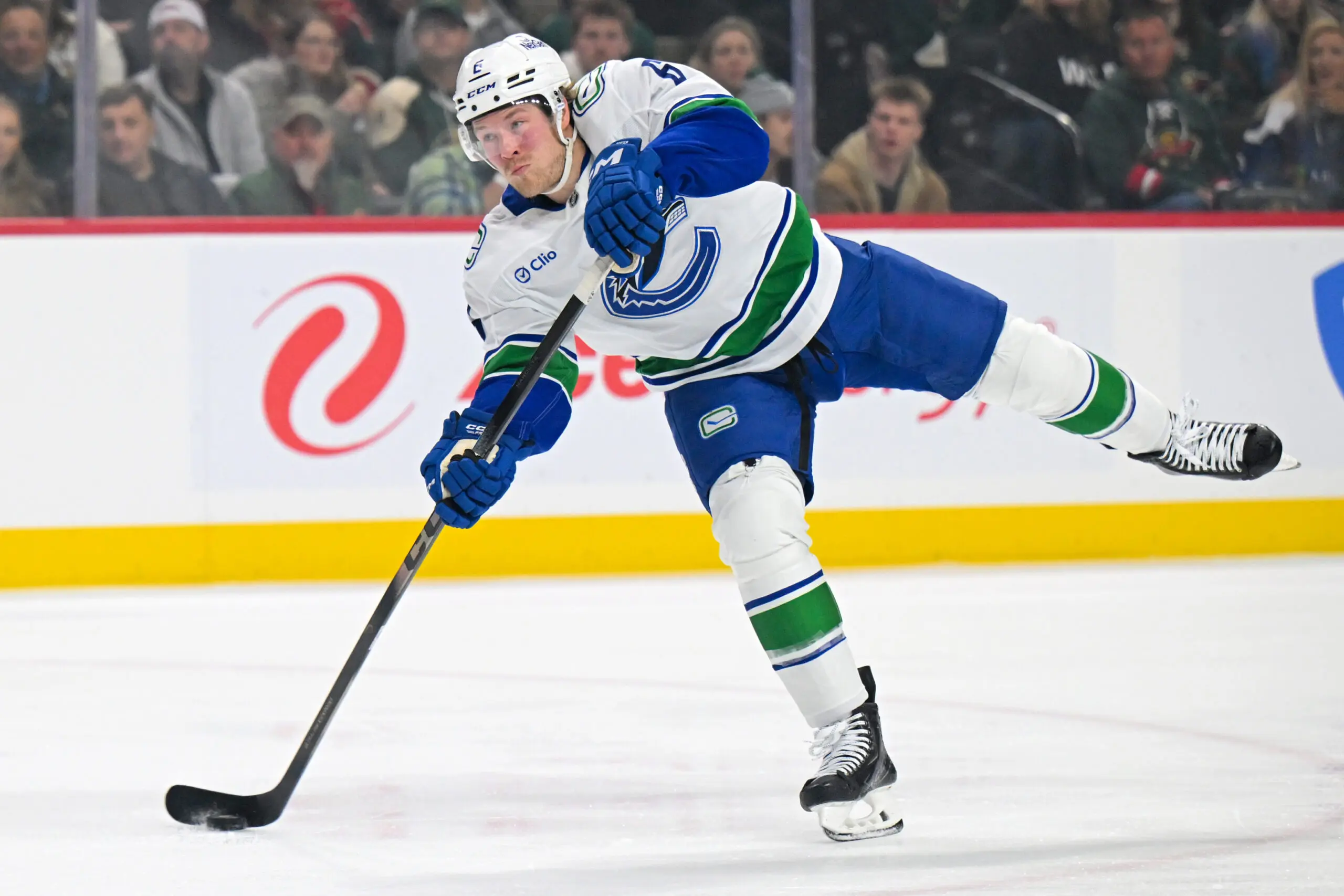
Photo credit: © Nick Wosika-Imagn Images

Aug 5, 2026, 12:00 EDTUpdated: Aug 4, 2026, 23:45 EDT


Despite enduring a career-long 21-game goal drought last season, Brock Boeser can still beat NHL goaltenders. The question facing him this season is how often the Vancouver Canucks can put him in position to do so.
Should Vancouver’s rebuild eventually push him toward considering a move to a playoff contender, any deal would require his approval under his no-movement clause. His best chance of restoring enough league-wide value to make that option realistic is to return to the 30-goal range and prove he can still help a contender win.
Boeser enters the second year of the seven-year, $50.75-million contract he signed last summer. At a $7.25-million cap hit, the Canucks need more than leadership and steady top six minutes from their longest-serving player. For a roster that finished 30th in the NHL with 216 goals last season, Vancouver needs increased goal totals from Elias Pettersson and Brock Boeser at the top of the lineup.
The Minnesotan scored 22 times and added 26 assists in 75 games during a difficult 2025-26 campaign. He missed time with another concussion and finished with a league-worst minus-48 rating. Boeser recovered late, leading Vancouver with 10 goals and 23 points in 25 games after the Olympic break, and his work with Marco Rossi and Liam Öhgren gave the Canucks one of their few encouraging combinations down the stretch.
Whether that finish to a dismal season revives talk of Boeser returning as a 30-goal scorer remains to be seen, but he can inch toward that mark by firing pucks on goal more often.
Boeser put 166 shots on net last season, good for 2.21 per game. He took 204 shots when he scored 40 goals in 2023-24, averaging 2.52 per game and converting 19.6% of his attempts, pairing increased volume with finishing that ranked among the NHL’s best.
Every season for Boeser is seemingly about hitting the 30-goal mark, but at 29 years old, and only getting there once, what does a realistic season look like for Vancouver’s longest tenured player?
Exceeding expectations: 30-40 goals, 220+ shots, positive +/-
A return to the 30-goal club would qualify as an excellent response to the 2024/25 campaign, especially if Boeser pushes beyond 30 without relying on an unsustainable shooting percentage.
The top 25 goal scorers – who all had over 30 goals – last season averaged about 245 shots and 3.10 per game. That group also averaged more than 41 goals, so it includes high-volume stars such as Nathan MacKinnon, Connor McDavid, and Jason Robertson. Boeser does not need to match that average to score 30, but his 166 shots fell well below the usual volume produced by the league’s top scorers.
Players closer to the 30-goal line showed that strong finishers can reach that mark with fewer attempts. Juraj Slafkovsky scored 30 goals on 180 shots, Tom Wilson scored 30 on 153, Anthony Mantha scored 33 on 152, and Mark Scheifele scored 36 on 175.
Those players converted between 16.7 and 21.7% of their shots. Boeser has the release and scoring history to finish above league average, but at last season’s rate, Boeser would need 226 shots to score 30 goals at his 13.3% shooting percentage. If he raised his percentage to 16%, he would need 188.
Boeser has reached 188 shots four times in his career. He has also recorded a shooting percentage above 16% in four full or shortened seasons. A 30-goal campaign does not demand a repeat of everything that happened in 2023-24, but he will likely need to combine parts of both profiles.
His target should be about 190 shots, or roughly 2.3 per game over a healthy season, although reaching 200 would give him more margin for error. Thirty goals on 200 shots works out to a 15% shooting percentage, a daunting mark but one Boeser has cleared several times.
The quality of those attempts, however, is just as important as the total.
The former North Dakota Fighting-Hawk scored 17 high-danger goals in 2024-25, placing in the 93rd percentile among NHL forwards according to NHL Edge. He also tied for second in the league with nine goals on tips or deflections, a mark of how much his scoring has changed since his early NHL seasons. Boeser still owns a dangerous wrist shot, but much of his offence now comes through his crafty work around the crease.
Vancouver needs him inside the dots rather than drifting to the perimeter waiting for a perfect pass. Rossi should help. He can carry the puck through the neutral zone, hold possession and draw defenders before finding Boeser in scoring areas, while Öhgren’s forechecking can create second chances and extend offensive-zone shifts off his speed.
A steady first-unit power play would also help boost that total. Boeser scored 16 power play goals during his 40-goal season, accounting for 40% of his total. Scoring between 30 and 34 goals would indicate that Boeser remains a high-end finisher, while reaching 35 would likely mean he has taken at least 200 shots and scored at least 10 times on the power play.
Meeting expectations: 22-29 goals, break even at 5-on-5, improve minus-48 finish
Boeser’s most reasonable goal projection comes in somewhere in the mid-to-high 20s.
He has scored between 22 and 29 goals six times, including 29 as a rookie, 26 in his second season, 23 twice and 25 in 2024-25. His career works out to just under 30 goals per 82 games, though injuries and shortened seasons have often kept his final total below that line.
Netting 25 to 28 goals and approximately 55 points would give the Canucks reasonable production from a $7.25-million winger, and fits Boeser’s established career level more closely than another run at 40.
His year will be defined by more than just goals, though.
Boeser’s minus-48 rating was ugly, even after accounting for the problems with plus-minus as a statistic, such as quality of teammates, goaltending, empty-net situations, and overall team strength. Vancouver finished with a minus-100 goal differential as a team, which pulled down nearly everyone who played major minutes.
Still, Boeser isn’t completely absolved of responsibility. The Canucks were outscored 63-29 with him on the ice at five-on-five and controlled only 41.4% of the expected goals. His actual goal differential looked worse than the quality of chances suggested, but his lines spent too much time defending.
Meeting expectations should include a sizable improvement in those numbers. Boeser does not need to become Vancouver’s best defensive forward, but he needs to help his line hold the puck and avoid another season in which opponents own close to 60% of the expected offence during his minutes.
A final line around 27 goals, 28 assists and 55 points would seem about par for the course.
Below expectations: 10-21 goals, fewer than 84 games played and 140 shots on goal
Barring an injury that costs him a large part of the season, the longtime Canuck would fall below expectations if he fails to reach 22 goals.
Another year with near-20 goals would be difficult to accept if he plays 70 or more games, given that Vancouver awarded him a seven-year contract because it believed his scoring would hold into his 30s. The Canucks cannot afford to receive middle-six production from that deal this early.
Boeser recorded only 145 shots in 2024-25 and followed with 166 last season. Another total below 160 would raise concerns. His 22 goals last season closely matched the number of chances he generated, leaving less room to blame the result on poor luck. The 21-game drought hurt his total, but his overall workload never reached the level normally associated with a 30-goal scorer.
A season between 18 and 21 goals would put more scrutiny on the remaining six years of his contract, and anything near 10 to 15 goals over a mostly healthy schedule would signal an alarmingly rapid decline.
2026-27 goals for Boeser
- Play a full 84-game season
- Continue developing chemistry with Rossi
- Fire 200+ shots on goal
- Score 10+ on the power play
- Put up 30 goals and 30 assists
Returning to Boeser’s peak form starts with approximately one extra shot every four games, and contributing to a dangerous attack on the power play. If Boeser approaches 190 shots and stays healthy, which is a huge question mark given his track record, history says 30 goals remains within reach. But if he settles near 160 again, the Canucks will probably receive another season in the low 20s.
Sponsored by bet365


Breaking News
- Canucks: What happened the last time a controversial former captain returned to Vancouver?
- Scenes from morning skate: Canucks looking to snap winless skid and spoil Quinn Hughes’ homecoming
- Canucks place defenceman Jack Thompson on NHL waivers
- Could the Canucks swing a trade for Capitals forward Ivan Miroshnichenko?
- Canucks’ Ohgren responds to healthy scratch: ‘I know I have to play harder’

Vancouver CanucksTeam Cap Summary

Cap Summary
2026-27
2027-28
Projected Cap Hit
$87,295,050
$71,329,167
Projected Cap Space
$16,704,950
$42,170,833
Current Cap Space
$19,176,096
$42,170,833
Active Players
23/23
13/23
Draft Picks
Round
'27
'28
1
1
1
2
2
2
3
1
1