
CanucksArmy has no direct affiliation to the Vancouver Canucks, Canucks Sports & Entertainment, NHL, or NHLPA
Could the Canucks still trade Brock Boeser, and should they?
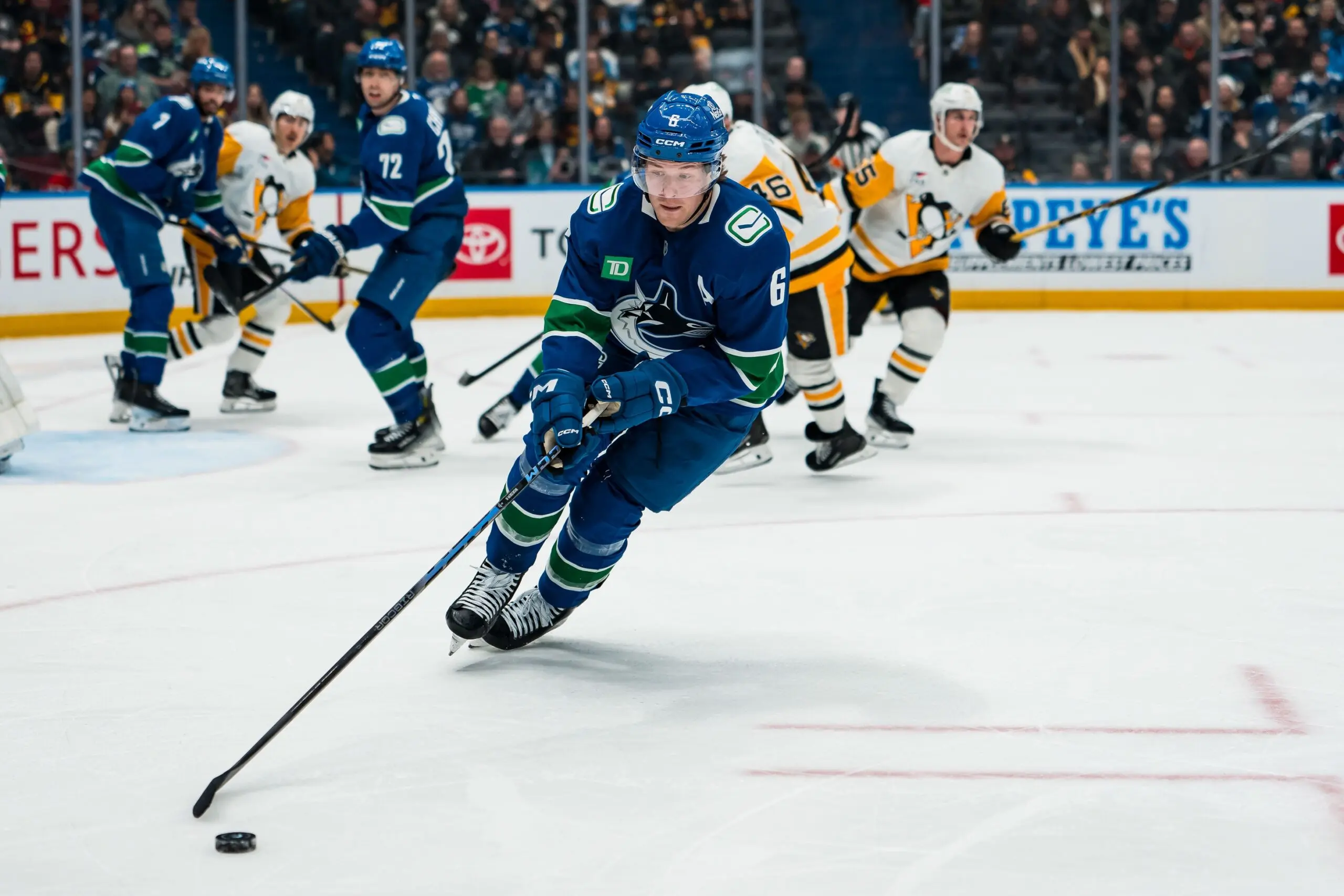
Photo credit: © Bob Frid-Imagn Images

Feb 16, 2026, 13:33 EST


The Brock Market has hit historic lows this season. And we’re not just saying that for the sake of a good pun.
In a season in which the Vancouver Canucks have collectively tanked as a team, it’s arguable that no individual’s performance has tanked quite so badly as has Brock Boeser’s. He headed into the Olympic Break with just 12 goals and 25 points in 50 games, putting him on pace for just 19 goals and 41 points – easily the slowest pace of his career thus far, going all the way back to his rookie campaign.
And yet, we’ve still heard a lot of different things when it comes to Boeser’s future in Vancouver. If we’re sticking with our motif here, the Brock reports have been inconsistent, at best.
We’ve heard that Boeser’s brand-new contract extension, combined with the performance that has followed, makes him a non-moveable asset, or at least an asset that the Canucks would have to pay to move.
Other reports aren’t so sure about the negative value angle, but suggest that Boeser is a veteran the Canucks would prefer to hang on to.
And still other reports have Boeser, along with Conor Garland, as the Vancouver veteran “most likely” to be moved before the March 6 Trade Deadline, with this last opinion coming from Thomas Drance of The Athletic.
So where does the truth lie? Are the Canucks really stuck between a Brock and a hard place?
It’s not hard to see where the ‘Boeser now has negative value’ crowd is coming from. This season of career-worst production comes directly after Boeser signed a seven-year, $7.25 million AAV extension on the precipice of free agency.
The contract essentially amounted to a non-raise, once NHL inflation was factored in, but then it was expected that Boeser would, at the very least, maintain his traditional numbers until further inflation brought his cap percentage as the years wound on. But here we are in Year One of the deal, and Boeser already appears to have fallen off a cliff.
One has to imagine there are teams out there that were prepared to offer Boeser a significant contract this summer, and who are now breathing sighs of relief that they did not. Anyone trading for Boeser now has to be comfortable having him on the books at $7.25 million from now until 2032. They’d have to be fine committing to him from age 28 right through to 35. That’s a big ask, and it’s easy to understand if the answer is ‘no’ given Boeser’s current returns.
But what if that’s not quite the case. What if there might still be some interest in Boeser from around the league, even if it’s only minor or passing interest?
A way to frame this question that might make particularly contextual sense to a Canucks fan is this: why is Garland considered so moveable, and Boeser is not?
Garland is almost exactly one year older than Boeser. He, too, signed an extension this summer, and his doesn’t kick in until 2026-27, so its six years will run until 2032, too.
And just like Boeser, Garland followed that extension up with some uncharacteristically low production. He started off well enough, with 11 points in 11 games to start the season, but he’s only got 14 points in the 35 games since. Garland sits at just seven goals and 25 points through 46 games, which paces for 12 goals and 44 points across a full 82-game schedule. In other words, he’s pacing for about the same as Boeser is.
And while Boeser has come on a bit lately – with eight points in 13 January games before suffering another cheapshot-induced concussion – Garland remains ice-cold, with literally zero January points of his own.
Why then, are some suggesting the Canucks could get up to a first round pick back for Garland, but would have to pay to get rid of Boeser? Something isn’t quite adding up here.
Boeser is the younger of the two. If we had to predict whose game might age better, that distinction probably goes to Garland. But then Boeser has always played a game that does no rely on speed, so maybe there’s less risk of a slow-down with him.
Garland certainly plays the game with more pace, and brings more intangibles to the table, especially when it comes to defensive coverage – even if that hasn’t exactly been on display in 2025-26.
But while Garland has the competitive edge, at least as far as the eye-test is concerned, it has to be said that Boeser has the much better postseason track record. He’s notched 11 goals and 23 points in 29 playoff games in his career, whereas Garland has just seven points in 21.
Boeser has a well-earned reputation as a clutch goal-scorer, especially in the playoffs (or when the Nashville Predators are the opponent).
There is a salary discrepancy, but it’s not that extreme. Boeser is set to make $1.25 million more per season for the next six years than Garland. As it stands, Garland is paid about average second-line compensation. Within a few years of inflation, Boeser’s salary will be there. Is that $1.25 million gap really enough to swing the value from ‘potential first’ to ‘no value whatsoever’? Especially when Boeser’s career PPG (0.76) remains a fair bit higher than Garland’s (0.60)?
We’re not so sure. A quick look around the league shows that cap space is as abundant as it has ever been, while goal-scoring remains at a premium. A full 18 of 31 other NHL teams have enough current cap space to add Boeser’s $7.25 million hit to their rosters without any subtractions, and that number will grow by deadline time. If teams want to add some goal-scoring to their mix before this 2026 Deadline, then Boeser will be an affordable option for most of them – at least as far as this season itself is concerned. But then, as inflation continues and the cap ceiling continues to skyrocket, Boeser’s contract becomes an easier-to-swallow percentage of the cap with each passing year thereafter.
All they’d be betting on is that A) Boeser has a couple more decent, bounceback-ish seasons left in him and B) by the time he really falls off, his cap hit will have become comparatively manageable. One can imagine at least a team or two willing to take that bet to get an edge in these ultra-close 2025-26 standings.
The fact of the matter is that worse players that Boeser will get bigger contracts in free agency soon enough. If not this offseason, then by next offseason. The teams that might be most attracted to the idea of trading for Boeser might be those teams who traditionally struggle to draw in free agents of their own, and who might need to instead focus on UFAs already signed by other teams.
With that in mind, however, we have to mention that Boeser holds a full no-movement clause in this season and for the next three seasons running. Boeser only moves if he wants to move, and that could take any of those less desirable destinations firmly off the table.
That’s about as far as we can take the “could” question today. We think the declarations of Boeser having suddenly developed truly negative value in a single half-season, with his team collapsing around him, are decidedly overstated. But with that said, the length of commitment required to trade for Boeser, and the existence of that NMC, are definitely enough to make a trade incredibly difficult to pull off, and probably preclude Boeser from being “most likely” to be moved by the Trade Deadline.
That brings us to “should.” Let’s take that negative value option out of the equation right away. The Canucks have no reason to pay to ditch Boeser at this point, or at any point soon. If he really is negative value, he won’t be traded, simple as that.
But let’s imagine that there is at least one team out there willing to take Boeser on without being paid to do so – or, perhaps, even willing to pay a mid-round pick for the privilege – and that Boeser agrees to go there. Is now the time to pull the trigger?
That all comes down to a bet, and it’s the same one being asked of potential trading partners. Is this truly a cliff that Boeser has fallen off? Or is this just a bad season that will be rebounded upon, at least to some extent?
Boeser had paced for a 30-goal season in most of his seasons prior to this one. He’s 28 years old, and will turn 29 in a couple of weeks. What you’ve got to ask yourself – or, what GM Patrik Allvin and Co. have to ask themselves – is if they believe Boeser has a better season or two left in him. And given his history of production, and the fact that he hasn’t quite aged out of his prime years yet, the odds of that seem pretty high.
The question then becomes whether or not trading Boeser later, somewhere down the road amidst a more productive campaign, might be the more lucrative option. If Boeser can get you a fourth round pick today, but could get a couple of seconds in the middle of a 30-goal season next year, is it worth the risk to wait that long?
The real answer may lay in the latter years of Boeser’s contract. No one knows quite how long a Canucks rebuild might take, but one has to hope they’re at least moving toward a more competitive state within about five or six years.
At that point, Boeser will be in his mid-30s. At that point, he likely will have fallen off some sort of production-based cliff. Sure, his $7.25 million cap hit will represent a smaller percentage of the cap at that point, but it will never be chump change.
It could be that Boeser’s contract extension becomes most onerous, and gets the most in the way, at right about the time that the Canucks need cap space in order to sign extensions for their current youth movement – the Zeev Buiums, the Tom Willanders, the Braeden Cootes, the [INSERT 2026 DRAFT PICK HERE]s.
There’s an element of ‘getting out’ of the Boeser contract here now that the window has decidedly shifted, and maybe that surpasses any possibility of getting more for Boeser a season or two into the future.
Could the Canucks trade Boeser? The answer is probably “yes.” Should the Canucks trade Boeser? The safest answer to that is probably also “yes.” But will the Canucks trade Boeser? For now, the power to decide that is entirely in Boeser’s own hands.
Sponsored by bet365


Breaking News
- Former Canucks captain Quinn Hughes speaks ahead of return to Vancouver
- How Canucks’ Cootes is doing compared to other 2025 first-round picks playing in the AHL
- Scenes from practice: Pettersson and Boeser reunited as Canucks skate at UBC on Saturday
- Abbotsford Canucks preview: Players to watch in weekend rematch with the Wranglers
- How the Canucks can fix their early-season defensive breakdowns

Vancouver CanucksTeam Cap Summary

Cap Summary
2026-27
2027-28
Projected Cap Hit
$87,295,050
$71,329,167
Projected Cap Space
$16,704,950
$42,170,833
Current Cap Space
$19,176,096
$42,170,833
Active Players
23/23
13/23
Draft Picks
Round
'27
'28
1
1
1
2
2
2
3
1
1