
CanucksArmy has no direct affiliation to the Vancouver Canucks, Canucks Sports & Entertainment, NHL, or NHLPA
How does the Flames’ rebuild compare to the Canucks’ so far?
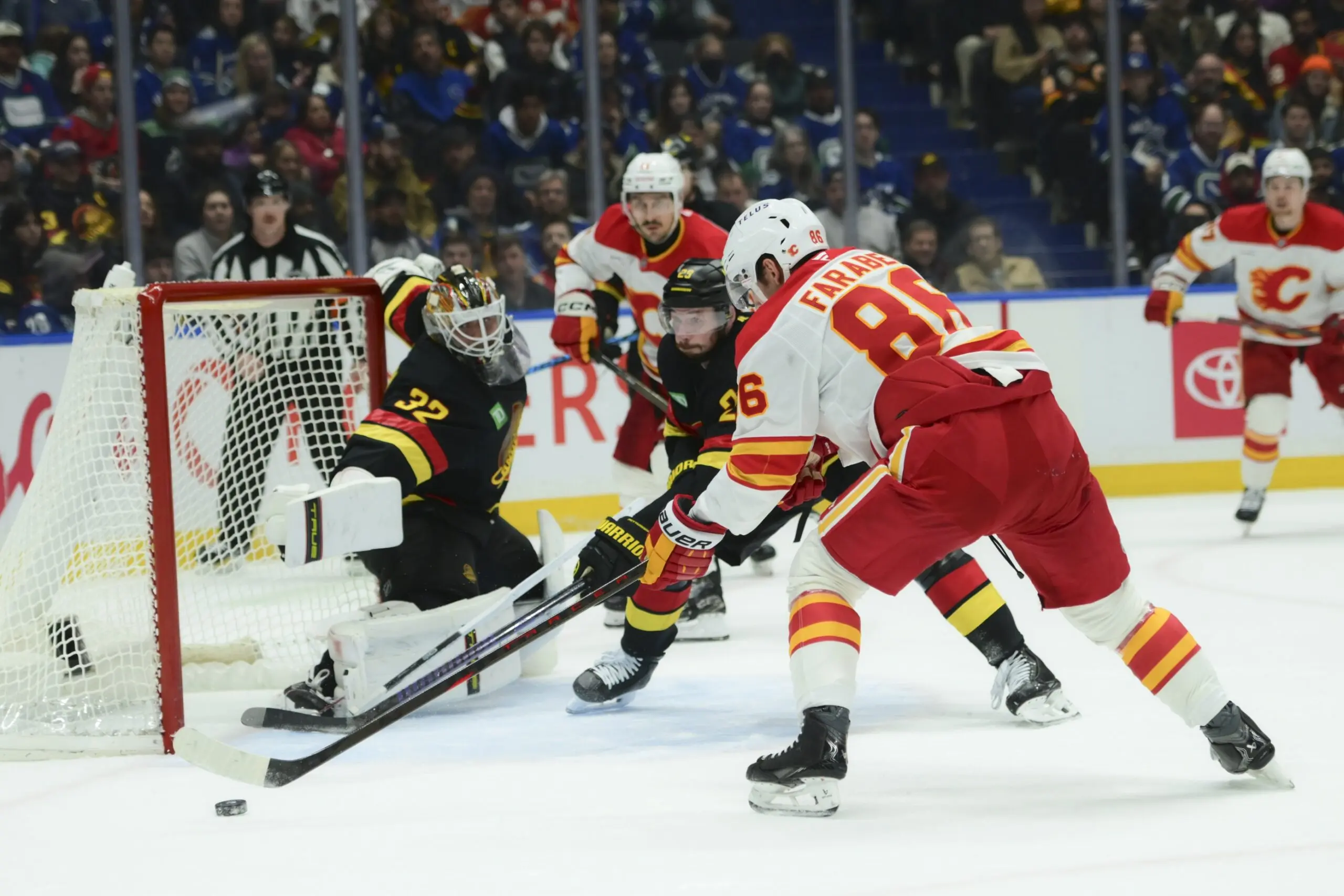
Photo credit: © Simon Fearn-Imagn Images

Jan 21, 2026, 12:00 ESTUpdated: Jan 21, 2026, 05:26 EST


The Vancouver Canucks are no longer the only rebuilding show in Western Canada.
The Calgary Flames have been stuck in a bit of a competitive no-man’s land for the past couple of seasons, not terribly dissimilar to the Canucks. But, as has been the case with the Canucks, a direct lack of success in 2025-26 has woken the Flames up to the reality of their situation. And now, with Sunday’s trade of pending UFA Rasmus Andersson to the Vegas Golden Knights, the Flames would appear to be officially entering a rebuild of some sort of their own.
In other words, the Canucks may not be focused on being competitive right now, but that doesn’t mean they don’t have competition.
The timeline is not exactly parallel here. The Canucks came into 2025-26 with some delusions of contention. The Flames, meanwhile, finished ahead of the Canucks in the 2024-25 standings, but have seemed to be slowly heading in this direction for a while, with the trades of veterans like Noah Hanifin, Jacob Markstrom, Chris Tanev, and Tyler Toffoli over the past few years.
But now, within the 2025-26 season, both Pacific Division rivals have really kicked off a rebuilding process with the trade of a major defender. That makes for a convenient point of comparison to look at which rebuild has accomplished the most so far, and which is set up for more success in the future.
We’ll be looking at three key categories here: under-23 players, draft picks, and tradeable assets.
Under-23 players
Both the Canucks and Flames begin their rebuilding process without that true, better-than-blue-chip franchise asset on hand, but with a fine stable of under-23 players all the same.
The Flames are led in this regard by 19-year-old RD Zayne Parekh, who recently set some new scoring standards at the World Junior Championships. He’s joined on the roster by the 19-year-old Matvei Gridin, the 21-year-old (but injured) Samuel Honzek, and the 21-year-old Hunter Brzustewicz. In the system, they’ve got a couple of notable 18-year-old centres in Cole Reschny and Cullen Potter.
As we mentioned, the Flames have been at this a little longer than the Canucks, in terms of selling off pieces, and they’ve benefited from extra draft selections as a result. They’ve made five first-round picks in the past three drafts, as compared to the Canucks’ two.
But then the under-23 stocks are probably more even than they should be, given the circumstances. The Canucks can stack a fine top-six of their own against Parekh, Reschny, Gridin, Potter, Honzek, and Brzustewicz with Zeev Buium, Tom Willander, Braeden Cootes, Liam Öhgren, Jonathan Lekkerimäki, and the younger Elias Pettersson.
If we were to sort that list of 12 in order of general future NHL potential, it’d probably go:
Buium, Parekh, Willander, Cootes, Reschny, Gridin, Potter, Öhgren, Lekkerimäki, Honzek, Pettersson, Brzustewicz.
The Canucks’ set is probably more top-heavy and contains a bit more star-power, whereas the Flames’ set has a bit more depth in the middle. Either way, they’re very comparable lists.
Where the Flames have a notable leg up is just outside the under-23 range. The Canucks don’t really have a difference-maker in that next 23-26 zone, aside from perhaps Marco Rossi as a potential 2C. The Flames, on the other hand, have the 24-year-old Dustin Wolf in place as a star goalie for the next decade. That’s a significant difference, and while the Canucks have some good young goalies of their own in the system in Aleksei Medvedev and Nikita Tolopilo, they sure don’t have a Wolf.
That said, the Canucks do have an advantage if we really expand our vision to include anyone on the roster who might feasibly still contribute on the other end of a rebuild. They’ve got two major players of note in 27-year-old Elias Pettersson and 28-year-old Filip Hronek, each of whom can theoretically play major roles for the foreseeable future. The Flames’ key vets, on the other hand, are all much older.
Draft Picks
The Flames have made more picks over the last couple of years than the Canucks, and that trend might continue. As it stands, the Flames have two first-round picks in each of the next two drafts: their own two, the Golden Knights’ 2026 pick from the Hanifin trade, and the Golden Knights’ 2027 pick from the Andersson trade. If the Knights win the Cup this year, the Flames will add another Vegas first-rounder, but for now, it’s just a second. That gives the Flames five second-rounders over the next three drafts.
The Canucks, meanwhile, also have two picks in the upcoming first round, their own and the Minnesota pick acquired in the Quinn Hughes trade. It is hoped they can acquire more. But for now, they’ve only got their own firsts in 2027 and 2028. The Canucks have also already traded away their 2027 second-rounder in the Ilya Mikheyev dump of 2024, but now they’ve got the Sharks’ 2026 and 2027 seconds to more than make up for it.
If we’re keeping score on ‘picks in the top-60 of the next three drafts,’ it’s 9-8 in favour of the Flames, and 5-4 if we’re talking just the first rounds.
A key point to make is that, for both the Canucks and Flames, their top asset – and soon to be the player at the top of that under-23 chart – is their 2026 first-round pick. Both teams look very likely to draft within the top five. Currently, it is the Canucks who are slated to draft higher, but the rest of the regular season or the lottery could change that quickly.
If the Flames had a head start when it came to adding young players to the roster, it does not appear that they’re going to give that lead up anytime soon, at least in terms of quantity. So, the Canucks are already playing a form of catch-up, but thankfully, they’ve got one last advantage in our final category of comparison.
Tradeable Assets
The Canucks, for the time being, would seem to have more to give.
Vancouver has a good number of pending UFA pieces that should yield pick-based returns, ranging from two second-round picks (specifically Kiefer Sherwood) to the mid rounds (Evander Kane) to the late rounds (Teddy Blueger, David Kampf).
Collectively, they might add up to the equivalent value of the extra first-round pick the Flames are currently holding over the Canucks in the upcoming drafts.
But the Canucks also have more non-UFA pieces of interest around the league than do the Flames.
The Canucks could, and are reportedly considering, selling off any number of veterans. Folks like Conor Garland, Marcus Pettersson, Drew O’Connor, Jake DeBrusk, and Tyler Myers could all return decent-to-good pick packages if shopped around the league. Then there are the truly big-ticket items, like Hronek and the other older Pettersson, who could yield large returns under the right circumstances, but who may not be outright sold.
Compare that to the Flames’ stable of sellables. They’ve got Nazem Kadri, sure, but he’s 35 and reportedly does not want to move. They have Mackenzie Weegar as perhaps their top asset, but he pales in comparison to, say, Hronek. They even have their own overpaid former superstar in Jonathan Huberdeau, but he seems much trickier to move and much less potentially valuable than Pettersson. At every turn, the Canucks have a lot more to sell than the Flames do, and if they play their cards right, that should allow them to catch up on the additional assets Calgary has built up over the last couple of years of trading.
From that point onward, who knows? The lead in this rebuild race will probably be determined by who gets the higher picks in 2026 and 2027, and then how the players selected in those drafts develop from there. For now, the two teams are in startlingly similar positions.
Sponsored by bet365


Breaking News
- 10 statistics that stand out from the first 10 Canucks games
- Could the Vancouver Canucks and Ottawa Senators hook up on an in-season forward trade?
- The Statsies: Canucks dominated at 5v5 in 4-2 loss to Lightning
- The Stanchies: Prime Lankinen returns, Canucks still go winless on road trip with 4-2 loss to Lightning
- Instant Reaction: Canucks give up four unanswered goals in 4-2 loss to Lightning

Vancouver CanucksTeam Cap Summary

Cap Summary
2026-27
2027-28
Projected Cap Hit
$87,295,050
$71,329,167
Projected Cap Space
$16,704,950
$42,170,833
Current Cap Space
$18,413,411
$42,170,833
Active Players
23/23
13/23
Draft Picks
Round
'27
'28
1
1
1
2
2
2
3
1
1