
CanucksArmy has no direct affiliation to the Vancouver Canucks, Canucks Sports & Entertainment, NHL, or NHLPA
How does the Brady Tkachuk trade return compare to what the Canucks got back for Quinn Hughes?
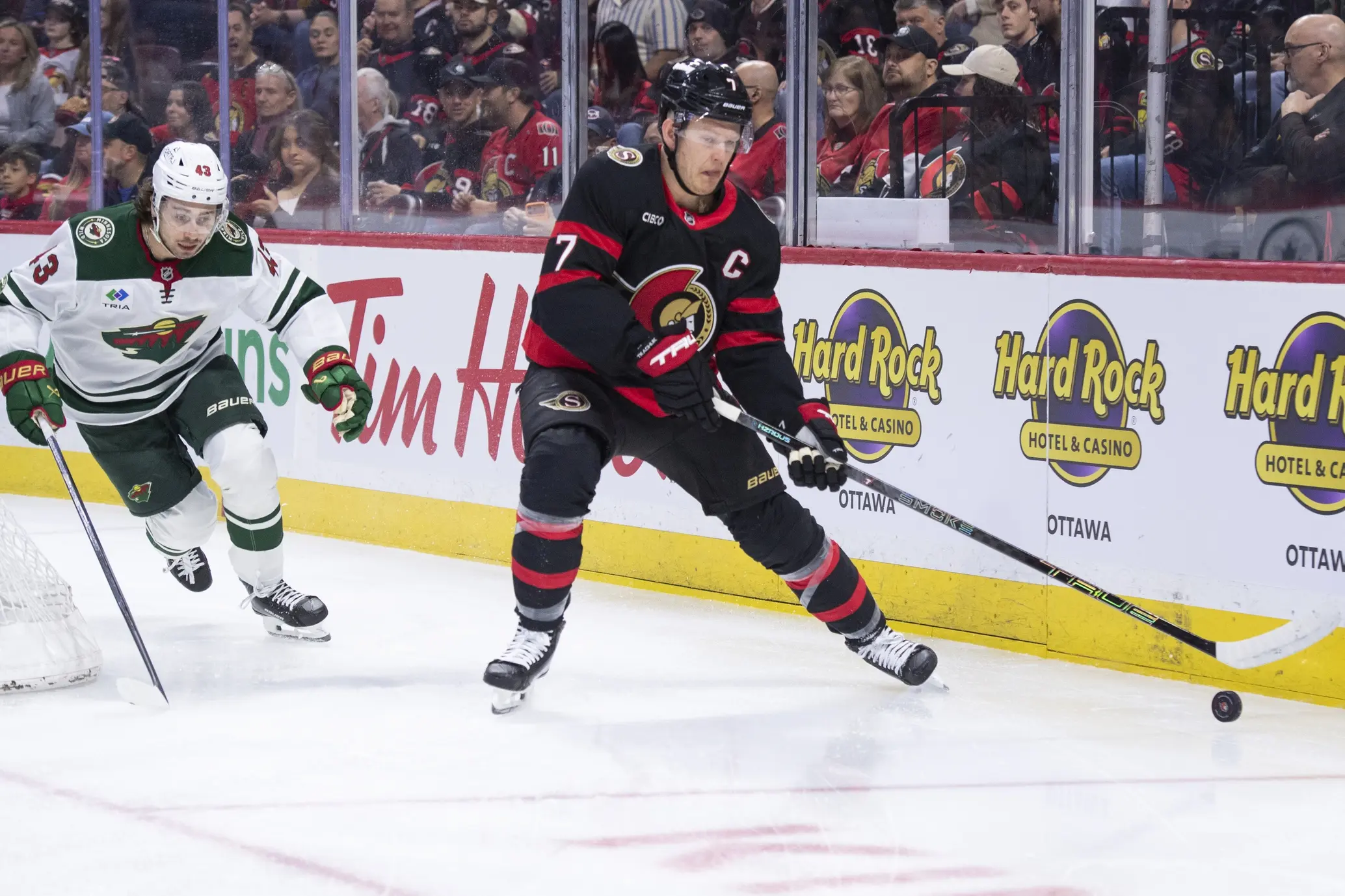
Photo credit: © Marc DesRosiers-Imagn Images

Jun 22, 2026, 12:00 EDTUpdated: Jun 22, 2026, 19:32 EDT


The trade that sent Quinn Hughes from the Vancouver Canucks to the Minnesota Wild this past December remains the biggest blockbuster of the past year. But we’ve now had our biggest blockbuster since, and the news broke on Sunday evening.
The Ottawa Senators dealt their own captain, Brady Tkachuk, to the Florida Panthers, where he’ll join his brother Matthew on what has become far and away the most annoying roster in recent NHL history. In return, the Senators got back the ninth and 25th overall picks in this upcoming 2026 Entry Draft, along with a top-10 protected first rounder from 2029 and a second rounder from 2027. All told, it’s three firsts and a second for Tkachuk.
It makes a lot of sense to compare these two trades. Hughes and Tkachuk were born about a month apart, are long-time friends, and were drafted within three picks of one another, at fourth and seventh overall in the 2018 Draft. Both were captains of their Canadian clubs with two seasons (or parts of two seasons, in Hughes’ case) left on their contracts at the time of their trades. Both had informed their teams that they were not particularly interested in re-signing when those contracts ran out, all but guaranteeing they’d be dealt.
Now, there are some key differences, with the most important being that Hughes was and is a better player than Tkachuk. No matter how one distinguishes their tiers of NHL players, they’re sure to have Tkachuk at least one rung below Hughes. That said, Tkachuk is at the very least a superstar in his own right, and one won’t find too many better comparables for the Hughes trade out there.
Comparing the two trades head-to-head is also surprisingly easy to do, because in the end, both of them returned exactly four future-based assets. And comparing the returns head-to-head is exactly what we’re here to do today. Mostly for fun, but also to give a bit of context to how the Canucks did, comparatively, when faced with the same situation as the Sens.
The comparison starts with each trade’s most valuable piece, and there’s not too much debate about which pieces those are currently. The centrepiece of the Canucks’ return was Zeev Buium, skating in his rookie season at 20 years old. The centrepiece of the Senators’ return – at least for now – is the ninth overall pick in the upcoming draft.
Buium’s selection by the Wild came at a slightly later spot, at 12th overall in the 2024 Draft. Then again, that was generally considered to have been a better draft class than the upcoming one, so the 12th overall then is already fairly close to the ninth overall today.
On top of that, Buium has developed very quickly and very well post-draft. He debuted in the 2025 playoffs for the Wild to rave reviews and has, at various points, been named a top-10 under-23 talent in the NHL. Sure, some of that shine came off due to some understandable growing pains after arriving in Vancouver, but that doesn’t change much about his value.
Given the additional certainty Buium’s development brings to the table, we hope it’s not too controversial to suggest that, as of now, he’s the more valuable asset than the ninth overall. However, that could obviously change depending on what Florida does with that pick itself.
The easiest comparison we’ll make is between the two other 2026 first-rounders. The Canucks got what has turned out to be the 24th overall pick from the Wild as part of their trade, though it hadn’t been locked into that placement yet. The Senators just got back the 25th overall pick, exactly one spot later. So, clearly, the Canucks got the more valuable asset here, but only by the thinnest of possible margins.
The rest of the head-to-head matchups get a little trickier. The most valuable remaining assets on either side of the trade are definitely centre Marco Rossi for the Canucks, and that top-10 protected first-round pick in 2029 for the Panthers. But how do those two assets compare to one another?
Rossi was himself the ninth overall selection back in 2020. On the one hand, he’s developed fairly well since then, having hit a high of 60 points in his first full NHL season of 2024-25. On the other hand, Rossi has had that development hampered by illness and injury, and his size has been seen by some as a limiting factor.
The top-10 protected 2029 first is tough to gauge in value because it could wind up falling pretty much anywhere. It is top-10 protected, yes, but that only means that if the pick falls within the top 10 of the 2029 draft, it will transfer to an unprotected 2030 first-round pick.
And that could be a fairly lucrative piece. Brady Tkachuk himself will be hitting 30 that year, and he’s one of the younger members of the Panthers core at this point. His brother Matthew will be 32, Aleksander Barkov, Sam Reinhart, Aaron Ekblad, Gustav Forsling, and Sam Bennett will be 34, and Seth Jones will be 35. Brad Marchand will be a whopping 42 and still under contract until 2031.
What we’re saying is that the Panthers’ competitive window may very well have slammed shut at that point. The 2029 first thus stands a good chance of either ranking close to a top-10 pick in that year, or of sliding to an unprotected pick in 2030, which could reasonably be an incredibly high one – perhaps even a lottery pick if the Panthers really fall off hard.
That’s all, a little far into the future to predict with any certainty. So, under the classic principle of a bird in the hand being worth two in the bush, we’d suggest that Rossi is currently the more valuable asset between the two, but only for now. By the time we actually get to 2029, that could change. And there’s definitely an argument to be had about which type of asset is truly most valuable to a rebuilding franchise.
The last two pieces to compare are Liam Öhgren for the Canucks and a 2027 second-round pick for the Senators. Öhgren was himself a first-rounder, picked at 19th overall in the 2022 Draft. But he didn’t exactly trend positively from there, and by the time of his trade to Vancouver, he’d accomplished just seven NHL points in 46 games across three seasons for the Wild.
Öhgren’s overall value had definitely taken a hit, but how much of one? Probably not enough to drop him down to the equivalency of what should be a later Panther second round pick in next year’s draft. Once again, the Canucks would seem to have at least a slight edge on this head-to-head, at least for now, and this one seems likely to stick, too.
Put them one after another, and it’s hard not to like how the Canucks’ side of things compares to the Senators’. Buium is probably more valuable than the ninth overall, so far. The 24th overall obviously beats out the 25th. Rossi is a more valuable piece than the undetermined 2029/2030 for the time being, though that could change. And Öhgren was and certainly is more valuable than a late second.
We must acknowledge that such head-to-head comparisons are a little impractical, and that every trade is unique, and comes from a set of unique circumstances, and so on. At the same time, one can’t help but feel that the Canucks ultimately did very well for themselves in the return for Hughes. At the very least, they seem to have come out well ahead of the Senators from a very similar situation, and that’s not for nothing.
Sponsored by bet365


Recent articles from Stephan Roget
Breaking News
- Canucks and their fans hit a home run honouring John Garrett on Cheech night
- What are the Canucks’ expiring UFAs worth in a trade now, and where might they be by the deadline?
- ‘Same story again’: Canucks’ Pettersson and Sasson express frustration after losing streak extends to eight
- The Stanchies: Hot dogs fall from the sky as Canucks fall 6-3 to the Hurricanes
- Instant Reaction: Canucks’ penalty kill perfect in 6-3 loss to Hurricanes

Vancouver CanucksTeam Cap Summary

Cap Summary
2026-27
2027-28
Projected Cap Hit
$87,295,050
$71,329,167
Projected Cap Space
$16,704,950
$42,170,833
Current Cap Space
$18,732,718
$42,170,833
Active Players
23/23
13/23
Draft Picks
Round
'27
'28
1
1
1
2
2
2
3
1
1