
CanucksArmy has no direct affiliation to the Vancouver Canucks, Canucks Sports & Entertainment, NHL, or NHLPA
How contracts like Jake DeBrusk’s have gained relative value after another round of free agency
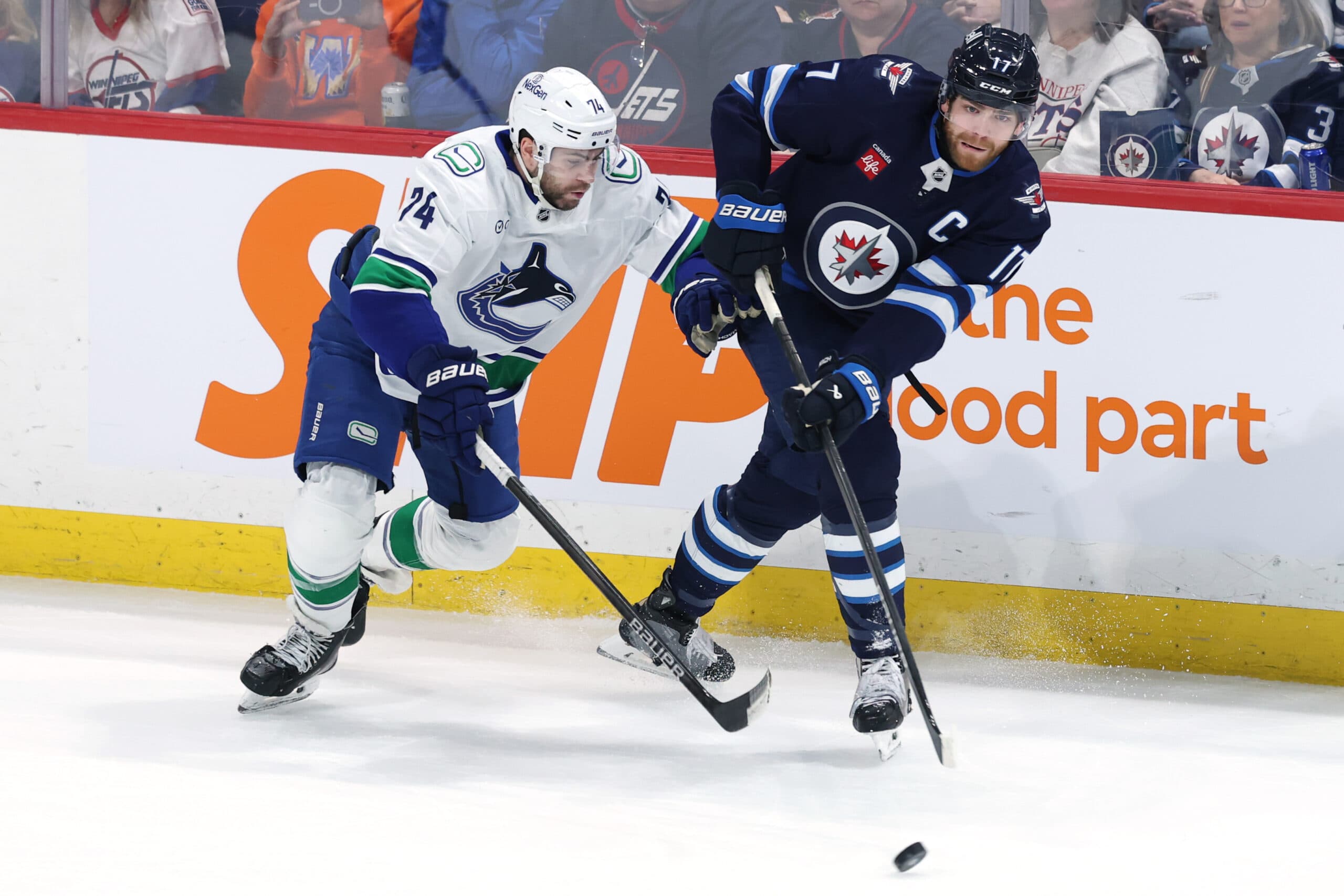
Photo credit: © James Carey Lauder-Imagn Images

Jul 29, 2026, 12:00 EDTUpdated: Jul 29, 2026, 11:41 EDT


The NHL salary cap has been going through a growth spurt lately. After the cap ceiling had been frozen at $81.5 million for three straight years from 2019-20 through to 2021-22, the league exited the ‘flat cap era’ with a modest increase to $82.5 million as of 2022-23. The next year, it went up to $83.5 million. The year after that, it went up to $88 million, an increase of 5%. The year after that, last season’s 2025-26 campaign, the ceiling climbed to $95.5 million for a further increase of 8.5%. And now, for the upcoming 2026-27 season, the cap ceiling is set at $104 million, a further increase of 9%.
Put all that together, and from 2020 to present, the cap ceiling has expanded from $81.5 million to $104 million in the span of just five offseasons. That’s an increase of 27.6%, which means that the amount of available cap space in the league has increased by almost an extra third.
It’s easy enough to look at numbers like that and understand why the league has undergone a period of salary inflation on a conceptual level. And it’s also easy enough to look at some of the extreme after-effects, like $18 million contracts, and see that inflation in action.
But to really see the impact on the day-to-day value of the average NHL contract, one has to dive a little bit deeper into the facts and figures. For that, we need an example, and today, we’re going to use Jake DeBrusk for that purpose.
Why DeBrusk? Four reasons. For one, he signed his current contract back in 2024, right before three subsequent years of massive cap increases really kicked the inflation into high gear, and as such he’s a good benchmark for change. For two, his $5.5 million cap hit is getting fairly close to the NHL’s average, which should climb past $4 million sometime in the next year or so. DeBrusk represents a nice, middle-of-the-road comparable.
For three, DeBrusk may be inconsistent and streaky on a day-to-day basis, but his yearly statline has been quite consistent, with him having scored at least 19 goals and 40 points in each of his past five seasons. Thus, as an actual on-ice player, DeBrusk’s value hasn’t gone too much up or down.
And for four, DeBrusk remains very much on the trade block, and so his relative trade value is of interest beyond our thought experiment here.
With our example selected, we can begin, and we’ll start with something fairly simple: cap percentage. It’s often been said that NHL fans and media alike would do better to focus more on cap percentages than they do raw cap hits, as in the percentage of the total cap ceiling that a contract takes up when signed, and how that percentage tends to shrink over time.
When DeBrusk signed his seven-year, $5.5 million UFA contract with the Canucks in July of 2024, he was signing under an $88 million cap ceiling. At that point, his contract took up 6.25% of the available cap.
The next year, with the cap up to $95.5 million, DeBrusk’s cap percentage shrunk to 5.76%. And for next season, with the cap going up to $104 million, DeBrusk is set for a cap percentage of just 5.28%.
Now, to the untrained eye, that’s a difference of just under 1% from Year One to Year Three, and who really cares about 1%? But if we’re sticking with percentages, DeBrusk’s personal share of the cap has decreased by almost 20%. He’s thus one-fifth less costly, relatively speaking, than he was at the start of his contract, and that might reasonably mean he is one-fifth more valuable.
Unfortunately, that would be a bit of an oversimplification, if for no other reason than the fact that the NHL’s inflation has not been evenly applied across its entire salary structure. As is almost always the case in life, the rich have got richer, and an excess amount of the extra cap space available has gone to players near the top of the earnings chart – like the aforementioned Leo Carlsson and his $18 million offer sheet.
So, let’s try to look at it a different way. In 2023-24, DeBrusk’s last season with the Boston Bruins, he scored 40 points. That tied him for 157th in league scoring among forwards (with future teammate Marco Rossi, for the record).
He then signed that contract with the Canucks for $5.5 million, and entered the next season, 2024-25, in a tie for the 103rd highest cap hit among forwards. By that measure, DeBrusk’s compensation was a little high compared to his relative output, but then that’s perhaps to be expected of a freshly minted UFA contract.
In his first season with the Canucks, DeBrusk notched 48 points, two off his career high. That put him in a tie with Kyle Palmieri and Andrei Svechnikov for 122nd overall among NHL forwards, a decent climb from the previous season. At the same time, other contracts being signed around him slid DeBrusk down to a tie for the 108th highest cap hit among forwards in the league.
Without him changing his output much, and with his contract set in stone, already the two numbers were getting close to one another.
Which brings us to the present day. DeBrusk scored 42 points last year, a step down, but right in line with his career average. Those 42 points ranked him in a tie for 153rd place among forwards in 2025-26, right around where he was two seasons ago.
Now, heading into the 2026-27 season, DeBrusk is set to be tied for the 126th-highest cap hit among forwards, and tied with 12 other players, at that, which makes for a range from the 126th to the 138th highest cap hits.
In other words, within two seasons of inflation, DeBrusk has gone from his salary-ranking far outpacing his production-ranking to the two numbers being nearly even. Factor in that a number of the players producing more and making less than DeBrusk are players on entry-level contracts, with their salaries artificially capped, and the conclusion has to be that DeBrusk has gone from at least slightly-overpaid to making pretty much exactly what he should in just two offseasons’ worth of inflation. (And, yes, there is more to determining a fair salary than just production, but it is by far the biggest determinant, especially for forwards.)
One can’t help but feel like, as a result of that, DeBrusk has gained relative value over the course of his contract, and that probably includes trade value, too.
Of course, this inflationary process doesn’t stop here, either. The NHL’s cap ceiling is predicted to climb up to $113.5 million for next season, which would be a further increase of 9.1%, the largest yet.
With DeBrusk just 29 years old, and likely to maintain that 20ish-goal, 40ish-point average for at least the next few seasons, that should mean that his contract will make the full transition from a standard UFA overpay to a somewhat bargain value by some point in 2027.
That’s just not the way in which we’re used to seeing UFA contracts age. But this is a new era of NHL hockey, and it’s an era that will come to be defined by inflation. That’s good news, value-wise, for any of those long-term contracts already signed by the Canucks, and we might say especially for DeBrusk’s, who finds himself increasingly in the middle-ground of NHL salary.
It just might not as good of news for all those contracts the Canucks have yet to sign with their upcoming, youthful new core…
Sponsored by bet365


Breaking News
- The Stanchies: Prime Lankinen returns, Canucks still go winless on road trip with 4-2 loss to Lightning
- Instant Reaction: Canucks give up four unanswered goals in 4-2 loss to Lightning
- Canucks: D Elias Pettersson’s impressive start is more than just passing the eye test
- What’s behind Marco Rossi’s seven-game scoring drought for the Canucks?
- Canucks Game Day: Looking to close out lengthy road trip with a win vs. Lightning

Vancouver CanucksTeam Cap Summary

Cap Summary
2026-27
2027-28
Projected Cap Hit
$87,295,050
$71,329,167
Projected Cap Space
$16,704,950
$42,170,833
Current Cap Space
$18,413,411
$42,170,833
Active Players
23/23
13/23
Draft Picks
Round
'27
'28
1
1
1
2
2
2
3
1
1