
CanucksArmy has no direct affiliation to the Vancouver Canucks, Canucks Sports & Entertainment, NHL, or NHLPA
With a condensed January schedule ahead, Canucks should consider trading early to avoid further injuries
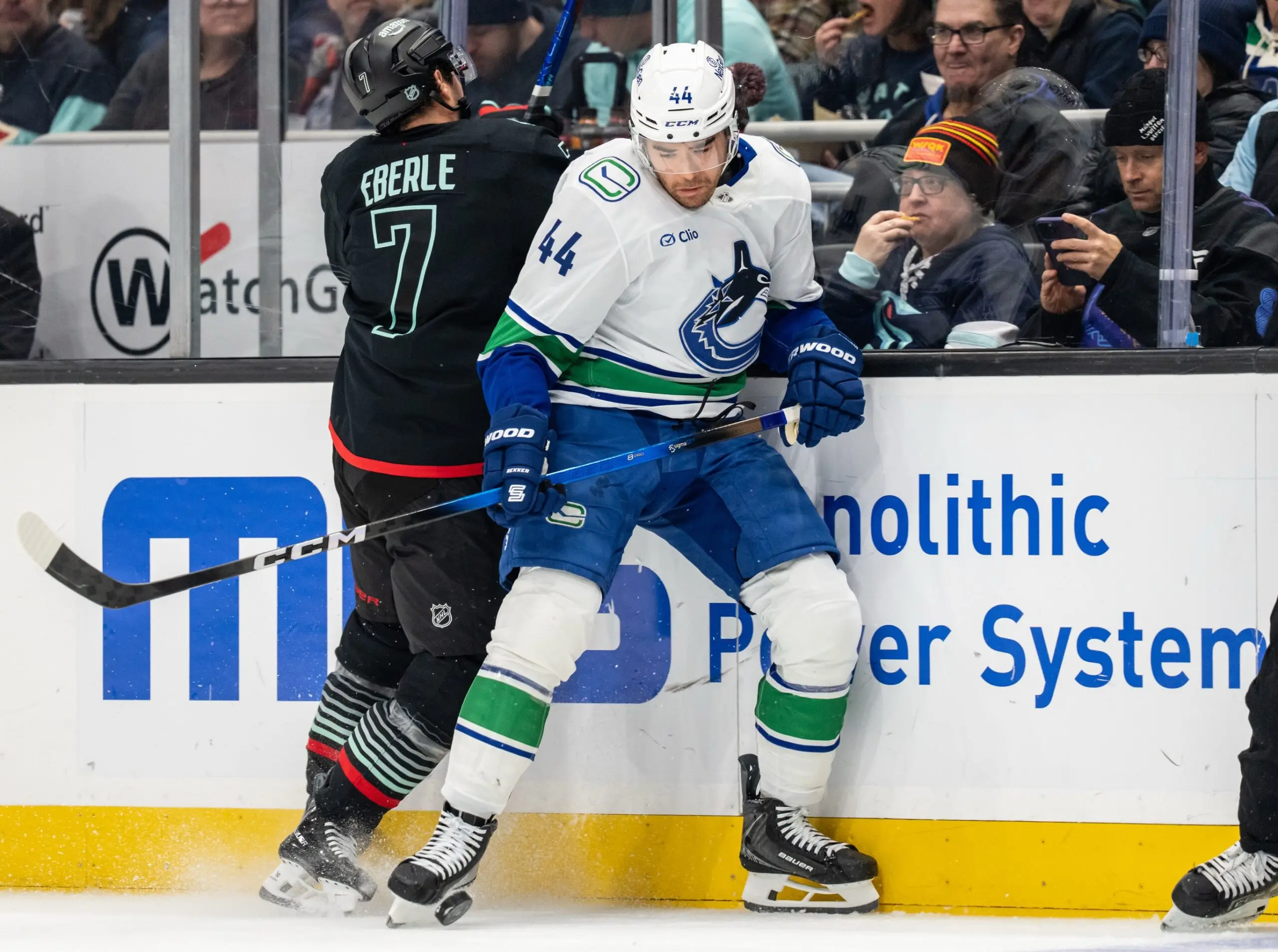
Photo credit: © Stephen Brashear-Imagn Images

Jan 2, 2026, 14:02 EST


The Vancouver Canucks learned this week that they would be without forwards Conor Garland and Marco Rossi for “at least a week,” if not longer. Now, normally, when a team is down a couple of players, the last thing it wants to do is trade more. But the situation might be the exact opposite for the 2025-26 Canucks.
These injuries should serve to remind them that there are plenty of things that can get in the way of a pending trade – and hopefully give them a bit of a push to get their selling done sooner, rather than later.
Facing an extraordinarily condensed schedule in January, the risk of an injury suddenly and permanently scuppering plans for a trade is higher than ever, and that must be considered as the team makes decisions.
We are, of course, primarily talking about the Canucks’ pending UFAs here – meaning Kiefer Sherwood, Evander Kane, David Kämpf, and if he recovers from his current injury soon enough and doesn’t obtain another, maybe Teddy Blueger, too. These are the players with whom, if the Canucks miss their chance to cash in, they will not receive another. Each of these players will be able to walk at the end of the season if not traded.
It’s an opportunity to add future assets that cannot be wasted, and acting sooner rather than later is one way to avoid any wasting.
Starting on January 2, 2026, the Canucks will play 16 games in 30 days, a pace slightly higher than a game every other night. Mercifully, 10 of those games are at home, but the month does include a six-game East Coast road trip right in the middle.
A schedule like that always carries the risk of increased injuries. More games mean more chances to get hurt. More games mean fewer practices and off-days to work through the kinks of a minor ailment to prevent it from growing into something more consequential. More games mean more travel, when it comes to that road trip, which means less rest. The Canucks are already one of the league’s most-travelled and, in 2025-26 specifically, most-injured teams.
The odds of the Canucks suffering more injuries beyond Garland and Rossi in January seem high – almost unavoidable, really.
And we might posit that the injury risk to some of the Canucks’ key trade-chips is higher than average on top of that. Let’s think about Sherwood, who still throws an average of 16 hits every 60 minutes. Thus far, Sherwood has remained remarkably healthy in his professional hockey career, having missed fewer than 10 NHL games due to injury in total across several seasons. But every time Sherwood collides with another player, there’s the potential for injury. The same goes for every time he blocks a shot on a penalty kill or takes a retaliatory slash or punch for his rambunctious nature.
The Canucks believe they can get a first-round pick and then some in exchange for Sherwood. Imagine the swing in fortune, then, if an ill-timed injury were to prevent them from ever making that trade.
Kane, on the other hand, is 34 years old and has a long and noteworthy injury history that includes missing the entire 2024-25 season. To put it bluntly, he’s at risk of an injury nearly every time he steps onto the ice. Him getting pummelled in a fight with Nick Seeler of the Philadelphia Flyers the other night could have easily led to a serious injury.
All this said, we understand that injuries are inevitable in hockey and that they can’t always be prevented in any practical way. The Canucks aren’t going to bubble-wrap Sherwood until they should trade him, and nor should they. There is still a need to play these players so as to maintain or increase their trade values, of course.
But getting those trades done sooner rather than later is one way the team can exert a little control over the uncontrollable and avoid the inevitable by getting ahead of it.
As we’ve written about already, the months ahead of the 2026 Trade Deadline – set for March 6, 2026 – is going to be a little time-crunchier than usual. The NHL is going into an Olympic roster freeze for much of February, and no trading will be allowed during that period.
In other words, the Canucks and every other team have about a month to get their dealing done now, and then after the Olympics, they’ve got just a week-and-a-half for any other trading business. Those are some pretty narrow windows, and one of the side effects of that will be that any injury could be that much more impactful to the chances of a trade.
We realize we’re getting into jinx territory here, so avoid this paragraph if you’re superstitious, but imagine if Sherwood were to incur one of those classic ‘four-to-six weeks’ injuries in one of the coming games. That automatically takes him out of the picture until after the Olympic break. Could the Canucks still trade him while injured? Yes, they could, but it would almost have to harm the quality of the return. They could wait and try to jam a trade through in the week-and-a-half between the roster freeze and the deadline, but then they’re operating on a very limited timeline, and that could hurt the return, too.
The long and short of it is that the Canucks can avoid a lot of unpleasant uncertainties by acting sooner rather than later when it comes to selling their UFAs. It’s always a bit of a give-and-take, because surely GM Patrik Allvin and Co. are, at least in part, waiting for the offers to get even better. But there’s always a risk to waiting, and that risk seems higher than ever in January 2026.
For those already on Team Tank, trading these players sooner rather than later costs nothing and could be seen as a positive when it comes to sending the Canucks even further down the standings. There’s also the fact that quality players like Aatu Räty are getting scratched on a regular basis, and prospects like Jonathan Lekkerimäki are down in Abbotsford waiting for further chances.
By trading the UFAs here near the start of January as opposed to waiting for better offers that may never come, the Canucks avoid the risk of deal-devastating injuries, they assist the tank, and they make space for the youth movement to continue.
And when you put it that way, sooner-than-later really seems like the way to go in these particular circumstances.
Sponsored by bet365


Breaking News
- Canucks: D Elias Pettersson’s impressive start is more than just passing the eye test
- What’s behind Marco Rossi’s seven-game scoring drought for the Canucks?
- Canucks Game Day: Looking to close out lengthy road trip with a win vs. Lightning
- Vancouver Canucks practice in Tampa Bay; Abbotsford signs defenceman to PTO
- Why did Canucks fans rate Aatu Räty higher than the rest of the league?

Vancouver CanucksTeam Cap Summary

Cap Summary
2026-27
2027-28
Projected Cap Hit
$87,295,050
$71,329,167
Projected Cap Space
$16,704,950
$42,170,833
Current Cap Space
$18,309,380
$42,170,833
Active Players
23/23
13/23
Draft Picks
Round
'27
'28
1
1
1
2
2
2
3
1
1