
CanucksArmy has no direct affiliation to the Vancouver Canucks, Canucks Sports & Entertainment, NHL, or NHLPA
CA Draft profiles: Carson Carels brings pedigree as one of the more well-rounded defender in this class
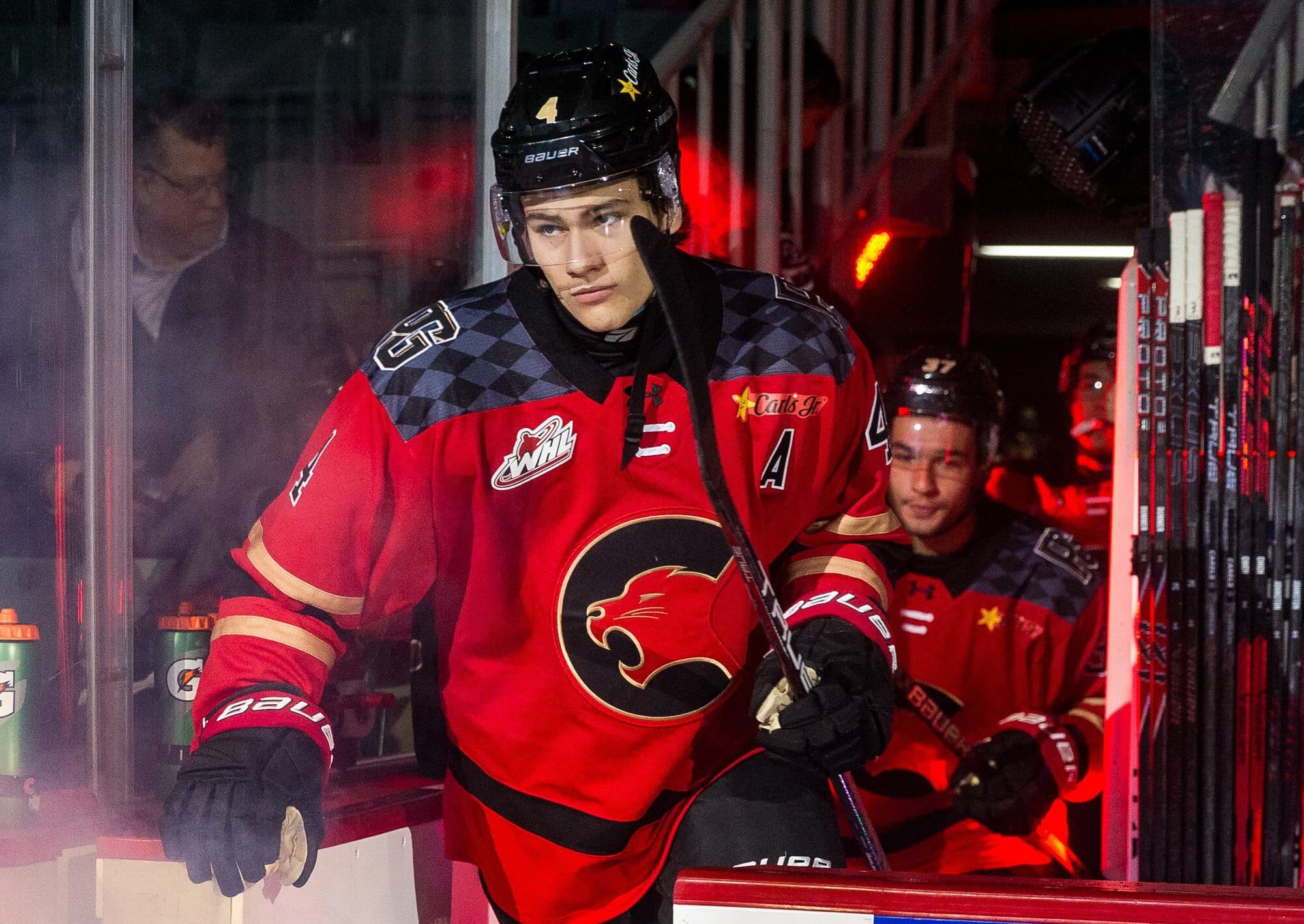
Photo credit: @PGCougars on Twitter/X


The Vancouver Canucks have officially clinched the 32nd spot in the NHL standings, securing the best odds (25.5%) at the first overall pick in the 2026 NHL Draft.
Assuming no major moves are made at the podium, the organization holds 10 draft picks and a crucial opportunity to restock a prospect pool that has begun to thin out. With that in mind, we continue with our draft profile series.
While the primary focus will remain on players within Vancouver’s likely selection range, we’ll also highlight several notable names over the coming months to provide a full picture of this year’s class.
Today, we bring you one of the most well-rounded defencemen in the draft class, enjoying a breakout in his second WHL season as a 17-year-old defenceman.
Carson Carels
Team: Prince Goerge Cougars (WHL) | Age: 17 | Position: Defence | Height: 6’2 | Weight: 202 lbs | Shoots: Left | Points: 58 GP, 20G, 53A | Central Scouting mid-term rank: #3 North American Skater
While names like Gavin McKenna, Ivar Stenberg, and Keaton Verhoeff have all occupied much of the 2026 NHL Draft spotlight, Carson Carels has quietly gone about his business while putting together one of the most impressive statistical seasons of any player in this class.
By now, the current landscape among the top defencemen is relatively clear. Verhoeff brings size and long-term projection as a physically imposing two-way presence, while Chase Reid offers dynamic, high-end offensive upside as a potential number-one and power play quarterback. Carels, meanwhile, fits somewhere in between, offering a complete and well-rounded profile that touches on all areas of the game as a jack-of-all-trades. He consistently impacts the game in a variety of ways and does so with a level of competitiveness that is difficult to overlook.
That competitive identity could be rooted in his background. Raised in the small town of Cypress River, Manitoba, Carels grew up working on his family’s cow farm, and that work ethic is evident in how he approaches the game. He plays with an incredible chip on his shoulder, delivering bone-crushing checks, and rarely waits for the play to come to him. There is a noticeable consistency to his effort level, which shows up in all three zones.
Carels established himself as a high-end player to watch during his 16-year-old season, where he recorded 35 points in 60 games in the Western Hockey League with Prince George. He’s also been involved on the International stage, representing Canada at the U17, U18 and now U20 levels.
Now, in his draft-eligible year, he has taken a significant step forward, eating roughly 27 minutes per night in all situations imaginable. Serving as an assistant captain, he finished second among all WHL defencemen with 73 points (20 goals, 53 assists) in 58 games, more than doubling his previous output while playing fewer games. He led his team with 35 primary assists and also earned a spot on Team Canada’s World Junior roster, where he played a depth role and contributed to a bronze medal finish.
Following his return from World Juniors, Carels took his game to the next level. Over his final 30 games of the regular season, he recorded 44 points and produced 12 multi-point performances, while being held off the scoresheet just four times. That level of consistency has helped solidify his place firmly within top-five conversations, with some evaluators, including Craig Button, ranking him as high as second overall.
The intrigue in Carels’ game begins with his foundation. At 6-foot-2 and just over 200 pounds, he possesses a strong, projectable frame and is not shy about using it. He plays a competitive, physical style, consistently finishing checks and engaging in battles without hesitation. He does not rely on opponents to make the first move; instead, he initiates contact and asserts himself to put opponents on edge whenever he is on the ice.
His skating also plays a major role in his effectiveness. Carels shows fluid edgework and a powerful stride, allowing him to move efficiently in all directions. He is comfortable carrying the puck or joining the rush, and he recovers quickly if the play breaks down. From the blue line, he uses his edges to create space and manipulate defenders, and he maintains his pace and control with the puck on his stick, which helps drive transition play.
That same mobility translates well defensively. Carels maintains tight gaps, makes quick reads, and uses a combination of body positioning and stick work to disrupt opposing plays. He is effective defending the rush and can match the pace of high-end forwards, making him a difficult player to beat cleanly. His competitive nature only enhances that aspect of his game, as he consistently stays engaged and finishes plays.
Offensively, Carels’ production has been a fun storyline this season, though it is driven more by intelligence and processing than pure flash. He sees the ice well and distributes the puck effectively, often finding teammates in motion or creating opportunities through quick, decisive reads. His ability to think the game at a high level allows him to contribute consistently across all three zones.
That said, his offensive tools are not without limitations. His hands can show flashes of brilliance, but they aren’t a defining feature, and while he is capable of making plays under pressure, he does not rely on high-end deception to generate offence. Similarly, his shot is serviceable but not a major weapon, which likely positions him more as a secondary power play option rather than a primary offensive driver at the next level. He was able to score a ton of goals using a mixture of said flash and snapshots, but without a high level of dynamism, many question whether he’ll be able to translate that into becoming a successful offensive defenceman.
That said, his goal package is quite impressive.
As has been the case with every defender we’ve covered here at CanucksArmy, his decision-making can come into question from time to time, particularly in the defensive zone, where reads can occasionally break down or plays can be forced. However, those instances are relatively minor compared to the overall stability and completeness of his game.
Ultimately, what defines Carels as a prospect is his balance. In a draft class where many defenders bring high-end traits paired with notable question marks, Carels offers a more complete and dependable profile. While Reid may carry the higher offensive ceiling and Verhoeff the more unique physical projection, Carels provides a blend of consistency, intelligence, and competitiveness that makes him an appealing option for teams seeking a reliable top-three defenceman with upside. He brings just as many translatable tools as his defensive peers, and even kills penalties at a high rate. The primary differentiator between him and the aforementioned is that he shoots left in an environment where right-shot defencemen tend to carry added value.
And it very well could be as simple as that.
If he were to shoot right, there is a world where Carels was the highest-ranked defender from day one. And because of that, there is a very real possibility that Carson Carels hears his name called as the first defenceman off the board in June.
Check out our other draft profiles:
Sponsored by bet365


Breaking News
- Scenes from morning skate: Meriläinen starts, Rossi out again as Canucks host Cup champs from Carolina
- ‘Sucks to see him go’: Max Sasson and Linus Karlsson reflect on Aatu Räty trade
- How do Elias Pettersson’s first 10 games of 2026-27 compare to his other 10-game starts?
- ‘Important to stay together’: Gallagher leaning on togetherness amid Canucks’ losing streak
- Scenes from practice: Canucks promote Linus Karlsson to top line; Rossi absent due to illness

Vancouver CanucksTeam Cap Summary

Cap Summary
2026-27
2027-28
Projected Cap Hit
$87,295,050
$71,329,167
Projected Cap Space
$16,704,950
$42,170,833
Current Cap Space
$18,625,059
$42,170,833
Active Players
23/23
13/23
Draft Picks
Round
'27
'28
1
1
1
2
2
2
3
1
1