
CanucksArmy has no direct affiliation to the Vancouver Canucks, Canucks Sports & Entertainment, NHL, or NHLPA
CA Draft profiles: Making the case for Gavin McKenna at first overall
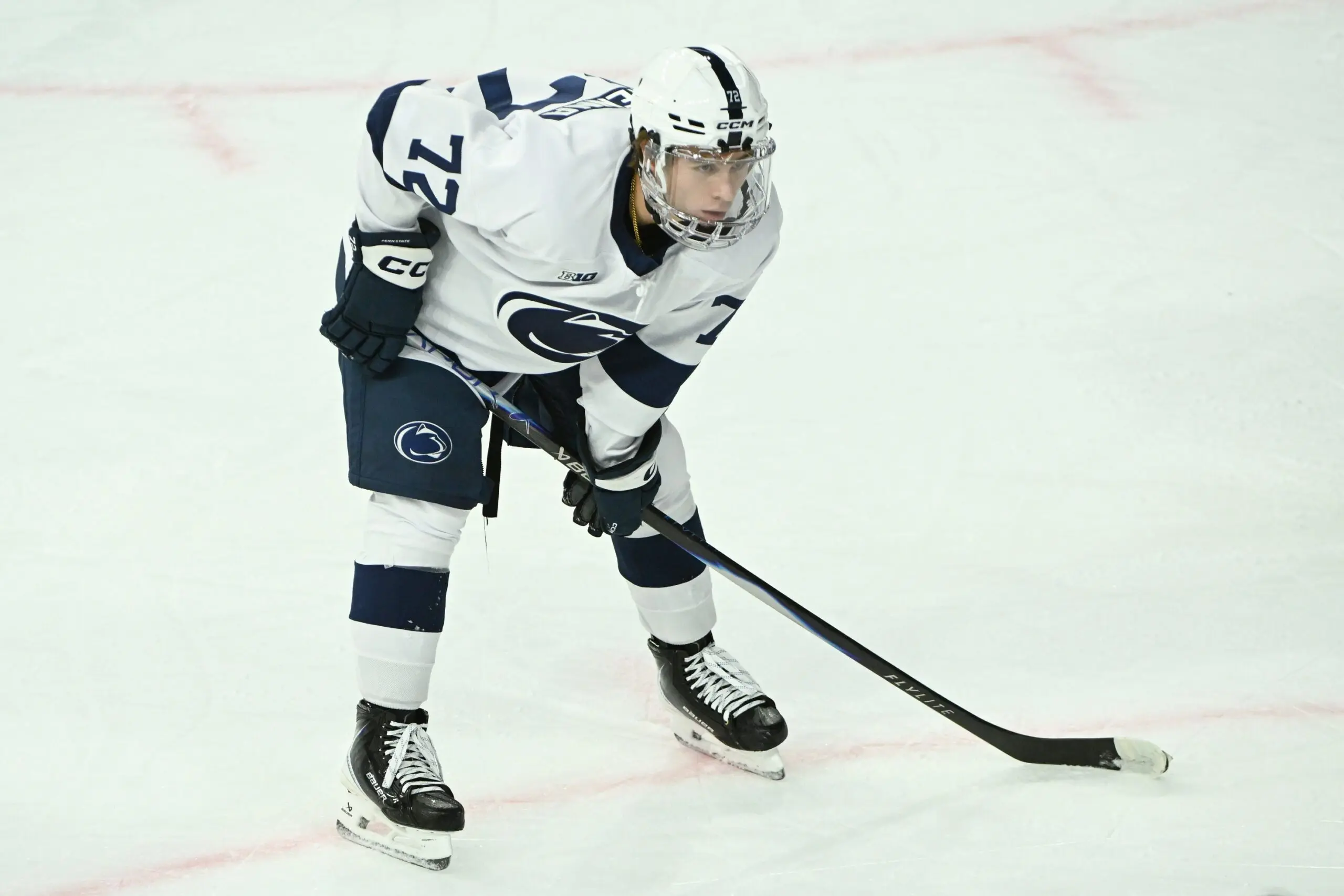
Photo credit: Barry Reeger-Imagn Images


The Vancouver Canucks have officially clinched the 32nd spot in the NHL standings, securing the best odds (25.5%) at the first overall pick in the 2026 NHL Draft.
Assuming no major moves are made at the podium, the organization holds 10 draft picks and a crucial opportunity to restock a prospect pool that has begun to thin out. With that in mind, we begin our draft profile series.
While the primary focus will remain on players within Vancouver’s likely selection range, we’ll also highlight several notable names over the coming months to provide a full picture of this year’s class.
Today, we begin with one of the more polarizing potential first-overall picks in quite some time.
Gavin McKenna
Team: Penn State University | Age: 18 | Position: Left Wing | Height: 6’0 | Weight: 170 lbs | Shoots: Left | Points: 35 GP, 15G, 36A | Central Scouting rank: #1 North American Skater
It’s not often that a potential first overall pick comes with this level of uncertainty, but the conversation surrounding Gavin McKenna has been anything but straightforward and far from unanimous.
Heading into the 2025–26 season, there was little debate. Coming off a dominant 129-point campaign — plus another 38 in a deep playoff run — with the Medicine Hat Tigers (WHL), McKenna appeared to be a near lock to go first overall. After all, only three 17-year-olds have reached the 125-point mark since the year 2000: Connor Bedard (149) and McKenna (129).
Who could ignore those numbers?
Rather than return for another dominant season with a powerhouse Tigers team, McKenna chose to challenge himself at Penn State. While his season would ultimately come with its share of ups and downs and a slower-than-expected start, the decision to take the uneasy path should be commended.
The NCAA is a vastly different environment and one where space is limited, time is scarce, and every shift comes against older, stronger competition. We have seen firsthand from other 2026 draft-eligibles – Tynan Lawrence, Keaton Verhoeff, Oscar Hemming and Ilia Morozov – just how challenging this league can be. And yet, despite the adjustment, McKenna still thrived. When all was said and done, his efforts earned him this year’s Big Ten Rookie of the Year, a Hobey Baker nomination, and even a Bronze Medal at this year’s World Junior Championships.
Despite that slower start, he finished his draft-eligible season with 51 points in 36 games, ranking (tied) fourth in the nation, while his 1.46 points-per-game sat second overall. He outproduced every teammate by a significant margin and, in most cases, was the engine driving Penn State’s offence on any given night.
It’s important to note that, unlike some programs that iced potent, highly skilled squads, the Nittany Lions weren’t necessarily flooded with premium talent. Only five skaters on the team were NHL draft picks, and aside from Jackson Smith, a Columbus Blue Jacket product, not a single skater was taken in the first round. If the Nittany Lions wanted to be successful, the majority of their offence had to come from Gavin’s creative stick.
So why the hesitation on Gavin at first overall? Well, for some, there are none. He’s been compared to Nikita Kucherov and Mitch Marner and is likely to be a top generator at the NHL level. Yet, for others, the discussion goes well beyond production and trends into concerning territory with poor habits and a lacklustre two-way game.
With the puck on his stick, there may not be a more dynamic player in this class. He’s a transitional darling with elite hands, capable of slowing the game down, disguising intentions to pull in and manipulate defenders at will. His ability to operate in tight spaces, paired with elite-level vision, allows him to consistently create offence in ways few players can. He processes the game multiple steps ahead, threading quick one-touch passes through traffic, executing no-look feeds, and making high-difficulty plays look routine.
If you want to get nitpicky, there is a tendency to try too many moves that will require some taming at the next level. But given his talent level, some simple guidance and teachable moments should counter those tendencies over time. For us, it’s not an overly cause for concern, as you’d rather dial back skill than start from scratch altogether. He’s a true offensive facilitator and the type of player you build a system around. In other words, he’s exactly what a team like the Vancouver Canucks are looking for in a top-end prospect.
His shot, while secondary to his playmaking, is still a legitimate weapon. He generates power with minimal space and uses a quick and snappy release to catch goalies and defenders off guard. Despite finishing third in the nation with 152 shots, there’s still an argument that he could shoot more and with a higher level of purpose. He’s a player constantly gauging his next play, where he could stand to utilize his release in more dangerous and effective ways.
Of course, much of the discussion around his production centres around the man advantage and whether his potential as a player lies in being a “power play merchant”. While he certainly excels at driving offence from the flank on the man advantage, his production wasn’t solely reliant on the power play, especially down the stretch of the season.
The reality is that only 21 of his total 51 points came while on the man advantage. Of his 36 assists this season, 16 came on the power play (11 primary, five secondary), and of his 15 goals, only a third of them came off the man advantage. After returning from the World Juniors, his game picked up in several ways, and producing at even strength was one of them, with just eight (of 33) PP points.
The main concerns lie elsewhere.
At 6-foot and 170 pounds, McKenna remains slight, even after a year of bulking within a premium training environment. While there’s still runway to develop his frame, that lack of strength shows in most areas of his game today.
McKenna thrives under the radar, typically away from traffic, waiting for his moment to pounce and create. It just so happens that he’s incredibly efficient at making his opportunities count in those cases, but you’ll rarely find him in the mix for plays or engaging in many board battles. As an example, similar to Jack Hughes, the NHL’s timing and overall aggression are likely to require him to adjust in a significant way. Even on the offensive, he will send relatively low percentage shots toward the net rather than drive toward high-danger areas, simply because he ran out of room from the half-wall.
Those tendencies spill over into his defensive play. His off-puck engagement can be inconsistent, particularly in tracking and backchecking situations, and his poor effort often leaves viewers frustrated. There are moments where he simply doesn’t apply pressure or take aggressive routes defensively, and he’s often beaten in board battles and can be easily thrown off the puck. There are a lot of swipes, drive-bys and standing around waiting for the play to develop in front of him.
The plays below are just a few examples of him being outmuscled or of giving up on plays. It’s been a common theme throughout his season, and the main cause for his volatile draft projection.
In the skating department, McKenna can be best described as a slightly above-average mover. His edges are fluid, and he can manipulate defenders with quick maneuvers and escapes. But as a straight-line skater, his speed is simply average — perhaps slightly above — and not necessarily a strength. With that said, the in-tight style of game that he plays negates much of those concerns, as he weaves in and out of traffic rather than north-south. His game is more about manipulation than burning those from the outside.
At the end of the day, drafting a player of McKenna’s ilk is the classic trade-off. His offensive ceiling is among the highest in the draft and potentially franchise-altering. But his game will require refinement away from the puck and an adjustment to the physical demands of the NHL. Many of the league’s greats that we see today were able to make that adjustment, and it’s a simple matter of whether you want to take that risk with your high-end pick.
If you’re betting on pure offensive talent and game-breaking ability, Gavin McKenna is an easy choice at the top of the draft. And for an organization deprived of that mould, he’s an easy choice for the Vancouver Canucks with the first overall pick.
Sponsored by bet365


Breaking News
- The Stanchies: Jonathan Lekkerimäki notches a goal and an assist, and that’s all we’ll say
- ‘It’s embarrassing’: Brock Boeser brutally honest following Canucks’ ninth straight loss
- Instant Reaction: Canucks go nearly 40 minutes without a shot in 5-2 loss to Red Wings
- What’s behind ex-Canuck Conor Garland’s struggles in Columbus?
- NHL Notebook: Senators fans ruthless and creative in Brady Tkachuk’s return to Ottawa

Vancouver CanucksTeam Cap Summary

Cap Summary
2026-27
2027-28
Projected Cap Hit
$87,295,050
$71,329,167
Projected Cap Space
$16,704,950
$42,170,833
Current Cap Space
$18,951,815
$42,170,833
Active Players
23/23
13/23
Draft Picks
Round
'27
'28
1
1
1
2
2
2
3
1
1