
CanucksArmy has no direct affiliation to the Vancouver Canucks, Canucks Sports & Entertainment, NHL, or NHLPA
A brief history of the Canucks trading draft picks for young players with “upside”
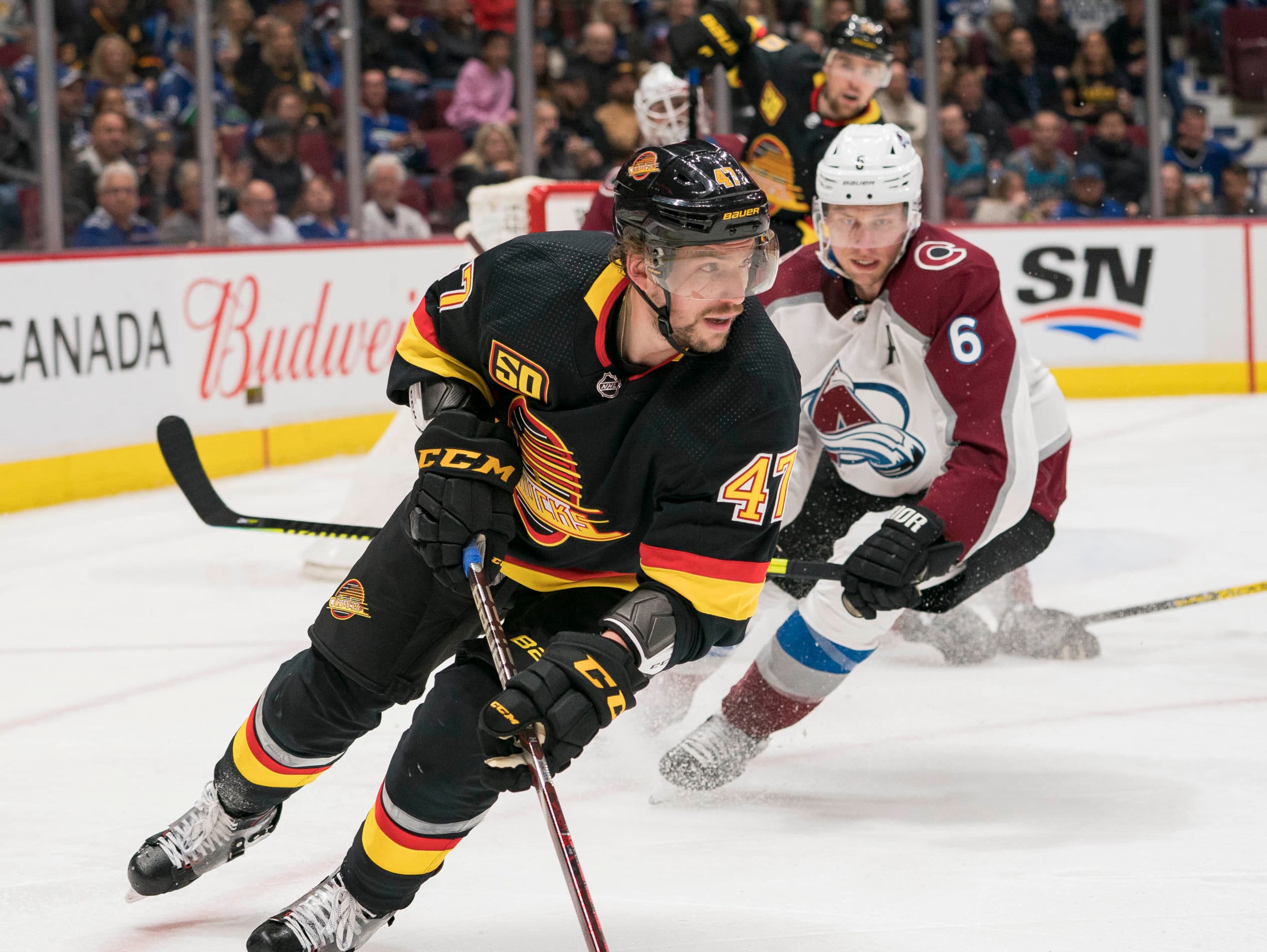
Photo credit: © Bob Frid-USA TODAY Sports

Apr 11, 2026, 14:09 EDTUpdated: Apr 12, 2026, 02:06 EDT


The Vancouver Canucks have done a decent enough job of the traditional first step of conducting a rebuild, that being the accumulation of draft picks. Through various trades and through not trading their own picks, the Canucks now have 10 picks in the first two rounds of the next three drafts.
One of the next steps, of course, is actually doing something with those picks. And on that front, Canucks fans received a headline this week that may have caused some understandable consternation. Thomas Drance of The Athletic reported, “There is a distinct possibility, however, that the Canucks will explore their options on the trade market this summer and will be open to utilizing their various extra second-round and third-round picks in trades that return younger players with the ability to contribute at the NHL level on a more expedited timeline.”
Drance cited some recent trades, including the Washington Capitals acquired Justin Sourdif (for a second and a sixth), the Philadelphia Flyers acquiring Trevor Zegras (for Ryan Poehling, a second, and a fourth), and the Pittsburgh Penguins acquiring Yegor Chinakhov (for Danton Heinen, a second, and a third) as examples of the kind of exchange he was talking about.
Now, keep in mind that this seemed like a carefully-worded statement, intended to walk that fine line between speculation and hearsay. But whatever the level of truth here, it’s a notion that is almost certain to raise the hackles of Vancouver fans, for the simple reason that Vancouver fans have already been there and done that a number of times before.
We decided to look back through the trade archives and track down all the times in recent memory that this franchise has made that same choice to trade decent draft picks for prospects and players a little further down the developmental path. Those players said to be both “NHL ready” and to have “upside.” What we found was not nearly as many examples as we expected, but also a general trend of failure. When we look back at most of these trades, it’s not hard to see that the Canucks were better off keeping and making their picks in pretty much every case.
That’s probably why Canucks fans cringe a bit when they hear “draft picks out, young players in,” whether they believe it, don’t believe it, or don’t want to believe it. It’s a strategy that has almost never worked before in Vancouver.
January 14, 2000: Vancouver trades conditional second and third round picks to New Jersey for Vadim Sharifjanov and a third round pick
We’re going all the way back to the start of the century for our first example. The Canucks brought in the 25-year-old Sharifjanov, who was in the midst of a disappointing sophomore season after a fine rookie campaign. They gave up a second and the higher of two third-rounders in exchange. None of the draft picks involved here turned into NHLers, but then neither did Sharifjanov. He played just 17 games for the Canucks, scored three points, was sent down to the minors the year after, and was back to Russia a year after that.
May 31, 2001: Vancouver trades second and third round picks to Florida for Alex Auld
We had to go this far back just to ensure we had at least one example where this kind of trading actually worked out for the Canucks. The year was 2001, and the Canucks were willing to deal a second and a third for a 20-year-old goaltending prospect just wrapping up his OHL career.
Those picks turned into Tuomas Pihlman, who played 15 NHL games, and John Adams, who was a fine enough president but never made it to the NHL.
Auld, meanwhile, stepped right into the professional ranks the next season, suiting up for his first NHL game and spending the bulk of the year with the Manitoba Moose. He’d be seen in spot-duty for the next couple of years – which we realize stretches the bounds of Auld being considered “NHL-ready” at the time of the trade – before somewhat unexpectedly taking over as starter in 2005-06. The next summer, Auld was part of the package sent to Florida in exchange for Roberto Luongo.
So, yeah, you could definitely say this original transaction worked out in the Canucks’ favour, but it’s not a perfect example of what we’re talking about here.
June 23, 2007: Canucks trade Jason King and a conditional third round pick to Anaheim for Ryan Shannon
We jump a half-decade forward for our next example. Here, we find a trade that didn’t really work out too well for anyone, but that also didn’t cause much harm. Shannon was coming off a rookie season in which his Anaheim Ducks won the Stanley Cup. King, meanwhile, was coming off a couple of years in the minors after a very brief run of rookie glory back in 2003-04.
In the end, Shannon played just 27 games for the Canucks (13 points) before moving on to the Ottawa organization. King played only four games for the Ducks before heading overseas. And best of all, that conditional third-rounder required Shannon to play a certain number of games for the Canucks, and he didn’t, so it was unfulfilled and never changed hands.
July 4, 2008: Canucks trade a second and a third round pick to Buffalo for Steve Bernier
Bernier was another in a long line of would-be Sedin linemates that the Canucks tried to make happen. In fact, he was kind of the last, as Alex Burrows would be taking over the job shortly after the 23-year-old Bernier arrived in town. For his part, Bernier, who already had 177 NHL games under his belt prior, played two seasons in Vancouver, totalling 54 points in 140 regular season games before heading to Florida ahead of the 2011 run.
The second round pick made its way to Columbus, where it was used on Petr Straka, who played just three NHL games. But the Sabres kept the third and used it on Brayden McNabb, who remains a valuable NHL defender to this day.
This is the first example where we can really say that this sort of deal really hurt the Canucks, but it won’t be the last.
June 28, 2014: Canucks trade a second round pick to Los Angeles for Linden Vey
Welcome to the Benning Era. Former GM Jim Benning gets a lot of blame for a lot of things; many of them very fair, others less so. But one item he definitely has to wear is being the reason Vancouver fans are wary of trading draft picks for “ready to contribute” young players.
It was a declared strategy of the Benning front office, and it did not work out in the Canucks’ Vey, who was five years removed from his own draft year at the age of 23 and had thus far only managed 18 NHL games with the Kings.
Vey would total 116 games with the Canucks and 25 points. Then it was a brief sojourn in Calgary before heading overseas, where he remains to this day.
Fortunately, the Canucks did not trade their own second here, but the second they got back from Tampa Bay in exchange for Jason Garrison. That pick was used by the Kings on defender Roland McKeown, who only ever managed 16 NHL games.
It must be noted, however, that long-time and continued NHLers Brandon Montour, Ryan Donato, and Christian Dvorak were all taken in the next few picks after McKeown.
November 25, 2014: Canucks trade Alexandre Mallet and a third round pick to New York Islanders for Andrey Pedan
The Canucks traded Mallet, a second round pick in 2012 who had already flamed out by this point, and a third to the NYI for a big, mean 21-year-old prospect defender in Pedan. At 6’5” and 213 pounds, it’s not hard to see what the Canucks saw in Pedan, but he’d only ever make it up to the Canucks for 13 games (and zero points) in the 2015-16 season. He was back in the minors the next year, and onto the KHL by 2018-19, where he remains to this day – but not before being packaged with a fourth round pick in a trade for Derrick Pouliot.
That third round pick really made the rounds though. The Islanders sent it to Buffalo for Michael Neuvirth, then Buffalo sent it to Pittsburgh as compensation for hiring coach Dan Bylsma. And then the pick came back home to Vancouver as part of the trade that sent Nick Bonino, Adam Clendening, and a second to the Penguins in exchange for Brandon Sutter and this third. The Canucks then used it on Will Lockwood, who would ultimately be exchanged for a different kind of failed reclamation project in Vitali Kravtsov.
March 2, 2015: Canucks trade a second round pick to Calgary for Sven Baertschi
We arrive at our most famous example. At the time of the trade, Baertschi was 22 years old, but the former 13th overall pick had only managed 66 NHL games across four professional seasons with the Flames.
We could not call Baertschi a total bust for the Canucks. He scored as many as 18 goals and 35 points in 68 games for the Canucks (in the 2016-17 season), and totalled 110 points across 225 Vancouver games. At times, and before concussions got in the way, Baertschi showed some real chemistry on some youth lines.
But that all pales in comparison to what happened with the pick. The Flames used it to pick Rasmus Andersson at 53rd overall. The defender went on to play 584 games for Calgary across 10 seasons – many of them coinciding with a time at which the Canucks desperately needed an RD on their roster exactly like Andersson. Instead, he learned to straight-up “hate” the Canucks. And then, as a pending UFA, Andersson was cashed out via trade to the Vegas Golden Knights for Zach Whitecloud, a first, a conditional second, and a prospect.
The Canucks definitely could have used Andersson’s services on the ice over the past decade, and they could have used that eventual injection of draft capital even more.
Conclusion
In the end, the Canucks-specific evidence leads us to believe that trading draft picks for young, “NHL-ready” players with “upside” is not a strategy for success. It’s worked out into a positive exactly once, in the form of Alex Auld. It’s hurt the Canucks a number of times, via missing out on picks like Rasmus Andersson and others. And it must be said that, even in those cases where the Canucks made out even – via the picks they traded being used on busts – that can still be seen as an overall loss, because who’s to say that the Canucks couldn’t have made better selections themselves, or used said picks in other, better trades?
Before we close off, we wanted to mention two other trades that almost fit this profile, but not quite. That’s the June 2019 deal that brought in JT Miller in exchange for Marek Mazanec, a conditional first, and a third, and the March 2023 deal that brought in Filip Hronek (and a fourth) in exchange for a protected first and a second.
Both trades were criticized, at the time, for being examples of what we are talking about here – attempts to shortchange a developmental process by exchanging picks for older players with upside. But in both cases, the Canucks wound up doing pretty well for themselves, and at the very least, walking away with valuable NHLers who could contribute for a number of years.
We bring this up to suggest that, if the Canucks are really interested in this sort of trade, they’ve had better success when seeking out higher-tier players, even if they’ve cost more to acquire. The sort of trades we’ve listed in this article, in which second and third rounders are dealt out in the search for so-called diamonds in the rough, on the other hand, never seem to work out.
Ultimately, it turns out there just aren’t that many diamonds hiding in the rough in the first place, and the best way to get the few that are there is to pluck them from the draft directly.
Sponsored by bet365


Breaking News
- Instant Reaction: Special teams the story as Canucks lose 4-1 to Devils
- Meet the three men reviving beloved ‘Sports Page’ in an all-new format
- Canucks Game Day: Dealing with the Devils in early Saturday start in New Jersey
- The Canucks have every reason to give Leevi Meriläinen a run of starts
- A look inside the Canucks early-season penalty killing struggles

Vancouver CanucksTeam Cap Summary

Cap Summary
2026-27
2027-28
Projected Cap Hit
$88,074,947
$71,329,167
Projected Cap Space
$15,925,053
$42,170,833
Current Cap Space
$16,790,545
$42,170,833
Active Players
23/23
13/23
Draft Picks
Round
'27
'28
1
1
1
2
2
2
3
1
1