
CanucksArmy has no direct affiliation to the Vancouver Canucks, Canucks Sports & Entertainment, NHL, or NHLPA
6 positives from a dreadful 2025-26 Canucks season
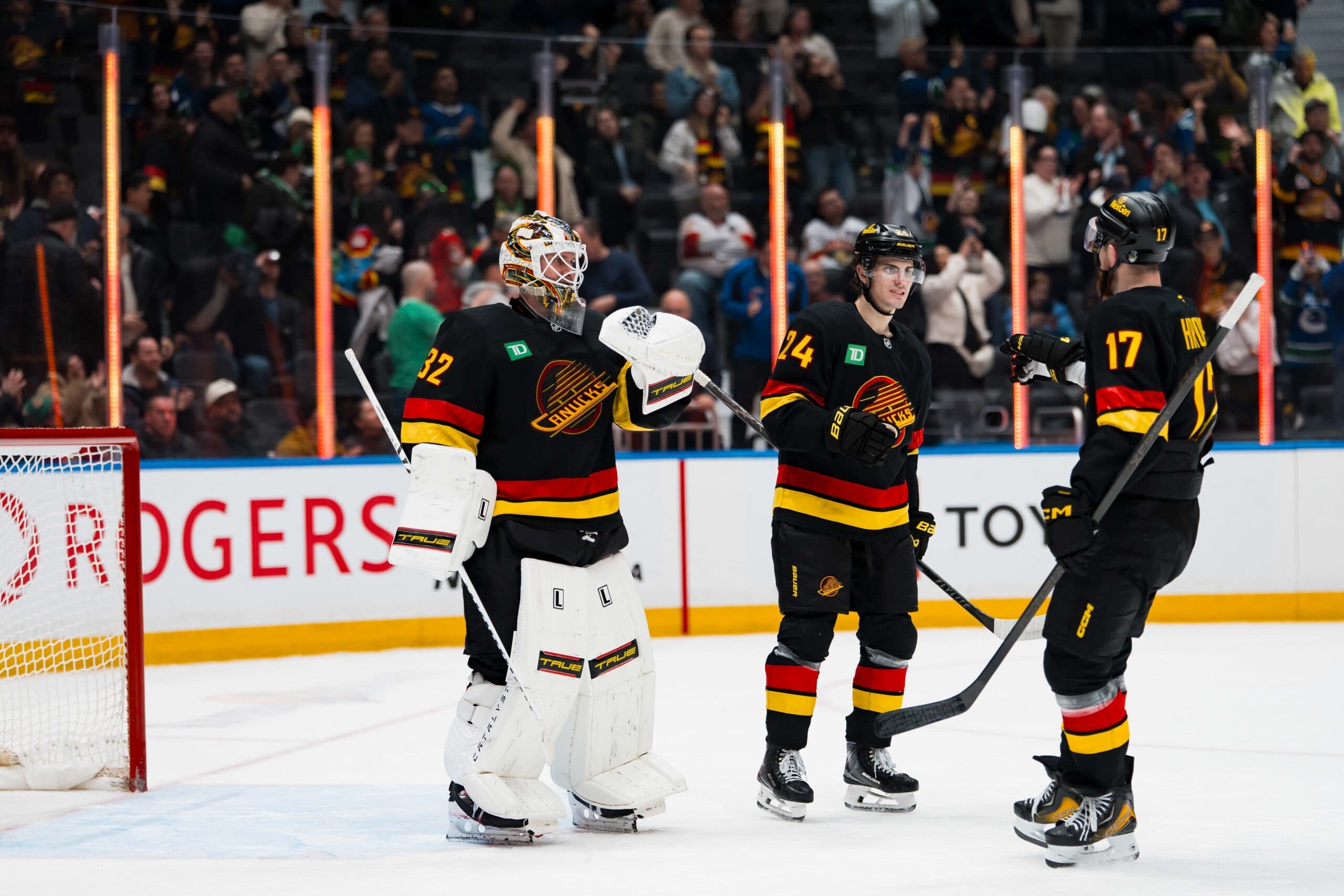
Photo credit: © Bob Frid-Imagn Images

Apr 11, 2026, 09:00 EDTUpdated: Apr 11, 2026, 20:48 EDT


You’ve read enough about how poorly the 2025-26 NHL season has gone for the Vancouver Canucks. After winning the Pacific Division just two seasons ago, the Canucks were right back into mediocrity this season, were forced to trade their captain, and entered into a long-overdue rebuild as a result.
And that, of course, is just a summary. The list of negative things that happened to this team is much longer. It includes a litany of injuries, a record-low number of home ice wins, and more.
But you’ve read all those, and the sun was just shining all week in Vancouver. That’s why we thought it’d be fitting to change gears a bit and go over six positives from what was an otherwise dreadful season for the Canucks.
1. A practice facility appears to be in motion
Many of the stories you will see in this piece come with a “yeah, but,” element to them. There are positives, but there’s often more to it. A quick example — any player returned in the Quinn Hughes trade playing well is no doubt a positive, but it comes with the questions of why the Canucks had to trade Hughes in the first place (although again, that’s not what we’re focusing on today).
But this story? This one is all positive. When CanucksArmy’s own Irfaan Gaffar broke the news that the Canucks were nearing an agreement to build their practice facility at Britannia Rink, it was a big win for the organization for a few reasons. First and foremost, this practice facility story has basically become a meme over the years, as Jim Rutherford’s non-updates every time he did a press conference quickly became routine. Second, it has the Canucks on their way to shed their title as the only NHL organization without a dedicated practice facility (something free agents absolutely ask about when deciding on where they should sign). Lastly, Britannia’s proximity to Rogers Arena is another obvious positive when it comes to this story, as the Canucks looked at options all over the Lower Mainland but appear poised to land the one that undoubtedly made the most sense from a logistical perspective.
2. The Canucks said the word rebuild and executed a perfect tank job
Over the years, the Canucks haven’t liked the word rebuild very much (just ask Mike Gillis and Trevor Linden!).
But after the Hughes trade — okay, and after they took the idea of “a retool with a hybrid form” out for a quick test drive after four wins immediately following the trade — the Canucks finally clarified their direction and told fans that yes, this was indeed a rebuild. Jim Rutherford also admitted that getting a high pick in the 2026 Draft was a key part of their rebuild plan.
Fans were right to be skeptical about the Canucks’ willingness to actually tear things down, and can still be skeptical about it as we head into the offseason. And while the Canucks didn’t move off of pending UFAs Teddy Blueger and Evander Kane at the Trade Deadline, they did ship out Kiefer Sherwood for a solid return, didn’t wait around to see if Conor Garland would force his way out of Vancouver once his no-move clause kicked in this summer, and even convinced Tyler Myers to waive his no-trade clause so they could flip him to the Dallas Stars for a couple of draft picks.
Those are all clear-cut rebuilding moves that further aided the Canucks in their effort to finish dead last, a position they ended up locking up sooner than almost anyone could have expected. Of course, that also means they secured the best odds of any team at landing the first overall pick in the 2026 NHL Draft, and at worst, they’ll fall to third overall. The Canucks — well-known for their tank-ruining late-season pushes to sell hope and season tickets for the following season over the past decade — haven’t drafted in the top three since 1999, when they selected Daniel and Henrik Sedin, so locking up a top-three draft selection is undoubtedly a positive for this team.
3. Brock Boeser finished the year strong
In the grand scheme of things, Brock Boeser scoring 20 goals and finishing at or near his career average of about 50 points per season, maybe doesn’t matter all that much. After all, the Canucks are in 32nd place with that production, and wouldn’t go any lower if Boeser put up 30 points.
But whether you’re of the opinion that the Canucks should look to trade Boeser at some point down the line or that they should keep him around for the duration of his new-ish contract, Boeser finishing the year strong is a good thing. Boeser seems to have real chemistry playing with Marco Rossi, and that’s undoubtedly a good thing, as it was a real concern that Boeser wouldn’t find a centre to play with after the Canucks traded JT Miller.
Over his last 16 games, most of which he’s played with Rossi as his centre, Boeser has put up nine of his 21 goals, and 10 of his 24 assists. Could a full season of playing with Rossi help Boeser get closer to the 40 goals and 73 points he put up back in 2023-24? That’s at least a conversation thanks to Boeser’s strong finish to the year.
4. The pieces returned in the Hughes trade
It feels like a cop out to add three individual bullet points for each player the Canucks got back in the Quinn Hughes trade, so we’ll just group them all together. After returning from an injury — the second time — Marco Rossi has looked like a solid second line centre, and has breathed new life into the Canucks’ power play. He’s a big part of Boeser’s strong finish to the year, and that’s a net positive for the organization.
Meanwhile, youngsters Zeev Buium and Liam Öhgren have both shown flashes at times. Öhgren, who is nearly two years older than Buium, has been the more consistent player and with 18 points through 47 games, looks like he could be a solid middle-six winger for the Canucks for years to come. Not bad for a player who was thought to be more of a throw-in to the Quinn Hughes trades.
For Buium, the fact that the Canucks fetched one of the game’s elite defence prospects remains, even if he hasn’t immediately stepped in and blown everyone away with his play. He doesn’t turn 21 until December, and has plenty of time to grow into the player many people think he can be.
5. Canucks targeted draft picks in their trades
In the Hughes trade, it was Minnesota’s first-round pick. But it was also the Kiefer Sherwood trade, where the Canucks got two second-round picks from the San Jose Sharks. For Conor Garland, the Blue Jackets coughed up a second and a third-round pick. In the Tyler Myers trade, the Canucks got Dallas to give them a second and a fourth.
At this point, it’s painfully obvious that what the Canucks really need is three or more game-breaking elite-level talents, typically found at or near the very top of the NHL Draft — a place the Canucks have seldom found themselves selecting at. In rare cases, those players are sometimes found later in the first round, and even rarer instances, in the second and third rounds as well. By targeting draft picks instead of taking flyers on B-level players that organizations are willing to trade away, the Canucks essentially stocked up on lottery tickets.
The easiest way to explain this: it becomes a lot harder to draft a diamond in the rough like Brayden Point or Nikita Kucherov if you don’t stock up on picks, and that’s exactly what the Canucks have done. Now, will one of their lottery tickets hit? We’ll have to wait and see, but the process is right, and given the long list of failed reclamation projects over the past decade that Canucks fans have had to endure, getting the process right is a great start.
6. Filip Hronek took a step both on and off the ice
We’ve often said that Filip Hronek might be the only Canucks defenceman who took a step forward in Adam Foote’s first season as head coach. Hronek is two points off tying his career high in points, and since the Quinn Hughes trade — and before, if we’re being honest — the Canucks have relied on Hronek to play in all situations and log heavy minutes for them. He’s been sensational for them all season, and that’s just on the ice.
Off the ice, Hronek has gotten plenty of credit for stepping up and being a real leader for the rebuilding Canucks. Hronek went to Max Sasson and other Abbotsford players to pick their brains on what made the culture in Abbotsford special enough to win a Calder Cup Championship last season. He’s been publicly added to the short list of candidates to be the Canucks’ next captain by Jim Rutherford. And whether you agree with that or not, there’s no denying that Hronek has been a valuable resource for his young Canucks teammates, in particular Zeev Buium and Tom Willander, both of whom have spoken glowingly about what Hronek has done for them.
What other positive from the Canucks’ season did we miss? Let us know in the comments section below!
PRESENTED BY PACIFIC TOYOTA DEALERS

Need performance without compromise? Check out the Toyota Prius Plug-In Hybrid. Enjoy up to 72 km of electric range on battery alone. Heading farther for an away game? It seamlessly switches to gas for a combined 962 km range. It’s a total power play on the road with a sleek design and sophisticated, tech-loaded interior. Plus, you can recharge easily at home or utilize over 2,000 public charging stations in BC. Experience range, style, and versatility. Visit your local Pacific Toyota dealer during Red Tag Days for limited-time offers.


Recent articles from David Quadrelli
Breaking News
- Meet the three men reviving beloved ‘Sports Page’ in an all-new format
- Canucks Game Day: Dealing with the Devils in early Saturday start in New Jersey
- The Canucks have every reason to give Leevi Meriläinen a run of starts
- A look inside the Canucks early-season penalty killing struggles
- ‘Best news ever’: Max Lapierre thrilled to see Canucks put Sedins, Johnson, and Malhotra in charge

Vancouver CanucksTeam Cap Summary

Cap Summary
2026-27
2027-28
Projected Cap Hit
$88,074,947
$71,329,167
Projected Cap Space
$15,925,053
$42,170,833
Current Cap Space
$16,790,545
$42,170,833
Active Players
23/23
13/23
Draft Picks
Round
'27
'28
1
1
1
2
2
2
3
1
1