
CanucksArmy has no direct affiliation to the Vancouver Canucks, Canucks Sports & Entertainment, NHL, or NHLPA
Analyzing Paul Cotter’s fit in the Canucks’ bottom six
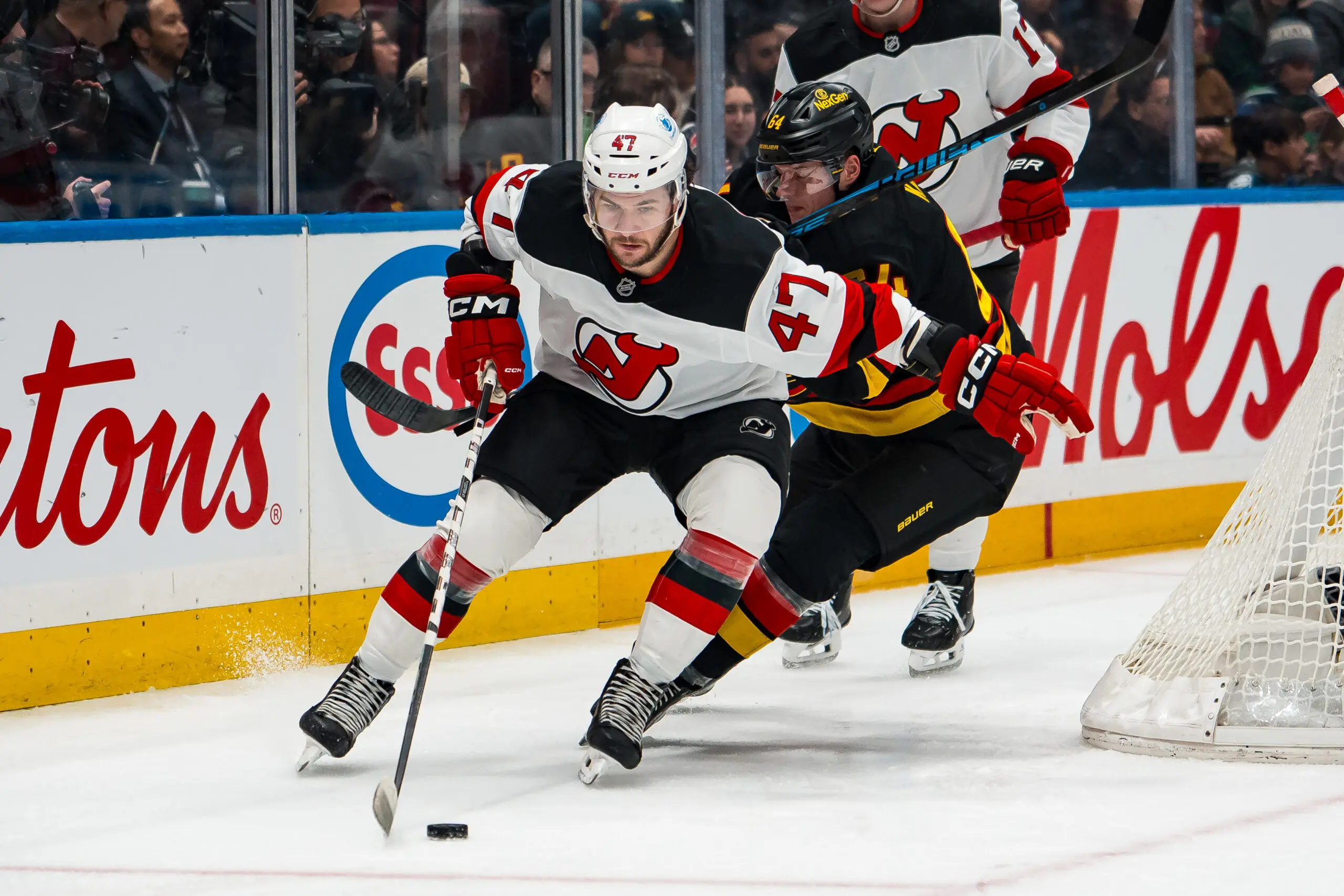
Photo credit: © Bob Frid-Imagn Images

Jul 17, 2026, 10:00 EDTUpdated: Jul 17, 2026, 00:23 EDT


Earlier this summer, Paul Cotter signed a one-year $2.15-million contract with the Vancouver Canucks after being left unqualified as an RFA by the New Jersey Devils. It was the latest turn in a career that has already included a championship, a trade, and two fairly different seasons in the Garden State.
The Vegas Golden Knights selected Cotter in the fourth round, 115th overall, at the 2018 NHL Draft. After developing with the Chicago Wolves and Henderson Silver Knights in the AHL, the Canton, Michigan, native made his NHL debut in November 2021. He became a full-time player the following season, scoring 13 goals in 55 games for the 2023 Stanley Cup champions. Although he did not appear during the playoff run, he played enough regular-season contests to have his name engraved on the trophy.
Cotter followed that up with a career high of 18 assists and 25 points in 76 appearances during 2023-24. Vegas monetized him that summer, sending the winger and a 2025 third-round pick to New Jersey for Alexander Holtz and goaltender Akira Schmid.
His first year with the Devils produced a personal-best 16 goals, along with six assists and 245 hits across 79 games, but that progress did not continue into 2025-26. Cotter fell to nine goals and 15 points last season, averaged fewer than 11 minutes per night and saw his five-on-five results deteriorate as the team fell out of the playoff picture.
Vancouver is betting that a defined assignment in its bottom-six can bring out the positive aspects of Cotter’s profile. The speed, shooting ability, and physical edge that helped him establish an NHL career are still there. Whether a defined role in the Canucks’ bottom-six can bring the best out of his abilities is another question.
Here is what Canucks fans should expect from Cotter in 2026-27:
High-end speed
Skating is the most impressive part of Cotter’s game. He reached a top speed of 37.21 kilometres per hour during the 2025-26 season, placing him in the 88th percentile among NHL skaters, and comfortably above the league average of 35.68 km/h.
Often described as an attacker off the rush, the former Devil’s maximum speed declined by roughly half a kilometre per hour from the 37.72 km/h he reached in 2024-25, but by no means is his mobility fading. Cotter’s average pace, however, was a more ordinary 15.96 km/h.
Vancouver’s fourth line has not always had that kind of transition threat in recent years. Cotter gives the coaching staff someone who can skate in straight lines, force the opposition to react on exits, and create breakaways in the neutral zone.
Rough stuff
In 296 NHL appearances, the former London Knights product has recorded 854 hits for an average of 2.89 per game. He finished with 192 last season after posting 245 in 2024-25 and 233 the year before. His ice time also slipped from 13:05 per night to 10:41, levelling out to an estimated 13.65 hits per 60 minutes in 2025-26.
The Canucks are looking for forecheckers, and Cotter’s ability to close space quickly and finish along the boards should help his line regain possession after chipping the puck in deep.
He’s also crossed the line before, and was suspended for two games in April 2025 for an illegal check to the head. So any further league discipline would make him a repeat offender.
Five-on-Five
Natural Stat Trick credited Cotter with a 41.81 percent expected-goal share at five-on-five last season. New Jersey was outscored 41-15 during those minutes, leaving him with a 26.79 percent share of the goals. The previous campaign was more respectable from a shot-quality perspective, but the Devils were still outscored 43-27 with him on the ice.
Across his two years in New Jersey, opponents held an 84-42 advantage during Cotter’s five-on-five shifts.
That’s somewhat troubling because Vancouver will be asking him to do roughly the same job he was asked to do in New Jersey, where the quality of team was arguably higher than that of what is currently in Vancouver. So if his line spent too much time in its own zone and failed to create enough at the other end for the Devils, how will he do any better with the Canucks?
NHL EDGE recorded Cotter at 41.8 percent of his ice time spent in the defensive zone, above the league average of 40.1 percent. Only 40.2 percent was spent in the attacking end, even though his starts were relatively balanced.
Those difficulties became more pronounced when he played with other direct, low-possession forwards. MoneyPuck had the Cotter-Nick Bjugstad-Maxim Tsyplakov combination — his most frequent linemates — controlling approximately 41.6 percent of expected goals over roughly 103 minutes.
Vancouver will likely construct its fourth line, with that in mind, and look for a playmaker to accompany Cotter’s straight line play.
Is he a centre?
The simple answer is no, not really.
Cotter is often described as a versatile winger who can also play centre, but he has taken only 288 faceoffs in his career. The win rate of 50.7 percent is not an issue, but the volume is far too low to suggest he can regularly be relied on to play centre. Can he take on the defensive responsibilities of a centre after someone else takes the draw? Sure, but he likely won’t be slotting in as a centre with two true wingers on his line.
That being said, his workload in the faceoff dot increased to 132 draws last season, winning 51.5 percent, after he took 78 at a 52.6 percent clip in 2024-25. It was by far the most draws Cotter has taken in a single season in his career.
Playing fourth line centre requires a reliable game supporting the puck below the goal line, managing defensive-zone coverage and distributing through the centre of the ice. None of those are really Cotter’s strong suits.
Using him as a secondary faceoff option could work, but he seems like a better fit on the flank.
Penalty-killing
Cotter has the speed, size, and reach to seemingly be a potentially impactful forward shorthanded, but his NHL coaches have rarely used him in that role. That suggests hockey IQ might be an issue.
He had essentially no penalty-killing time during 2023-24, approximately three seconds per game the following year and another negligible total last season. Basically, there is not enough evidence to describe him as a capable NHL penalty killer, much less someone who should immediately join one of Vancouver’s regular units.
The Canucks could experiment with him there during training camp, but until he proves otherwise, he should be viewed as an even-strength winger rather than a special-teams addition.
Finishing
Cotter’s drop in production can largely be chalked up to reduced opportunity and a lower shot volume.
His shot total fell from 90 to 61, but he still converted on 14.8 percent of his attempts, above his career mark of 13.9 percent. MoneyPuck’s shooting model also rated his finishing talent above the NHL average.
Supporting that assessment is the data that his hardest shot last season reached 147.61 km/h, placing him in the 89th percentile. There’s enough power to beat goaltenders from distance, but rarely the volume required to make that weapon a consistent threat.
That kind of sums up Cotter’s game in a nutshell. The tools are appealing, and he’s crafty in the shootout (three-for-five last season), but the quantity is somewhat limited.
He’s more accustomed to completing the play rather than creating for his teammates, with only 35 assists across 296 games. If the Canucks can get him moving downhill with someone who can make a play, Cotter should be able to get back into double digit goals.
Concerns of not driving possession, creating much offence for others, or earning any prolonged trust from two different organizations are all valid points. But Cotter’s five-on-five results last season were particularly poor, and likely not totally indicative of the player he is.
Like most of Vancouver’s July 1 signings, Cotter will be most impactful with a simplified role. Play him on the wing and encourage him to attack with speed, shoot when space opens, and make his contact serve a purpose.
And hopefully, if he’s successful in all the right areas, Cotter can chase his second Stanley Cup with a contender come the trade deadline.
PRESENTED BY VIVID SEATS



Breaking News
- The Statsies: Canucks overwhelmed at 5v5 in Hughes’ return after a strong first period
- The Stanchies: Boo birds rain on Hughes in return to Vancouver; Canucks lose 4-2 to Wild
- Instant Reaction: Canucks start strong but fall 4-2 to Wild in Hughes’ return to Vancouver
- Canucks: What happened the last time a controversial former captain returned to Vancouver?
- Scenes from morning skate: Canucks looking to snap winless skid and spoil Quinn Hughes’ homecoming

Vancouver CanucksTeam Cap Summary

Cap Summary
2026-27
2027-28
Projected Cap Hit
$87,295,050
$71,329,167
Projected Cap Space
$16,704,950
$42,170,833
Current Cap Space
$19,290,240
$42,170,833
Active Players
23/23
13/23
Draft Picks
Round
'27
'28
1
1
1
2
2
2
3
1
1