
CanucksArmy has no direct affiliation to the Vancouver Canucks, Canucks Sports & Entertainment, NHL, or NHLPA
CA’s complete ranking of the Canucks’ top 20 prospects: Summer 2026 edition
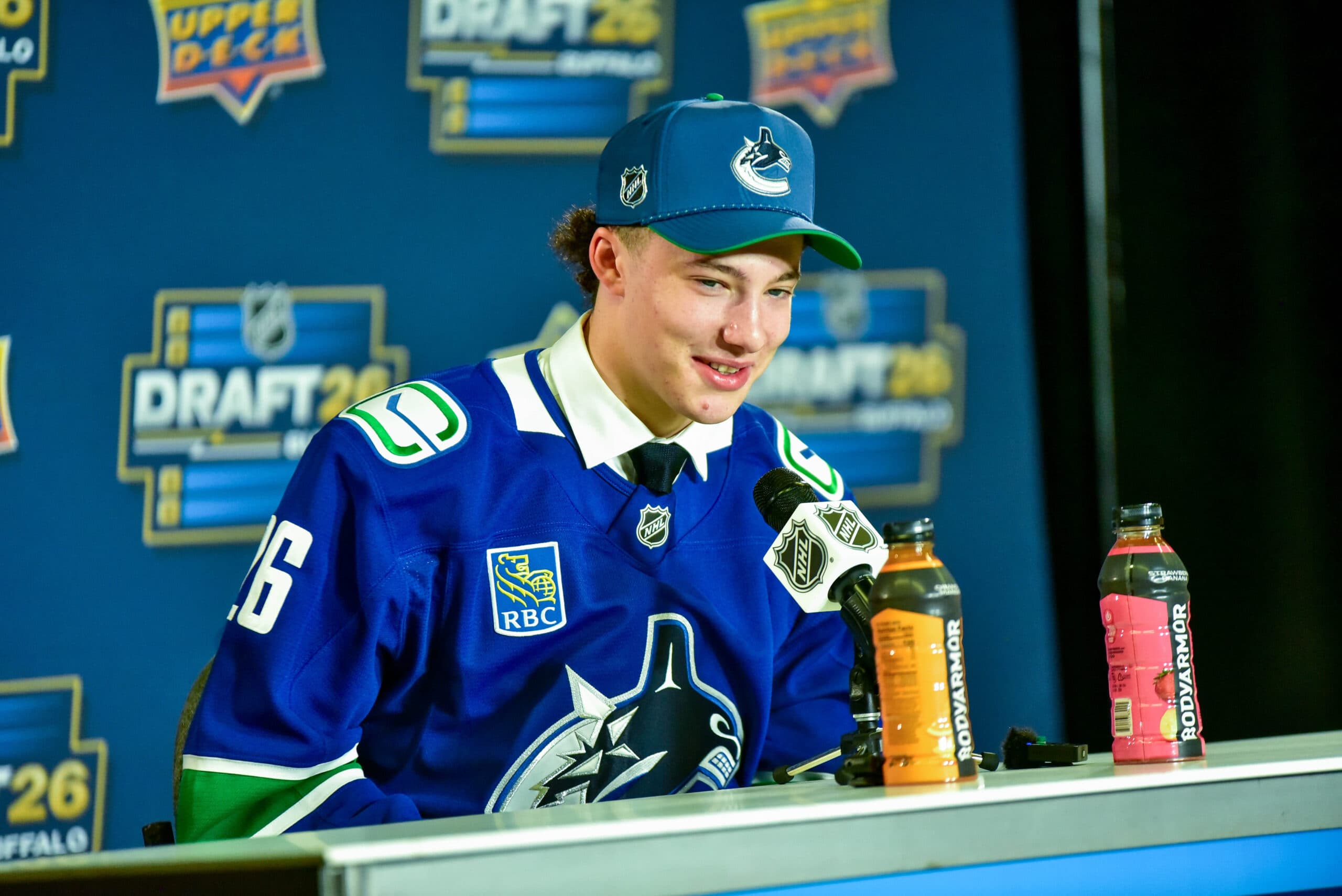
Photo credit: Steven Ellis | The Nation Network

Aug 5, 2026, 10:00 EDTUpdated: Aug 4, 2026, 22:48 EDT


Over the past 20 days, we’ve released our latest ranking of the top 20 Vancouver Canucks prospects. As always, those were published in the form of individual write-ups, and as always, we’ll put them all together here in one easy-to-find place, with an excerpt from each player’s write-up for each. Here is our ranking of the Canucks’ top 20 prospects, starting with number 20!
20 – Basile Sansonnens
The 2024 seventh-round pick isn’t going to wow anyone offensively. He recorded just three assists during the regular season to go with a goal and an assist in five games at the World Juniors. At this point, there’s little evidence to suggest offence will ever become a significant part of his game. Fortunately, that’s not why the Canucks drafted him. At his core, Sansonnens is an aggressive, defence-first blueliner who thrives in shutdown situations and penalty-killing roles. Whether battling in the corners or clearing the crease, he’s consistently willing to engage physically. He uses his active stick effectively to disrupt passing lanes and separate opponents from the puck. Standing 6-foot-4 and weighing 205 pounds, he already possesses a pro-ready frame and isn’t afraid to use it. That physicality was overwhelming at the QMJHL level, but perhaps more encouraging is that it’s already translating against professional competition.
19 – Wilson Björck
Offensively, Björck brings more creativity than he often gets credit for. Rather than simply playing at one speed, he has an excellent understanding of when to slow the game down. He regularly scans the ice before receiving the puck, buys himself an extra second with subtle changes of pace, and is capable of finding teammates through traffic or using his quick release to beat goaltenders from dangerous areas. He’s a smart player who processes the game well, allowing his hockey sense to compensate for some of the physical disadvantages he’ll continue to face. Those disadvantages remain the biggest question surrounding his projection.
18 – Ty Young
For a 21-year-old netminder, hitting a sophomore slump is practically a rite of passage. Goalie development is rarely a straight line upward, and minor speed bumps along the way are typically nothing to be concerned by. Young still possesses the raw, unteachable traits that the Canucks’ brass — particularly Ian Clark — covet. He’s got a solid 6’3″ frame, good length, moves well laterally, and naturally seals the ice effectively. Young’s developmental foundation remains strong, and a single season dip in numbers doesn’t erase his high-end toolkit. Assuming the Canucks carry three goaltenders and that Nikita Tolopilo mostly spends his time on the NHL roster, Young is going to be battling it out with fellow young goaltender Aku Koskenvuo for AHL starts down in Abbotsford.
17 – Gabe Chiarot
Chiarot’s outlook remains the same. He is your prototypical bottom-six, grind-you-down style of power forward. He’s aggressive along the walls and on the forecheck, retrieving pucks for his more offensive linemates. Chiarot isn’t afraid to go to the greasy areas in front of the net, but don’t expect him to be any sort of driver of offensive plays. That’s just not his game, and that’s okay.
16 – Connor Davis
The first thing you’ll notice when watching Davis play is his never-ending motor. His feet are always moving in both ends of the ice. Offensively, he picks up speed to pull off dekes to the outside, constantly keeping defenders on their toes. When the offensive side of his game isn’t flowing, Davis uses his motor on the forecheck to pressure opposing defenders into a quick decision, sometimes leading to turnovers, or on the backcheck to retrieve pucks and quickly transition back to offence. In our short viewings of Davis at Canucks Development Camp, we were really impressed with his shot.
15 – Anthony Romani
The steps that Romani has taken since being drafted, as well as between his first eligible draft year in 2023 and the year the Canucks took him in 2024, have now made him a player that could hold some legit NHL prowess. When it comes to Romani, the first trait that absolutely jumps off the page is his elite shot. Half his points this past season are goals, and it’s because of his high-end release, particularly off the rush. Romani can control the pace of play and find areas all over the ice where he can get his shot off and beat goaltenders. This goes along with his high-end offensive awareness; with both his shot and IQ paired together, it makes for projectable NHL skills.
14 – Yaroslav Bryzgalov
Bryzgalov isn’t a dynamic skater by any stretch of the imagination. His top speed and stride remain the biggest obstacles standing between him and professional success, and they’ll almost certainly be the primary focus of his development moving forward. Ironically, though, those skating limitations may have helped shape the style of play he’s developed. Rather than trying to outskate defenders, Bryzgalov slows the game down. He uses patience to draw opponents toward him before exploiting the space they’ve left behind. Combined with soft hands and impressive vision, he routinely uses that space to find passing lanes most would find difficult and combines soft hands and quick touches to make those lanes count.
13 – Kieren Dervin
Dervin is a high-IQ player at both ends of the ice. Offensively, he has a lot of skill and does well to attack defenders, while having the ability to create for himself all over the ice rather than sticking to the perimeter. Defensively, he’s smart as well, typically in the right spots to disrupt plays. He’s also very good at creating turnovers and starting breaks, creating offence off the rush. He’s a smart, creative player with a lot of the tools to be successful at the NCAA level. That being said, he’s going to need to get stronger, and although he plays a competitive style, he needs to add more aggression to his game to have success at the next level.
12 – Vilmer Alriksson
The towering winger isn’t just a big body; he’s got some offensive flair to his game with his skill, and he’s actually a fairly solid skater. Since being drafted, Alriksson immediately made the jump over to North America, playing two seasons in the OHL with both the Guelph Storm and the Brampton Steelheads. Now, this past season he spent the full year in Abbotsford, making the jump to the pro level. The point totals this past year are underwhelming, with just six goals and three assists for nine points in 43 games. Let’s keep in mind, though, that this was his first season of pro hockey and the expectation for Alriksson at this point shouldn’t be to put up big numbers. He was drafted as a project — he doesn’t have high production anywhere he’s played since his draft year. It’s going to take some time before we see Alriksson find his footing offensively.
11 – Dmitri Ivchenko
Ivchenko plays a composed game inside his crease. At 6-foot-3, he’s got good size and maximizes his frame by maintaining quiet feet and keeping his toes right along the edge of the blue paint when challenging shots. He’s also very comfortable in his post play, frequently utilizing the Reverse VH (RVH) drop on plays in tight, which aligns with how the Canucks want their goaltenders to play. When forced into uncomfortable situations, he relies on strong athleticism and his strong second-effort compete level to make some real highlight-reel saves.
10 – Ty Mueller
This past season, Mueller became more of a shooter and found success on the power play, doubling his previous goal total with the man advantage from the year prior. He’s got a sneaky release that can catch opposing netminders off guard, and with the puck on his stick more, further developed his playmaking ability. In his first two-game stint with Vancouver in 2024-25, Mueller played a more sheltered role. However, when the Cochrane, Alberta native got that two-game stint in 2025-26, he brought that offensive momentum with him in Vancouver, picking up his first NHL assist on Curtis Douglas’ first NHL goal, and lit the lamp himself in Edmonton with friends and family in attendance.
9 – Sawyer Mynio
With Mynio’s play, there is a lot to like. Offensively, he has very good vision, he moves and skates well, and he has a big point shot. Defensively, it’s the same kind of thing: he moves and skates well, he’s smart, and he knows where to be. Overall, he’s just a very solid two-way defenceman who has shown he can be relied on in all situations. The biggest hindrance to his defensive game, currently, is his size. Listed at 6’1”, 185 lbs, Mynio needs to get stronger if he’s going to really turn himself into an NHL defenceman.
8 – Niklas Aaram-Olsen
The most exciting parts of Aaram-Olsen’s game are his elite shot and his excellent puck handling skills. He’s a difference maker offensively and is a scoring threat all over the ice. He has a rocket of a one-timer, but can also beat goaltenders clean with his combination of power and accuracy. On top of the high-end skill and shooting ability, Aaram-Olsen shows some very high hockey IQ, along with good athleticism and skating ability. He has the ability to fly up and down the ice using his speed to get in on the forecheck and to get back on the back check.
7 – Riley Patterson
A summer move from the Barrie Colts to the Niagara IceDogs provided him with the newly formed role and responsibility he had been searching for, and he responded to that opportunity with a career year. After spending much of his first two OHL seasons cycling through Barrie’s lineup and frequently spending his shifts glued to the wing, Patterson erupted and became Niagara’s undisputed offensive leader. The Etobicoke, Ontario native finished the regular season with 40 goals and 84 points in 60 games, establishing career highs across the board while finishing tied for third in the OHL’s goal-scoring race. He also led Niagara by 10 goals and held a staggering 26-point advantage over the next-closest player on the team.
6 – Brooks Rogowski
The first thing that pops when it comes to Rogowski is his size. He’s a 6’7″ 235-lb centremen. Of course that’s the first thing to catch everyone’s eye, but there’s so much more to his game that makes him an excellent prospect. Occasionally, players with Rogowski’s stature will struggle with their skating early on in their careers as they’re still growing into their bodies. In his case, though, he’s already a very fluid skater. His first step needs some work; he needs to get a bit more explosive. However, once he gets going, he can fly up and down the ice, using his long stride to his advantage. On top of being a very solid skater, Rogowski is a good puck handler. He’s by no means a Patrick Kane-esque dangler, but he has the skill to make plays in tight at the front, as well as beat defenders one-on-one.
5 – Kirill Kudryavtsev
Kudryavtsev remains one of the best developmental stories within the organization. But a lot of credit has to go to the player as well. He has been on a steady trajectory throughout his two years in Abbotsford, largely due to his work ethic and reliability. Kudryavtsev is a coach’s dream because, no matter the situation, the Yaroslavl, Russia, native can be thrown out on the ice and excel in all three facets of the game. And he’s able to do all of this despite being just 5’11” tall. However, he leans into his stocky lower body and over 200-lb frame, which helps his confidence to box out the opposition positionally and keep the play in front of him. While he may not be the most physically imposing defenceman, his active stick remains elite. Kudryavtsev uses his stick to disrupt plays, knock the puck off his opponents’ sticks, win loose-puck battles, and easily turn his team on the transition heading back up the ice.
4 – Aleksei Medvedev
The things that stood out about Medvedev in his draft year haven’t changed. The size, athleticism, compete level, technical ability, puck-tracking ability, and more are all of high quality. He uses his long frame and flexibility to recover on second chances and make highlight-reel saves that would be in the back of the net against most goalies. His lateral pushes are explosive, and his ability to seal the lower portion of the net is still downright impressive. Medvedev’s baseline level of elite intangible qualities gives him a high enough floor that makes us firmly believe in his potential. To put it simply: technique and details can often be cleaned up somewhat easily when a goaltender has the physical tools that Medvedev does.
3 – Adam Novotný
The first thing you’ll notice when you watch Novotný’s game is his unbelievable shot. The proof is in the pudding; the kid scored 34 goals last season, his release is quick and deceptive, and he doesn’t need much time or space to unleash his shot. Novotný does a great job of attacking the middle of the ice and is very dangerous off the rush because he doesn’t need a ton of space to get his shot off; he’s able to attack the middle of the rush, rip a shot and beat the goalie clean. He may be considered a sniper, but Novotný is also a very capable playmaker; opposing teams see him as more of a shooting threat, which opens passing lanes for him to find his teammates and give them scoring chances. On top of being a major threat in the offensive zone, Novotný plays with a ton of compete. He uses his size to separate defenders from pucks on the forecheck and plays a high-energy game. He’s fairly responsible defensively as well; though he led the Petes in scoring, he was also used in late-game defensive situations to help the team get the win.
2 – Braeden Cootes
Cootes has never been the flashiest offensive player; however, his B-game is what sets him apart from his peers. He is a dog on the forecheck with a never-ending motor, hounding puck carriers, making his opposition uncomfortable, and often forcing turnovers. His hockey IQ is his strongest asset. He knows when to step up to pressure opponents, and constantly scans the ice to assist in finding the right play for his teammates in the offensive zone. And to complement his brains on the ice, Cootes also has the foot speed to keep up with his forward-thinking style of play. Cootes processes the game well, carries a deceptive shot, is defensively sound, and is trusted in all three facets of the game. Add all of that to his high-end compete and leadership qualities at just 19 years old, and it’s not hard to see the many pathways for Cootes to make an impact at the NHL level as early as the upcoming 2026-27 season.
1 – Caleb Malhotra
Offensively, his identity remains rooted in playmaking. By trade, he is a pass-first centre who thrives when drawing pressure toward himself before moving the puck into the space that pressure creates. He is comfortable operating at different speeds and does not need to attack every possession with pace. In fact, he is often at his best when slowing the game down. Malhotra has a knack for understanding how defensive coverage shifts around him. He can hold onto the puck long enough to force a defender out of position, wait for a passing lane to develop and then connect with a teammate through traffic. His vision is especially impressive around the slot and near the crease. He navigates congested areas well, uses his hands to avoid sticks and remains composed when surrounded by defenders. Rather than panicking under pressure, he draws opponents toward him, escapes contact and finds teammates arriving in open space. Going forward, the concern is not whether he possesses enough skill.
Sponsored by bet365


Breaking News
- How Canucks’ Cootes is doing compared to other 2025 first-round picks playing in the AHL
- Scenes from practice: Pettersson and Boeser reunited as Canucks skate at UBC on Saturday
- Abbotsford Canucks preview: Players to watch in weekend rematch with the Wranglers
- How the Canucks can fix their early-season defensive breakdowns
- ‘Glad to be somewhere I’m wanted’: Jacob Quillan excited for new opportunity with Canucks

Vancouver CanucksTeam Cap Summary

Cap Summary
2026-27
2027-28
Projected Cap Hit
$87,295,050
$71,329,167
Projected Cap Space
$16,704,950
$42,170,833
Current Cap Space
$19,063,296
$42,170,833
Active Players
23/23
13/23
Draft Picks
Round
'27
'28
1
1
1
2
2
2
3
1
1