
CanucksArmy has no direct affiliation to the Vancouver Canucks, Canucks Sports & Entertainment, NHL, or NHLPA
Why the Canucks’ offer sheet options will be limited to just the biggest ones this summer
Photo credit: © Bob Frid-Imagn Images

Apr 5, 2026, 14:00 EDTUpdated: Apr 6, 2026, 12:21 EDT


Trades. Draft picks. Free agent signings. Hirings. Firings.
The Vancouver Canucks are probably going to do a little bit of everything in what promises to be another busy and consequential 2026 offseason.
But if there’s one particular type of transaction that probably won’t occur, it’s an offer sheet.
On the home front, the Canucks have absolutely nothing to worry about when it comes to incoming offer sheets. Unless they acquire someone new in the interim, they’ve got exactly one pending RFA at the NHL level in Pierre-Olivier Joseph, and with all due respect to Joseph, he’s not the type of RFA to receive any offer sheet interest.
And it’s almost as unlikely that the Canucks send out any offer sheets of their own, too, albeit for different reasons.
In order to make an offer sheet – which, for the uninitiated, is a contract offer made from one team to another team’s unsigned restricted free agent, to which said team may respond by matching the contract or accepting pre-determined compensation – a team needs to have the requisite compensatory draft picks already in place.
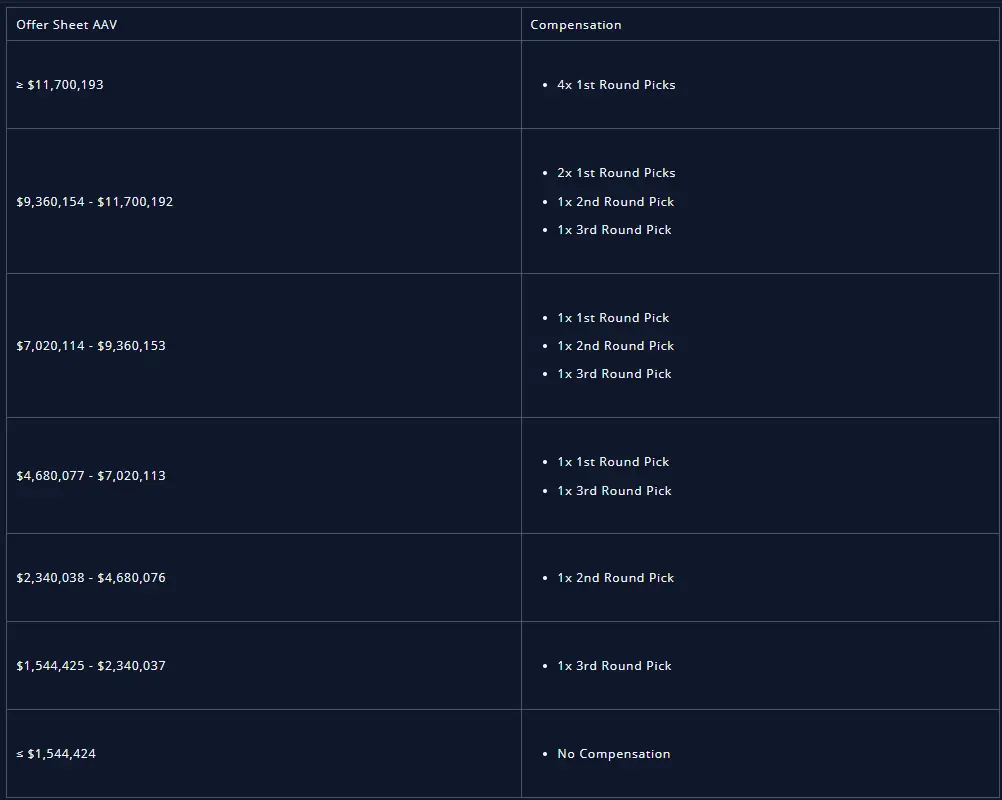
The exact compensation slate for 2026 offer sheets has yet to be released, but it’ll be similar to last year’s, just with slightly higher thresholds on each tier due to the rising cap ceiling:
 PuckPedia
2025 Offer Sheet compensation, from Puckpedia
A couple of things bear mentioning anytime we talk about offer sheet compensation. One is that, although an offer sheet can be for any length of term, any offer over five years is treated as a five-year offer for the purposes of determining compensation. In other words, a seven-year, $35 million has a $5 million AAV in the real world, but would be treated as if it were a five-year, $35 million offer in terms of compensation, meaning it would fall into the $7 million tier.
None of that is particularly relevant to the Canucks right now, for reasons that will be explained as we go. But what is more relevant is the fact that offer sheets occur during the free agency period, which occurs after the Entry Draft.
So, it is always a team’s next set of draft picks that must be made available when making offer sheets. For any offer sheets made during the 2026 offseason, it is 2027 draft picks, and perhaps beyond, that must be available.
For the Canucks, that seriously limits their options. The Canucks already traded their 2027 second round draft pick way back in June 2024 when they attached it to Ilya Mikheyev in order to get Chicago to take him.
The Canucks do have two other 2027 second rounders, brought back from the Kiefer Sherwood and Tyler Myers trades, but offer sheet compensation can only come from a team’s own draft picks.
Therefore, unless the Canucks trade with the Blackhawks to get that pick back, they’re unable to make any offer sheets in the third, fifth, and sixth compensation tiers, as each of them require a team to have their own 2027 second round pick in place. That leaves just the bottom two rungs, the middle one, and the uppermost tier.
We can safely leave those two bottom rungs aside for now. Offer sheets just aren’t made in that range, and so we can forget about the Canucks burning one on someone who makes less than $2.3 million or so – never mind the unlikelihood of a team letting someone valuable go for such little salary and such little compensation.
That brings us to the middle tier, in which an offer sheet between the AAVs of about $4.7 million and $7.1 million – again, these numbers will be slightly inflated by this summer – comes with compensation of one first round pick and one third round pick, if successful.
The Canucks would not be barred from making such an offer. They’ve got their own 2027 first and their own 2027 third in place. But finding anyone available at that price who is also worth that compensation is an exercise in futility.
We can find a number of intriguing pending RFAs who might be able to be pried away for an offer in that range. There are some highly-skilled young forwards out there like Buffalo’s Zach Benson, Winnipeg’s Cole Perfetti, Columbus’s Cole Sillinger, and New Jersey rookie Arseny Gritsyuk, who would absolutely be worth it if a $7 million-ish contract were all it took to nab them.
But it’d be that contract, plus a 2027 first and a 2027 third. And, by the nature of offer sheets, that first round pick would be an unprotected one.
Suffice it to say that the Canucks are looking very likely to stay in the standings cellar for the 2026-27 season, and that their 2027 first round pick is thus very likely to be a lottery pick. And then suffice it to say that none of the names we’ve listed above come anywhere near being worth even a potential lottery pick.
So, that more or less wraps up the middle tier of offer sheets for the Canucks. It’s not happening.
That leaves us with the uppermost tier. That’s the $11.7 million+ tier, which will be a $12 million+ tier by the time we hit the offseason, and that’s the tier that demands four of a team’s next five first round picks.
It’s the most exciting tier, and it’s also the only one the Canucks have any real business considering this offseason.
At this tier, we’re talking about the best of the best, and there are some great names to be talked about. But are there any names that might truly be worth four first round picks, never mind a gargantuan new salary on top of it?
There may actually be.
Rookies Cutter Gauthier of Anaheim and Alexander Nikishin of Carolina are very interesting players who might be sitting close to “worth it” at that price. Either way, however, they’re “10.2C RFAs” who do not have the requisite pro experience to receive an offer sheet, and are thus ineligible. So, forget about them.
Detroit’s Simon Edvinsson is eligible, and is very interesting, but is probably not someone the Canucks would target, and might not be worth four Vancouver first rounders at the end of the day.
But two names that may be worth it in every sense of the word are Anaheim centre Leo Carlsson and Chicago centre Connor Bedard.
The 21-year-old Carlsson, selected second overall in the 2023 Entry Draft, broke out in a big way in his third NHL season. For a minute there, he was pacing for about 100 points. He’s since slipped back to “mere” PPG status with 64 points in 65 games to date, though a few minor injuries may be to blame there.
In any case, Carlsson arrived as a franchise centre this season, and looks to remain as such for another decade, at least.
Then there’s Bedard, the only player selected ahead of Carlsson in that 2023 Draft. We don’t need to waste too much digital ink telling Vancouver fans about their hometown hero. Bedard broke out even harder than Carlsson this year with 71 points in 64 games, and did so on a decidedly non-playoff roster.
Both players are absolutely elite centres about to enter their full playing primes. Either Carlsson or Bedard are good enough to become figurative and literal centrepieces to the Canucks’ rebuild. Either would be exactly what the franchise is missing, and exactly what it will be looking for elsewhere if not here. But to say that either is truly worth an offer sheet takes a bit more consideration.
Four first round picks is an awful lot to pay, especially if any of those picks end up being lottery picks. Here, the nature of the top tier might be a boon to the Canucks. They could choose to hold on to their 2027 first rounder, specifically, and instead give up their 2028 through 2031 picks with a top-tier offer sheet. That 2027 pick is the one most likely to be a lottery pick, and maybe the Canucks are thinking they can pull themselves out of the basement by 2028.
Would four picks in the, say, 10-20 range of the first round be worth a Carlsson or a Bedard? That is starting to sound more realistic. One might ask if the Canucks are likely to draft four players with the cumulative value of a Bedard or a Carlsson with those picks, and the answer to that is “probably not.”
But then there’s the salary. Because to succeed in making an offer sheet, a team has to make an offer that the owning team is unwilling to match. And for players as good as Carlsson and Bedard, that brings us to some truly astronomical numbers.
Think about it. If your team had these players already in hand, what salary amount would be worth walking away from?
Could the Canucks steal Bedard away for, say, $15 million? Probably not! The Blackhawks might not be happy about it, but they’d still be likely to match that contract and deal with the issues it creates some other way.
Could the Canucks steal Carlsson away by matching the highest cap hit in the league, as in Kirill Kaprizov’s $17 million? Maybe! The Ducks do have an awful lot of other young talent to get under contract. But we’re still talking about straight-up stealing a 1C here. There is still the possibility that such an offer gets matched.
What if the Canucks went really off-the-board and made an offer sheet to Bedard at maximum salary, which will be somewhere north of $20 million for the 2026-27 season. At that point, do the Blackhawks walk away and take the compensatory first rounders?
Yeah, they probably do. But then the Canucks would have almost one-fifth of their salary structure tied to one player for the foreseeable future, they’d be down four first round picks, and they’d have a brand-new organizational enemy out for revenge.
In other words, there’s probably nothing much to hope for here. The only players truly worth the Canucks’ while when it comes to 2026 offer sheets are the kinds of players who are worth everyone’s while, and that means luxury spending in every sense of the word.
The safer move, and almost certainly the wiser move, is to take a more patient and measured approach to the rebuild.
PRESENTED BY PACIFIC TOYOTA DEALERS

Need performance without compromise? Check out the Toyota Prius Plug-In Hybrid. Enjoy up to 72 km of electric range on battery alone. Heading farther for an away game? It seamlessly switches to gas for a combined 962 km range. It’s a total power play on the road with a sleek design and sophisticated, tech-loaded interior. Plus, you can recharge easily at home or utilize over 2,000 public charging stations in BC. Experience range, style, and versatility. Visit your local Pacific Toyota dealer during Red Tag Days for limited-time offers.


Breaking News
- Canucks: What happened the last time a controversial former captain returned to Vancouver?
- Scenes from morning skate: Canucks looking to snap winless skid and spoil Quinn Hughes’ homecoming
- Canucks place defenceman Jack Thompson on NHL waivers
- Could the Canucks swing a trade for Capitals forward Ivan Miroshnichenko?
- Canucks’ Ohgren responds to healthy scratch: ‘I know I have to play harder’

Vancouver CanucksTeam Cap Summary

Cap Summary
2026-27
2027-28
Projected Cap Hit
$87,295,050
$71,329,167
Projected Cap Space
$16,704,950
$42,170,833
Current Cap Space
$19,176,096
$42,170,833
Active Players
23/23
13/23
Draft Picks
Round
'27
'28
1
1
1
2
2
2
3
1
1