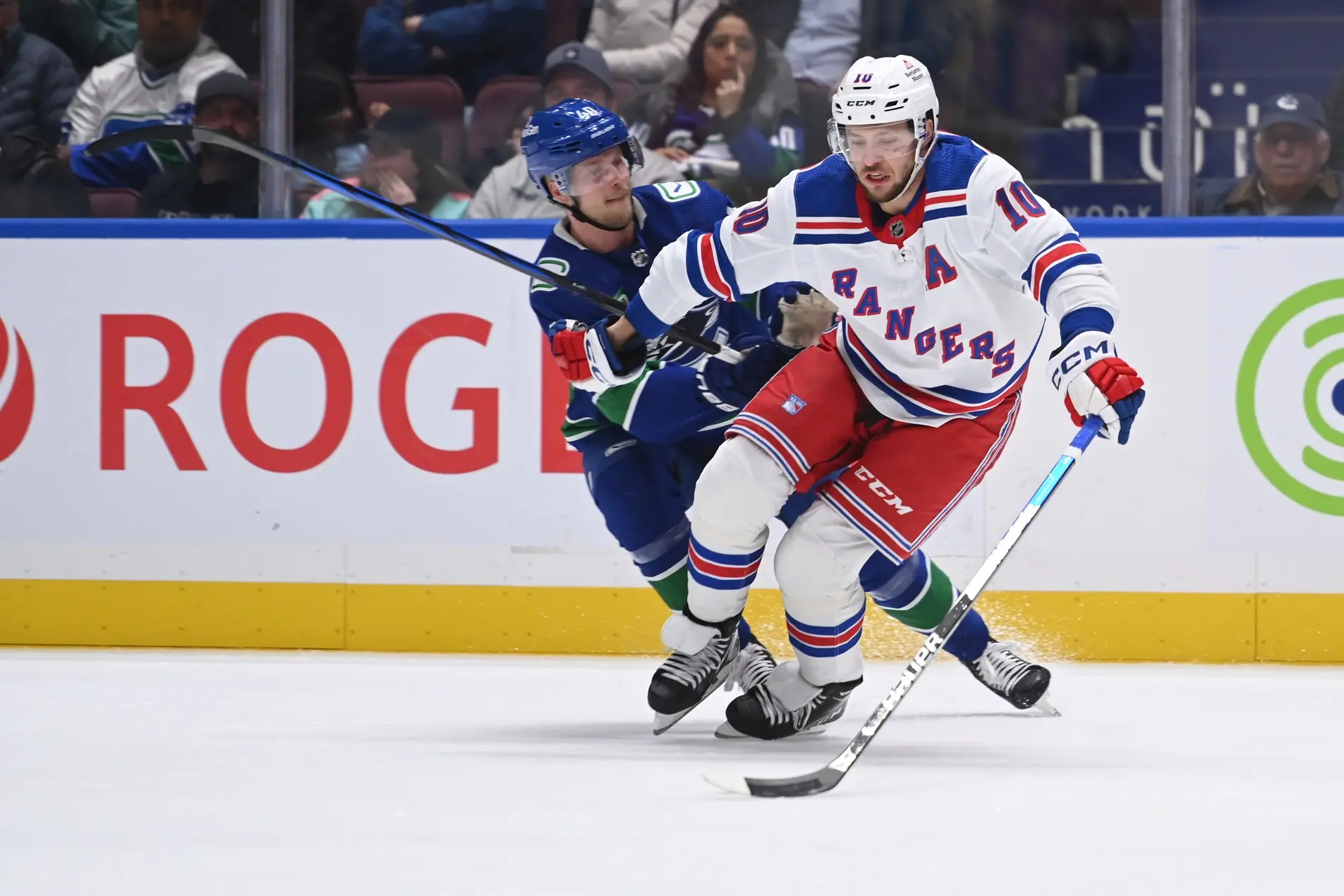
“If this is what a bona-fide elite player like Panarin gets when choosing his destination, what does that mean for Elias Pettersson?”
That same Artemi Panarin, who has been an elite first-line forward in the NHL since his debut in 2015-16, and who was above a point-per-game this season for a disastrous Rangers club that sits dead last in the Eastern Conference.
In the last three seasons, Panarin has scored 105 goals and 161 assists over 214 games. At 5-on-5 over that same timeframe, Panarin RANKS FIFTH in the NHL in points (148) and THIRD in goals (70), tied with Auston Matthews.
Having full control of where he gets traded to, on the promise of an extension on the receiving end of the deal, and with 50% of his contract retained, the 34-year-old Panarin returned a conditional 3rd-round pick that can become a 2nd-round pick IF the Kings win a single playoff round, a conditional 4th-round pick if the Kings win TWO playoff rounds, and 20-year-old, 6’2″ left-shot defensive prospect Liam Greentree.
I think you know where this piece is going. Unfortunately, the “Will Elias Pettersson waive? And would/should/will the Canucks trade him?” will become the Ross/Rachel “will they? won’t they?” of our time.
Pettersson, 27, has an ironclad No-Move Clause on his contract that carries an annual cap-hit of $11.6-million. The man they once called “The Alien” for his otherworldly performance is in year two of an extension that lasts until 2031-32. In year one, Pettersson drew significant criticism from head coach Rick Tocchet, management, and the market, for his poor play, dismal production (45 points in 60 games), and seemingly nonchalant attitude toward his spiralling form.
In the last three seasons, Pettersson has scored 62 goals and 106 points over 195 games. At 5-on-5 over that same timeframe, Pettersson ranks 98th in the NHL in points (85), tied with Gabriel Vilardi, Dylan Larkin, Adam Fantilli, and Mason Marchment, just one more point at 5-on-5 than the following players: Warren Foegele, Artturi Lehkonen, Anthony Cirelli, Mason McTavish, Sean Monahan, and Claude Giroux. Pettersson’s 31 goals at 5-on-5 rank 137th in a tie with Quinton Byfield, Sean Monahan, Jordan Staal, Brendan Gallagher, Will Cuylle, Anthony Duclair, Brett Howden, Yegor Chinakhov, and teammates Conor Garland and Nils Höglander!
There’s a lot to unpack from those player production comparables.
Instead, let’s identify a few of those players and their situations for management’s consideration as they regroup over the Olympic break before returning for another 25 games of Canuck hockey.
While not an ironclad No-Move Clause, Marchment is in the final year of a 3-year contract that carries a $4.5-million-dollar cap hit and has been moved twice since last summer. The Dallas Stars traded Marchment for a 2026 3rd-round pick and a 2025 4th-round pick to the Seattle Kraken. Mid-season, the Kraken traded Marchment to the Columbus Blue Jackets for a 2026 4th-round pick and a 2027 2nd-round pick. Marchment has 13 points in 14 games with the Blue Jackets and 26 points in 43 games this season.
Both the Stars and the Kraken viewed the cap space as more valuable to what they need to accomplish in their current windows than Marchment’s reliable 5v5 production.
One of the all-time “what ifs” of Canuck drafting history. I’m still holding out hope that D+1 right-shot defenceman Adam Polasek will suit up for Vancouver, but it’s looking like a long shot that he’ll play more games than the kid who spent years lighting it up for the Giants in the Canucks’ backyard.
I digress. In year one of a six-year extension featuring a six-team No-Trade Clause and an ironclad No-Move Clause throughout the entirety of the deal, Gallagher’s production and play completely fell off. After highs of 31, 33, and 22 goals from 2017-2019, Gallagher’s best goalscoring season did not come until year four of his deal.
A consummate professional who is frequently cited as one of the Habs’ best “culture carriers,” the Habs in the Jeff Gorton era valued the leadership qualities, grit, and tenacity of Gallagher over the potential value lost by having his contract count against their books during a time of rebuilding.
Now, Larkin is a bit of an outlier here in that he wasn’t traded. However, until his extension that kicked in for the 2023-24 season, he was frequently on trade boards and subject to trade speculation.
Larkin’s current deal carries a cap hit of $8.7-million with a full No-Trade Clause until 2027-28, before a 22-team No-Trade List takes effect over the final three years. Larkin is on pace to record his fifth straight 30-goal season while captaining a Detroit Red Wings team to a playoff spot, sitting 3rd-place in the Atlantic Division with 72 points through 58 games.
Assuming Detroit’s play holds up after the Olympic break, Larkin will be the first Red Wing to captain his team to a playoff berth since Henrik Zetterberg! Remember that the last time Detroit was close to a playoff berth, they were eliminated because John Tortorella’s Flyers gave up an empty net goal while chasing a regulation win for a playoff berth of their own.
Despite being mired in a decade straight of playoff absences and an Yzerplan that took much longer than to come together than anyone could have reasonably expected, the Red Wings held onto a true leader, who routinely faced the music with the media, and one who has always been brutally honest about the state of his team, their results, their individual performance, and backed up that talk with his performance on the ice.
Not featured on the list of production comparables over the last three seasons was Ondrej Palat, whose production fell off precipitously after leaving the Tampa Bay Lightning at the end of their 2022-23 postseason.
After reaching double-digit goals in eight of his 10 seasons with Tampa, Palat signed a five-year contract with the New Jersey Devils carrying an annual cap hit of $6-million-dollars and an ironclad No-Move-Clause throughout and a modified No-Trade Clause in the final two years of the deal.
Palat’s production pace dropped every season after leaving Tampa, bottoming out this season in New Jersey, with 10 points through 51 games. His place in the lineup and contract against the cap proved devastating at a time when the Devils were supposed to be contending and vying for the services of Quinn Hughes in trades.
In a move that was arguably “too little, too late” for Devils’ GM Tom Fitzgerald, Palat was shipped to the New York Islanders with a 3rd-round pick in 2026 and a 6th-round pick in 2027.
I’m not suggesting that Elias Pettersson is going to cost Vancouver assets to ship out. However, I am suggesting that the management group that hasn’t had a bet go their way in over two seasons needs to channel every bit of energy into determining whether Pettersson will become a Larkin or a Gallagher to this rebuilding era, or a Palat or Marchment type for the era to come.
Without naming names, Canucks players and coaches have spent time directly and indirectly lobbing criticism at the “leadership” and culture of the team. Before taking the job, this organization was roundly criticized for operating like “a country club.” Since taking the job, this management group has traded or let walk players they publicly acknowledged as culture carriers or leaders of the room. Bo Horvat, J.T. Miller, Quinn Hughes, Kiefer Sherwood, Luke Schenn, Ian Cole, Nikita Zadorov, and Dakota Joshua were all once held up as instrumental leadership figures. Keyword there being: once.
Now, when it comes to Elias Pettersson’s struggles, his contract that looks more and more onerous by the minute, and this management group, alarm bells are ringing.
Since the 2023-24 season, Patrik Allvin and Jim Rutherford handed over $400-million-dollars in contracts to Pettersson, Garland, Höglander, Sherwood, Jake DeBrusk, Dakota Joshua, Vasily Podkolzin, Teddy Blueger, Danton Heinen, Drew O’Connor, Tyler Myers, Filip Hronek, Vincent Desharnais, Derek Forbort, Marcus Pettersson, Thatcher Demko, and Kevin Lankinen. If you dial back to include contracts signed after the 2022-23 season, including J.T. Miller, Ilya Mikheyev, Curtis Lazar, Carson Soucy, and Andrei Kuzmenko‘s contracts, that’s half a billion dollars in contracts to players no longer contributing to the solution.
Among the above players, 11 remain on the active roster amid rampant trade speculation, 10 were traded mid-contract, and one was just shut down for the season due to hip surgery.
Given everything listed above, can you honestly look inside your soul and say that this management group knows whether Elias Pettersson is going to bounce back? They are generously 2/22 on contract bets for the above list of players who would provide value to them in the short term to give them the best chance to get into the playoffs year-over-year and convince Hughes to re-sign. Well, they were successful with one of those things (once), and failed at the other.
This organization already bet that Pettersson would return to his elite form once, before his No-Move clause had kicked in ahead of the 2024-25 season.
Knowing what a star like Artemi Panarin returned Chris Drury while in full control of his NHL fate on an expiring deal, with contract retention factored in, is it best to bite the bullet and take what you can get while there’s still something to be had? Or is it best to trust the group responsible for the above to get a character evaluation correct for the first time in a long time? I’m not sure this group can be trusted with either.
And we haven’t even touched on Conor Garland yet, who this management group extended this past offseason on a fairly reasonable six-year, $6 million AAV contract. The kicker, of course, is that right now, prior to that extension kicking in, Garland has zero trade protection. Next season — and for the next three after that as well — Garland’s contract carries a full no-move clause, and in the final three years, it’s a modified n0-trade clause.
The now-rebuilding Canucks have a complicated situation on their hands when it comes to Elias Pettersson, and their situation with Garland could get complicated if they don’t act soon. A nightmare scenario for the Canucks is that Garland — who right now has made no indication that he wants to leave his now-rebuilding team — decides in a year or two that he wants out. All of a sudden, the Canucks would find themselves heading into Garland trade discussions with almost no leverage. Of course, if the Canucks are serious about doing this rebuild right, they need to maximize the number of future assets they’re able to mine from their current veteran core.
That becomes a lot harder to do if they only trade their pending UFAs and decide too late into the process to get serious about moving out veterans with term on their deals.
Let this week’s Panarin trade serve as a warning that these things aren’t always easy to get right and that your hands can be tied more than you might’ve thought possible.
Let us know in the comments how the Panarin trade has changed/not changed your view of the Canucks’ work to be done this year.
Sponsored by bet365