
CanucksArmy has no direct affiliation to the Vancouver Canucks, Canucks Sports & Entertainment, NHL, or NHLPA
Canucks: Is Quinn Hughes worth a $17 million salary?
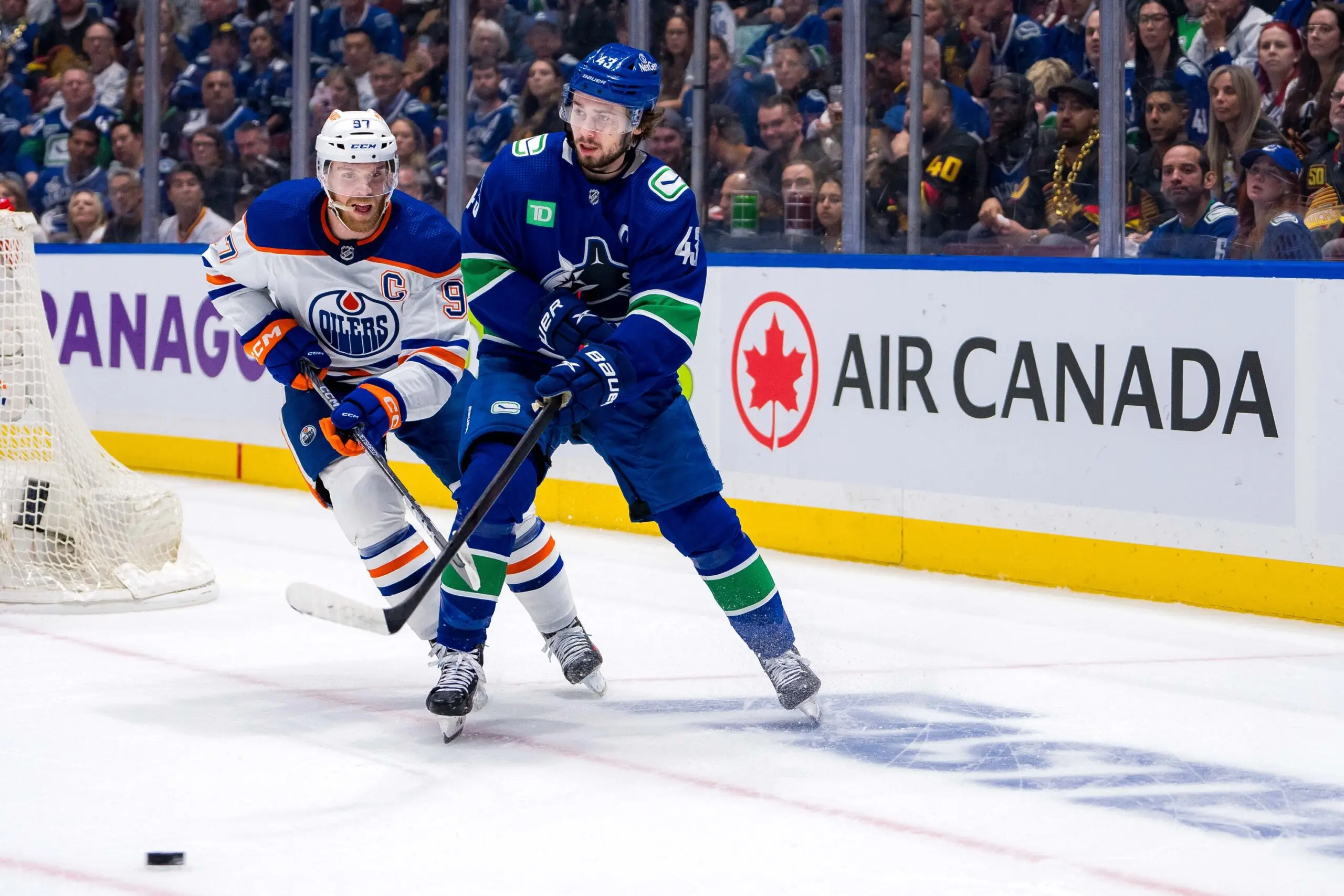
Photo credit: © Bob Frid-Imagn Images

Nov 10, 2025, 15:00 ESTUpdated: Nov 10, 2025, 13:51 EST


Way back in 1970, it cost the original ownership of the Vancouver Canucks a $6 million expansion fee to get the franchise up and running. Now, some 55 years later, it could cost the team more than double that to keep their franchise player in the fold.
We’re talking, of course, about captain Quinn Hughes, upon whose future contract status everything seems to be riding on right now. Even the latest burst of ‘rebuild’ talk has been centred around a feeling that the Canucks’ 2025-26 struggles will lead to his departure as a UFA in 2027. But that certainly hasn’t come to pass yet.
In the meantime, the Canucks still hold Hughes contractual rights for this season and the next, and should they hold onto him until July 1, 2026, they’ll be the first to be able to offer him his next contract. And, due to some changes in the new CBA, if they hold onto him for that long, they’ll be able to offer him far more money than anyone will after. In short, so long as the Canucks make the offer between July 1 and September 16, 2026, they’ll be able to offer Hughes a maximum contract length of eight years. After that, he’s down to a maximum of seven years if he’s re-signing with a team, and only six if he’s joining someone new.
Changes to bonus structure also means that, prior to September 16, the Canucks will be able to offer Hughes the majority of his compensation via signing bonuses, whereas after September 16, signing bonuses are capped at 60% of a contract’s value.
In other words, the Canucks, if they choose to press the advantage, will be able to offer Hughes more term and far more of his money up front than anyone else will thereafter. That means they should be able to make Hughes the largest offer he receives, by far. And that’s especially true if they negotiate openly on salary on top of those aforementioned advantages, by which we mean handing Hughes a blank cheque and allowing him to name his price.
But what might that price be, and is Hughes for sure worth any cost it might entail to retain him? That’s what we’re here to ponder today.
The National Hockey League has seen some truly staggering contracts signed of late. Sure, the big big one that everyone was expecting didn’t exactly materialize, with Connor McDavid electing to extend well under his maximum salary and term at two years, $12 million AAV with the Edmonton Oilers, but that was clearly a bit of an exception.
Auston Matthews set a new standard two years ago with a four-year, $13.25 million extension. That was bettered a year later by Leon Draisaitl’s eight-year, $14 million deal. We’ve put Draisaitl and Hughes head-to-head before and found them to make a roughly equal, borderline-MVP impact upon the game, so that contract makes plenty of sense as a Hughes comparable.
But Draisaitl’s deal will be almost two years old by the time Hughes signs his next deal, and that means two years out of date. Other, less-impactful players have signed in the interim, and signed for as much or even more. We’re talking Jack Eichel (eight years, $13.5 million), we’re talking Kyle Connor (eight years, $12 million), but we’re especially talking Kirill Kaprizov (eight years, $17 million).
Kaprizov, with his 408 points in 336 NHL games as of this count, is a genuine superstar and easily the greatest player in Minnesota Wild franchise history. We’re not here to perform a referendum on his contract, even if it is very clearly a case of someone absolutely maximizing their value. But we are here to state that, of the two, Hughes is the more impactful player, essentially across the board. Hughes is a one-time Norris winner and three-time nominee, whereas Kaprizov has finished in seventh place for the Hart Trophy once. With all due respect, it’s not even close.
Which means that, if he wants it to be, $17 million is the new bar of compensation on Hughes’ next contract. Really, the comparable is obvious: Kaprizov named his price for the Wild to hang on to him, knowing how desperate they were to do so. This closely mirrors at least the context of Hughes’ upcoming situation with the Canucks.
And there will be precious few other comparables to choose from. Right now the defender with the highest cap hit in the league is Erik Karlsson at $11.5 million, a number that Hughes should clearly eclipse. After that, it’s an open question – unless, of course, Cale Makar signs his own extension prior to Hughes, at which point he becomes the obvious standard. Those two are so far ahead of the rest of the pack of league defenders so as to be each other’s only real mutual comparable.
Even then, however, there’s really nothing to prevent Hughes from pointing at Kaprizov and saying, “Me too.” We don’t know that that’s necessarily going to happen, but it’s enough of a possibility to make it worth wondering: Is Hughes worth $17 million a year?
The shortest and simplest answer is probably that, if anyone is worth that, it’s Hughes. He’s currently leading the NHL in average ice-time at a staggering 26:54 a game, and doing his absolute best to hold his franchise up from total collapse as he does so. He’s this franchise’s all-time MVP in more ways than one.
A $17 million AAV extension, signed on July 1, 2026, would cover Hughes from ages 28 to 35, which isn’t exactly ‘prime,’ but is at least prime-adjacent. When signed, it would represent 14.9% of the projected cap for the eventual 2027-28 season, which is when the contract would take effect.
And when you put it in those percentage-based terms, it becomes tough to argue against. That 14.9% of the cap is barely more than the 13.2% that was represented by Elias Pettersson’s much-maligned $11.6 million AAV extension when it took effect as of last season. Are we really going to say that Hughes isn’t worth 1.7% more of the cap than Pettersson? Not likely.
Three players in NHL history have already had cap hits worth 15% or more of the total cap, those being McDavid, Matthews, and Nathan MacKinnon. When Kaprizov’s kicks in next year, it will be at 16.35%, setting a new standard.
At the end of the day, if anyone at all is worth such a large chunk of the cap, it’s difficult to say that Hughes is not one such player. Would a $17 million cap hit be difficult to navigate and construct the rest of a roster around? Sure, probably. Would it make it harder to build a winner? Almost certainly.
But if we’re talking just a pure, individual basis, then, yes, Quinn Hughes is worth $17 million a season, and will continue to be in seven months’ time when he actually becomes extension eligible. An eight-year contract at a $17 million cap hit equals a total value of $136 million, which will be far more than anyone else is ever able to offer Hughes, barring a pre-signing trade. From the Canucks’ perspective, that’s worth the price to retain their franchise player. Is it enough to make it worth that player’s while to stick around?
That will have to be waited upon and seen.
Sponsored by bet365


Recent articles from Stephan Roget
Breaking News
- The Stanchies: Jonathan Lekkerimäki notches a goal and an assist, and that’s all we’ll say
- ‘It’s embarrassing’: Brock Boeser brutally honest following Canucks’ ninth straight loss
- Instant Reaction: Canucks go nearly 40 minutes without a shot in 5-2 loss to Red Wings
- What’s behind ex-Canuck Conor Garland’s struggles in Columbus?
- NHL Notebook: Senators fans ruthless and creative in Brady Tkachuk’s return to Ottawa

Vancouver CanucksTeam Cap Summary

Cap Summary
2026-27
2027-28
Projected Cap Hit
$87,295,050
$71,329,167
Projected Cap Space
$16,704,950
$42,170,833
Current Cap Space
$18,951,815
$42,170,833
Active Players
23/23
13/23
Draft Picks
Round
'27
'28
1
1
1
2
2
2
3
1
1