


Jimmy Snuggerud scores on the power play. It's 3-1 Blues. 🎥: Prime Video | #Canucks

CanucksArmy has no direct affiliation to the Vancouver Canucks, Canucks Sports & Entertainment, NHL, or NHLPA
Canucks: Has Teddy Blueger’s absence made him an expendable asset?
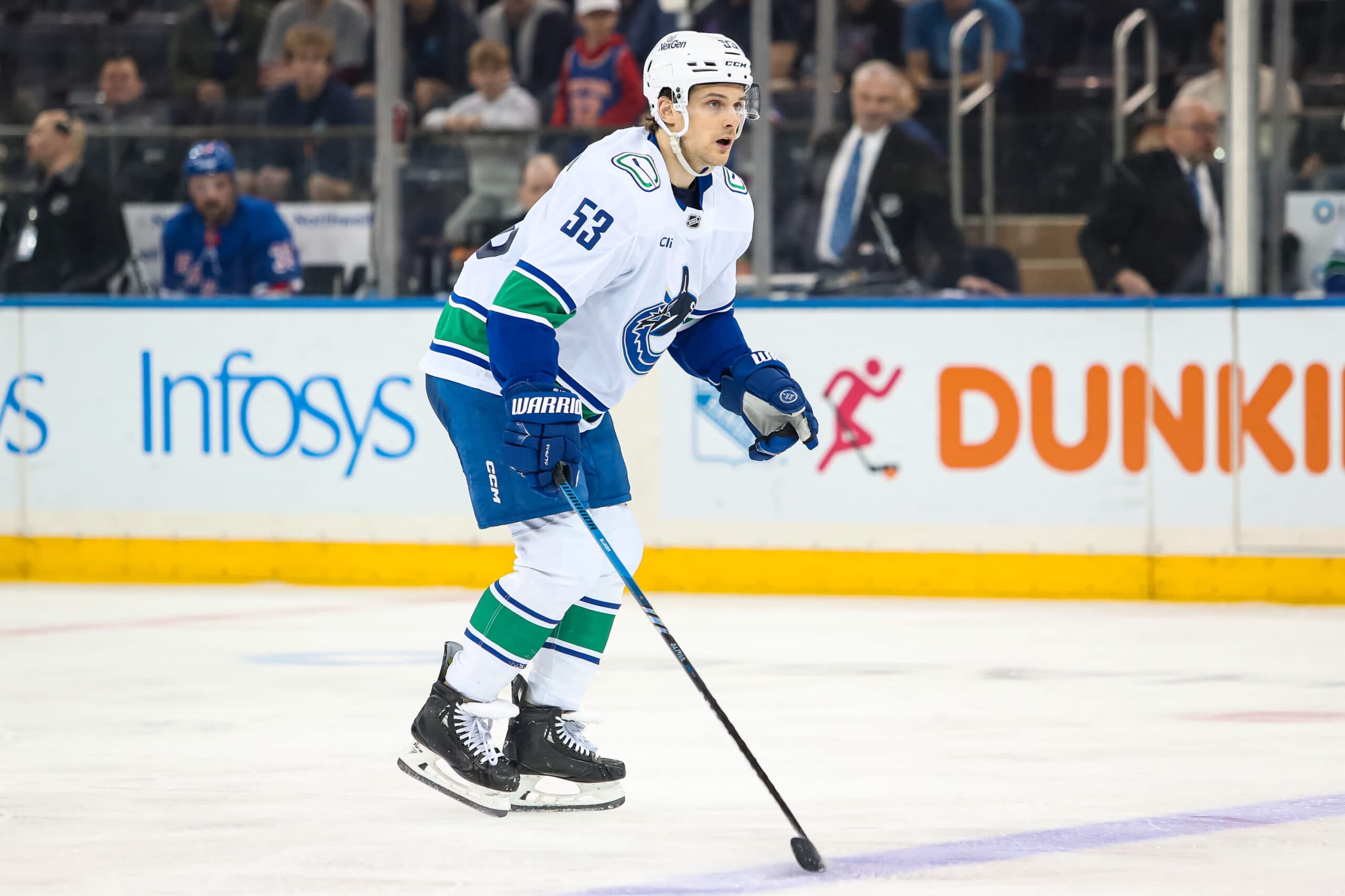
Photo credit: © Danny Wild-Imagn Images

By Tyson Cole
Oct 18, 2025, 16:35 EDTUpdated: Oct 18, 2025, 19:02 EDT
Teddy Blueger made his season debut last night as the Vancouver Canucks travelled to Chicago for a date with the Blackhawks.
In his debut, Blueger logged 12:57 minutes of ice time, finishing with three hits, two blocks and a minus-one rating. Blueger missed the first four games of the season with a knee injury suffered in the final preseason game against the Edmonton Oilers.
Coming into the season, the biggest question surrounding Blueger was who would play with him on the Canucks’ first penalty killing unit. There were some trade rumours surrounding him as it was reported that the Canucks were looking to clear cap room. However, those rumours cooled down after the Dakota Joshua trade, as the team valued Blueger’s penalty killing prowess and faceoff ability.
But after these first four games, have the players around him made Blueger expendable?
Don’t get it wrong, Blueger is still a valued member of the Canucks’ penalty kill. However, in his absence, the Canucks’ penalty kill didn’t really skip a beat.
Through the first two games, the Canucks were a perfect 9/9 down a man – 5/5 against the always intimidating Edmonton Oilers power play unit.
It wasn’t until halfway through their third game against the St. Louis Blues that they allowed a power play marker. And it was a bit of a weird play, as a forechecking Blue knocked the puck off Tyler Myers, and it bounced perfectly to Pavel Buchnevich at the side of the net, and Jimmy Snuggerud buried it at the net front – not really anybody’s fault, just a weird play.
You could also blame that goal on an “announcers jinx” as he mentioned the Canucks had a perfect penalty kill.
A few nights later, against the Dallas Stars, the Canucks allowed two power play goals, but those both came on the rush:
Mikko Rantanen puts the Stars up 2-0. 🎥: Sportsnet | #Canucks
Wyatt Johnston cuts the Vancouver lead in half with just over 2 minutes remaining in this game. 🎥: Sportsnet | #Canucks
Postgame, Head Coach Adam Foote was asked about his penalty kill, and he mentioned that the team just had a bad change which led to the rush chance:
“We know better. We shouldn’t get scored on on the rush against. We just had a bad change. I think Demmer [Thatcher Demko] would have had it, but I think it went under our stick and he picked it up late, from my view anyway.”
So, it’s not a system or a positioning issue, just a bad change that led to the power play goal against.
It’s actually not until their game against the Blackhawks that the Canucks allowed their first power play goal against due to poor positioning.
Ryan Donato scores on the power play for Chicago. It's 1-0 Blackhawks. 🎥: Sportsnet | #Canucks
They just let Andre Burakovsky walk down the left half-wall and lost the man on the back door.
As a whole, the Canucks’ penalty kill has been good this season. The recent goals against might have more to do with Derek Forbort being out for the last three games rather than Blueger.
The Canucks had a committee penalty killing approach without Blueger in the lineup. Conor Garland, Drew O’Connor, Kiefer Sherwood, Jake DeBrusk, Aatu Räty, Brock Boeser, Elias Pettersson and Arshdeep Bains all logged over three shorthanded minutes through the first four games of the season. This allowed most bodies to be fresh after the kill.
Now, if the Canucks are comfortable with parting with Blueger’s penalty killing ability, the only hesitation would be the organization’s lack of centre depth. However, Max Sasson has proven through these last two games that he might be ready to make the full-time jump. Placing him in the middle of Bains and Linus Karlsson, reconnecting the Abbotsford Canucks’ Calder Cup-winning top line, has done well in helping them transition to the NHL game.
In fact, against the Stars, they were the best line on either side according to the fancy stats.
The trio played 6:06 minutes of 5v5 ice time together. They controlled 92.31% of the shot attempts (12-1), 80% of the shot share (4-1) and 82.59% of the expected goals for (0.28-0.06) with them on the ice.
And on a high instinctive play, Sasson utilized his speed along the wing to score on the partial-break:
🚨CANUCKS GOAL🚨 MAX SASSON SCORES THE THIRD GOAL IN A ROW FOR THE CANUCKS! 🎥: Sportsnet | #Canucks
Foote credited the entire line postgame, giving the Canucks the spark they needed to complete the comeback against the Stars:
“I thought they had some jump. I mean, you saw it in preseason, and you saw it tonight. That speed on the goal. With that speed, defencemen will back off when he’s out there. And you saw that spread the D out. They weren’t playing as ‘up’ when that line was out there. They had to be cautious of that speed.”
Even Garland, who had himself a standout performance against the Stars, credited the line for boosting the energy:
“I thought that Sasson line kind of carried the pace for a bit and let us get our legs under us.”
And the three carried that over the next night, as the whole line worked together in the offensive zone to tie the game against the Blackhawks.
🚨CANUCKS GOAL🚨 Max Sasson scores in back to back games for Vancouver! We are tied up in Chicago! 🎥: Sportsnet | #Canucks
Bains digs the puck out of the skates along the boards, passes it to Karlsson, who finds Filip Hronek with open ice, and Sasson drives to the net with his stick on the ice and taps in the goal.
I personally covered the entire Abbotsford Canucks postseason run and got to watch these three guys work night in and night out when the games only intensified. The three complement each other so well. You’ve got the pace and playmaking from Bains, the blazing speed and deceptive shot from Sasson, and the puck retrievals and the net front presence from Karlsson that help the line produce in the AHL, and now they’re carrying that over to the NHL.
It’s more than that, though. The importance of having a fourth line that can carry the puck and build sustained pressure in the offensive zone is valuable. It not only builds momentum for the rest of the team, but it tires out the opponent and leads to more dump-and-changes, to which now you’re giving possession back to your top lines.
And they showed they could do that against the Stars when they controlled the shot attempts 12-1 at 5v5.
Now, it’s just a two-game sample size, so we’ll need to see this continue over a stretch of time before truly making Blueger expendable. But it’s a promising sign thus far.
As the lineup is currently constructed, with the way the Abby line performed, the only spot for Blueger to take when he returned was Räty’s. So, now you’ve got Blueger skating as your third line centre. Sure, he was terrific in that role in 2023-24, but that’s more to do with Garland driving play and Dakota Joshua having a breakout season than it was Blueger. The Latvian centre’s defensively sound game is valuable in a fourth-line role, but he doesn’t bring the offence needed to be an every-night third-line centre, without proper play drivers on his wings.
We’re still a long way from this being a reality. But with the way the penalty kill has performed without him, and the emergence of a promising fourth line, Blueger could be made an expendable asset by the Canucks. And if they do come to that decision, can Aatu Räty fill those shoes?
Sponsored by bet365


Breaking News
- JPat’s Monday Canucks Mailbag: Why is Brock Boeser playing so much on a rebuilding team?
- 10 statistics that stand out from the first 10 Canucks games
- Could the Vancouver Canucks and Ottawa Senators hook up on an in-season forward trade?
- The Statsies: Canucks dominated at 5v5 in 4-2 loss to Lightning
- The Stanchies: Prime Lankinen returns, Canucks still go winless on road trip with 4-2 loss to Lightning

Vancouver CanucksTeam Cap Summary

Cap Summary
2026-27
2027-28
Projected Cap Hit
$87,295,050
$71,329,167
Projected Cap Space
$16,704,950
$42,170,833
Current Cap Space
$18,518,630
$42,170,833
Active Players
23/23
13/23
Draft Picks
Round
'27
'28
1
1
1
2
2
2
3
1
1