
CanucksArmy has no direct affiliation to the Vancouver Canucks, Canucks Sports & Entertainment, NHL, or NHLPA
Is there a number at which a Kiefer Sherwood extension would make sense for the Canucks?
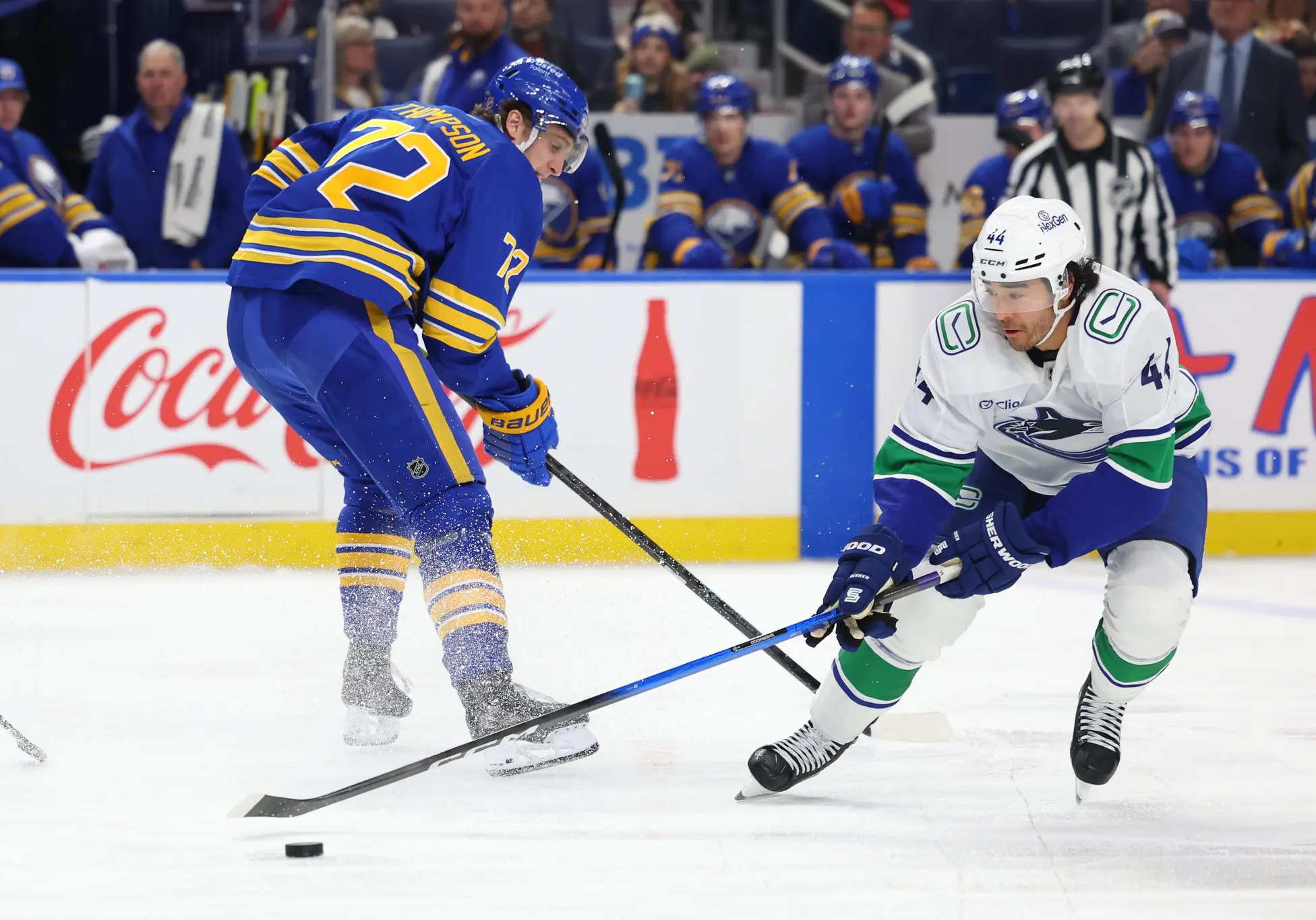
Photo credit: © Timothy T. Ludwig-Imagn Images

Jan 7, 2026, 13:30 ESTUpdated: Jan 7, 2026, 13:10 EST


It didn’t take long after the NHL lifted its holiday roster freeze for the trade-related drama to pick up surrounding the Vancouver Canucks once again.
There may have been a sense that things would progress fairly naturally and straightforwardly from the Quinn Hughes trade onward. Having already dealt their most valuable trade-chip, the Canucks – as voiced by POHO Jim Rutherford – seemed to verbally commit to a genuine rebuild.
Then came the second-guessing, the hedging, the talk of ‘hybridization.’ And the same old worries began to seep in again.
Now, if there was one thing that the Canucks faithful had been told was going to happen for sure, it was that the team was going to sell high on premium pending UFA Kiefer Sherwood. The fairly consistent talk over the past month had been that Sherwood would be sold to the highest bidder and that the bidding should reach at least as high as a first-round pick, if not higher.
Many had gone so far as to almost consider that first-rounder an asset already in hand.
But then, this past weekend, Elliotte Friedman dropped a bomb on that notion by reporting that Canucks management had decided to attempt to re-sign Sherwood after all and had made him a significant contract offer.
Understandably, Vancouver fans reacted as if a rug had been pulled out from under them. To be told to expect the team to make a choice that will benefit them in the long run, only to see them switch gears and take a more short-term approach, would not just be frustrating; it would be something that this fandom has experienced far too much in the past.
But, for one, an extension has not been signed yet, and until that happens, a Sherwood trade still remains the most likely outcome.
And, for two, Sherwood is a unique enough player that he bears at least some consideration as to whether there is any type of extension out there that might make sense for both team and player.
Obviously, there are plenty of numbers that might work for the Canucks. If Sherwood was willing to sign a new version of the same two-year, $1.5 million contract he’s currently playing under, well, why wouldn’t the Canucks say ‘yes’ to that?
Of course, Sherwood has earned a much larger deal than that. Rumour has it that the Canucks’ latest offer for him was somewhere in the neighbourhood of four years at a $4 million AAV. How workable is something like that?
The average NHL salary for the 2025-26 is about $3.5 million. By that standard, all Sherwood would have to do over the next four years to return surplus value on a $4 million cap hit would be to perform slightly above-average, and that sounds pretty doable, right?
Unfortunately, the NHL’s average salary is heavily skewed by the biggest superstar contracts at the top of the charts. The median salary is lower than that, and if we think about the average salary for a ‘middle-six’ player – as in someone who is not top-line – then that’s probably closer to about $2-2.5 million.
So, by that notion, Sherwood would have to really outperform the average player in his same position over the next four years for such a contract to have positive value. Again, that sounds doable, but it’s starting to sound like a more risky proposition.
It’s not too hard to find some cautionary tales around the NHL. There’s a good one right next door. The Edmonton Oilers traded for Trent Frederic at the cost of a couple draft picks, and then doubled down on that decision by signing Frederic to an eight-year, $3.85 million AAV extension.
Many gawked at that price tag, but the argument made at the time was roughly what we’ve stated above: it’s barely above the NHL average, the salary cap is going up anyway, so, really, what could it hurt?
Already in Year One of that contract, however, Frederic is hurting. He was recently made a healthy scratch, and the Oilers are committed to that deal for seven more years after that one. It’s not hard to see how a lengthy extension for a role-playing veteran can turn sour.
Nobody is suggesting that the Canucks are going to sign Sherwood to an eight-year deal. But Sherwood is already 30, and will turn 31 next month. Even a four-year deal buys ages 31 through 35. Those are not exactly prime years. Sure, Sherwood has developed later than most, and maybe his prime comes a little later than most. But the risk for a drop-off is there, and it gets steeper with each year added to an extension.
There are other factors to consider here. There’s the roster jam the Canucks are already experiencing up front, and that is only going to become exacerbated in 2026-27 if the team isn’t able to sell off some pieces as young players join the roster. On the other hand, you’ve got the mentorship factor and the possibility of Sherwood having a positive impact on the development of those youngsters.
But the most important factor to consider in a Sherwood extension is the opportunity cost, which is the potential trade return given up by choosing to keep him instead.
We tend to agree with the speculation that Sherwood should return a first, if not more. He’s one of the more impactful UFA rentals available, period, and that’s before we take into consideration his current $1.5 million cap hit – which could easily be retained down to a below-league-minimum $750,000.
And so, even if we can get to a point where a mid-term, mid-salary extension makes some sense – as in, a point where we can see Sherwood returning fair-to-good value over that rumoured four-year, $4 million AAV deal – we still don’t have the whole equation. Because the real question is this: what’s going to make a bigger positive difference in the long run, four-ish more years of Sherwood, or a new prospect drafted in the first round?
It’s not a slam-dunk here, either. As we said, Sherwood probably has some good years left, and he has proven a capable mentor. Few players set a better example for others with their own play.
But the odds of the Canucks really doing anything of note in those same four years are looking slim. So, the opportunity to use that time to develop a prospect so that they’re ready to fully contribute in a few years – as opposed to moving toward retirement, as Sherwood will be – is the opportunity that aligns far more closely with the team’s realistic timeline.
Think of how much of a difference having just two recent firsts in Tom Willander and Braeden Cootes ‘hit’ has made to the Canucks’ future outlook. It’s what the Canucks need more of, not less.
First-round picks are not guarantees. But the more one has, the better the odds. The Canucks can’t count on the first-round pick they obtained from the Minnesota Wild turning into a good player. But if they make a mid-to-late first-round selection with that pick, and then another with the pick they get for Sherwood, the odds of success have roughly doubled.
Could Sherwood play well enough to give surplus value on a 4×4 contract? Yes, that seems likely. But could he give enough surplus value on that contract to surpass the potential value of his own trade return?
That’s where we hit a snag. And that’s why, really, there is no realistic number that works for both team and player on a Sherwood extension.
Sponsored by bet365


Breaking News
- Canucks trade Aatu Räty to Maple Leafs for forwards Jacob Quillan and Brandon Buhr
- What’s behind the early struggles from Canucks’ Zeev Buium and Filip Hronek?
- Canucks’ Räty clears NHL waivers, will report to AHL Abbotsford
- Blackfish: Romani opens strong, Cootes continues to impress and Malhotra shows his offensive potential
- Scenes from morning skate: Chytil to make season debut for Canucks vs. Panthers

Vancouver CanucksTeam Cap Summary

Cap Summary
2026-27
2027-28
Projected Cap Hit
$88,074,947
$71,329,167
Projected Cap Space
$15,925,053
$42,170,833
Current Cap Space
$17,259,555
$42,170,833
Active Players
23/23
13/23
Draft Picks
Round
'27
'28
1
1
1
2
2
2
3
1
1