
CanucksArmy has no direct affiliation to the Vancouver Canucks, Canucks Sports & Entertainment, NHL, or NHLPA
How will Jamie Oleksiak do as Marcus Pettersson’s replacement on the Canucks’ blue line?
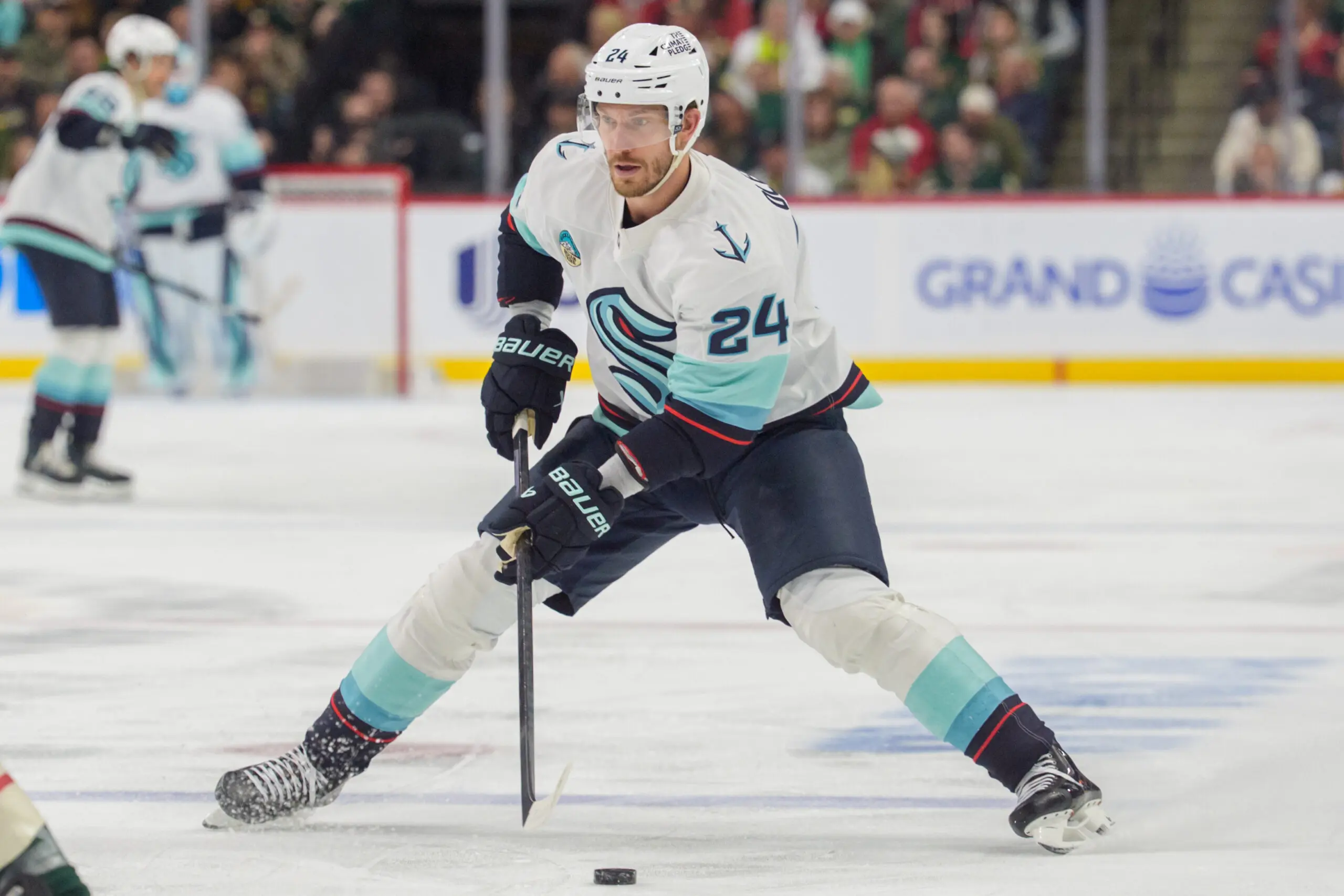
Photo credit: © Matt Blewett-Imagn Images

Jul 23, 2026, 09:15 EDT


The Vancouver Canucks traded away the defenceman who played more shorthanded minutes than anyone else on its roster and replaced him with one of the largest players in the NHL. The rebuilding Canucks saw an opportunity to add to their pool of future assets and took it, dealing Pettersson to the New York Rangers in exchange for a 2030 top-10 protected first-round pick. Shortly after the trade, they signed defenceman Jamie Oleksiak to a two-year contract worth $5 million annually. The short-term high AAV nature of the deal gives the Canucks the ability to move Oleksiak out for even more future assets, as team paid a premium for size at this past year’s trade deadline. But before that, Oleksiak will play games for the Canucks.
With Marcus Pettersson gone, Oleksiak seems like the natural fit to eat most of Pettersson’s old minutes on the left side.
It’s not exactly a like-for-like exchange — but the Canucks are hoping Oleksiak can do many of the things asked of Pettersson last season — play 18-20 minutes per night, and carry a leading role on the penalty kill.
Oleksiak’s workload has declined during the past two seasons, while his strengths are concentrated around the crease, along the boards, and in-zone defensive coverage. Vancouver is betting that the 6-foot-7, 252-pound veteran can stabilize a young blue line without being asked to play the type of minutes he logged earlier in his career.
Here is what Oleksiak has become, where he still provides value, and what fans should expect from him in Vancouver:
Oleksiak’s career to this point
The Dallas Stars selected Oleksiak 14th overall in the 2011 NHL Draft. His size made him an intriguing prospect, but he took several years to establish himself. The Toronto native moved between the Stars and their AHL affiliate during his first stint with the organization, until a trade to the Steel City in December 2017 helped change the direction of his career.
Acquired for a conditional fourth-round pick, the Pittsburgh Penguins gave Oleksiak a more consistent opportunity. Rather than expecting offence from a former high selection, Pittsburgh simplified his responsibilities as a defensive presence. Dallas brought him back 13 months later, sending the Penguins the same draft choice it had received in the original deal.
Oleksiak developed into a dependable member of the Stars’ back end during his second stay in Texas. He handled tougher matchups, played beside quicker partners, and contributed five goals during Dallas’ run to the 2020 Stanley Cup Final.
The Seattle Kraken selected him in the 2021 expansion draft before signing him to a five-year contract.
His best offensive season came in 2022-23, when he recorded nine goals and 25 points. The Kraken also reached the playoffs for the first time, upsetting the defending champion Colorado Avalanche before losing to Dallas in seven games. His responsibilities shrunk over the next three seasons.
Younger defenders in the Kraken system took on larger roles, and Seattle also added Brandon Montour, dropping Oleksiak’s average ice time from 19:39 in 2023-24 to 18:47 the following year, and down to 16:56 last season.
He reached unrestricted free agency with 758 regular-season games and another 57 playoff appearances behind him when Vancouver signed him to his current deal. The Canucks are certainly not acquiring the version of Oleksiak who averaged north of 20 minutes per night in Dallas, but are still adding an experienced defender whose role has become more specialized.
Last season’s results were below break-even
Oleksiak finished his final year in Seattle with five goals and 15 points across 78 games. He added 112 hits and 106 blocked shots while posting a +9 rating.
Seattle’s territorial numbers with him on the ice were less encouraging. According to MoneyPuck.com, the Kraken recorded 977 shot attempts and allowed 1,163 during his 1,173 minutes at five-on-five. That gave Oleksiak a 45.7 percent share of the attempts taken. Seattle controlled 46 percent of the unblocked attempts, 46.5 percent of the shots on goal, and 45.4 percent of the expected goals.
Natural Stat Trick credited the Kraken with approximately 41.5 expected goals for and 48.2 against during Oleksiak’s five-on-five minutes.
In short, Seattle spent more time defending than attacking with Oleksiak on the ice, but the actual scoring margin was very close. Opponents outscored the Kraken only 41-40 with the veteran deployed.
Stopping the rush and breaking out the puck are the biggest concerns surrounding his game.
He can end a cycle with his reach and protect the front of the net, but he is unlikely to deceive forecheckers, skate through traffic, or consistently manufacture an exit when the first option disappears. He can still be trusted with a strong first pass, but his partner will still need to retrieve pucks quickly, present a reliable target, and take on the more ambitious transition work.
Vancouver will need to pair Oleksiak with a defender who can handle much of that work with the puck. Can that be sophomore Tom Willander?
His game is quieting down, and that’s not the worst thing for the Canucks
The former first-round pick recorded 112 hits last season, up from 74 the year before.
That total remained below the rates he produced during his physical peak, but Oleksiak averaged more than two hits per game in six different seasons. However, he has not reached that mark since 2021-22.
But he still hasn’t stopped throwing the body. As he’s gotten older, the hulking blueliner now selects his moments more carefully to not get caught chasing a hit. Leaving position to pursue contact would create space behind him, especially against quicker attackers.
His best defensive shifts tend to be quiet. He keeps the puck outside the middle, takes away sticks around the blue paint, and forces opponents to work through his frame.
Vancouver should benefit in particular against teams that create offence below the hash marks, clearing screens, and preventing second opportunities before they reach the goaltender.
He’s not as slow as you might think
Oleksiak moves better in a straight line than his size might suggest.
NHL EDGE recorded his top speed at approximately 35.4 kilometres per hour last season, placing him in the 63rd percentile across the league. He produced 31 bursts above 32.2 kilometres per hour, which was close to the NHL average.
The veteran covered roughly 306 kilometres during the year and maintained an average skating speed of 13.9 kilometres per hour, so he can still build momentum once he gets moving.
His first few strides are still a struggle, as are sharp changes of direction and recoveries after an aggressive read. Being forced into frequent pivots would expose the weaker areas of his mobility. But when he can remain underneath the puck and keep the play in front of him, he’s still a competent NHL skater.
The heavy shot is another tool that remains above average.
His hardest attempt reached approximately 152.8 kilometres per hour, ranking in the 78th percentile. He put only 77 shots on goal, limiting how much impact that power had on his production.
Still useful below the goal line
Oleksiak has extensive experience playing shorthanded.
His size, reach, and net-front strength fit the bill of what Vancouver is looking for. He can occupy passing lanes through the slot, control opposing sticks, and clear loose pucks without wandering far from the crease.
His recent usage has trended downward, albeit on a Seattle team that hasn’t been very good altogether.
Oleksiak averaged 2:58 per game on the penalty kill in 2023-24. That fell to 2:39 the following season before dropping to 1:39 last year. He still ranked third among Seattle defencemen in shorthanded minutes, but he was no longer trusted on the first unit.
A compact structure should allow him to take advantage of his length and stay around the goalmouth. If the opposition utilizes a lot of east-west puck movement, Oleksiak is likely to get exposed, whereas he is still an above-average defender preventing attacks from below the goal line.
Anywhere close to three minutes per night would be a significant increase from his latest workload, and it’s hard to imagine Oleksiak not being first over the boards with Vancouver’s projected D-corps.
He’s basically replacing Marcus Pettersson
Vancouver traded Pettersson to the New York Rangers on the same day they signed Oleksiak. The transactions were separate, but the incoming blueliner will occupy the position his veteran predecessor left behind.
Their cap hits are close. Pettersson carries a $5.5-million average, while Oleksiak will earn $5 million, but the commitments are much different. Pettersson has five years remaining on his contract, and Vancouver replaced that term with a two-season agreement and acquired a conditional first-round pick in the process.
On the ice, though, Oleksiak does not have the capabilities to simply inherit all of Pettersson’s responsibilities.
The Swedish defender averaged 21:27 last season and led Vancouver with more than 222 shorthanded minutes. He was expected to take difficult matchups, move the puck out of trouble, and support a young partner in Tom Willander.
Oleksiak played nearly four-and-a-half fewer minutes per game and held a smaller role on Seattle’s penalty kill.
Vancouver also loses some puck movement in the exchange.
Pettersson could retrieve possession and make a clean first pass under pressure, while Oleksiak is more comfortable finding a nearby outlet and allowing his partner to direct the breakout. Pettersson stands 6-foot-5 but relies on positioning, angles, and his stick. Oleksiak carries considerably more weight and can remove opponents from the crease with more strength and ease.
The right partner(s) will be critical
Oleksiak’s underlying results provide a clear indication of the teammate he needs to play beside.
He spent 532 minutes beside Ryker Evans last season, when Seattle controlled 50.5 percent of the expected goals during that time, making it his strongest regular combination.
Evans supplied mobility and puck movement, while Oleksiak protected the space behind him. His 262 minutes with Montour produced a 48.6 percent share.
The results declined sharply beside Ryan Lindgren and Josh Mahura, generating little team offence and spending extended stretches inside Seattle’s own zone. Putting Oleksiak with another limited puck mover would create the same risk in Vancouver.
Tom Willander is the most logical candidate, having played most of last season alongside Pettersson, but that setup would place significant responsibility on a developing player in Willander for the second straight season to begin his career.
At some point, it would likely be best for Willander’s progression to dominate third-pair minutes. But that would mean pairing Oleksiak with someone like Luke Schenn.
Both players provide strength and experience, but neither can be expected to drive exits or skate the puck out. Aggressive forechecking teams would feast on that pair in its own end.
Vancouver will likely juggle the minutes of its blueliners and swap pairs around based on the state of the game, meaning Oleksiak and Hronek could see much of the time on ice if the Canucks are nursing a one goal lead with a minute remaining.
All in all, Oleksiak will make the Canucks larger and harder to play against. His durability is also not a problem after appearing in 78, 82, and 82 games during the past three seasons. But there are clear limits to what he should be asked to do.
The newest Canuck is unlikely to control possession, lead the rush, or return to the 25-point level he reached in 2022-23. If Vancouver can keep his role manageable and pair him with speed, Oleksiak can still give the Canucks exactly what they signed him for: stability, strength, and a much tougher path to the front of the net.
PRESENTED BY VIVID SEATS



Breaking News
- The Stanchies: Canucks serve up defensive zone breakdowns in Thanksgiving loss to Rangers
- Instant Reaction: Canucks struggle defending off the rush in 6-2 loss to Rangers
- Abbotsford weekly: Cootes and Lind tally 3 points each in Canucks’ first win of the season
- NHL fines Devils’ Evan Rodrigues $5,000 for high-sticking Canucks’ Marco Rossi in the neck
- Canucks Game Day: Desperate to shore up the penalty kill against the Rangers

Vancouver CanucksTeam Cap Summary

Cap Summary
2026-27
2027-28
Projected Cap Hit
$88,074,947
$71,329,167
Projected Cap Space
$15,925,053
$42,170,833
Current Cap Space
$16,975,056
$42,170,833
Active Players
23/23
13/23
Draft Picks
Round
'27
'28
1
1
1
2
2
2
3
1
1