


🚨Canucks goal🚨 Willander answers back quickly and the Canucks are ahead again! 🎥 Sportsnet | #Canucks

CanucksArmy has no direct affiliation to the Vancouver Canucks, Canucks Sports & Entertainment, NHL, or NHLPA
Canucks’ Tom Willander learned on the fly with heavy minutes in his rookie season: Year in Review
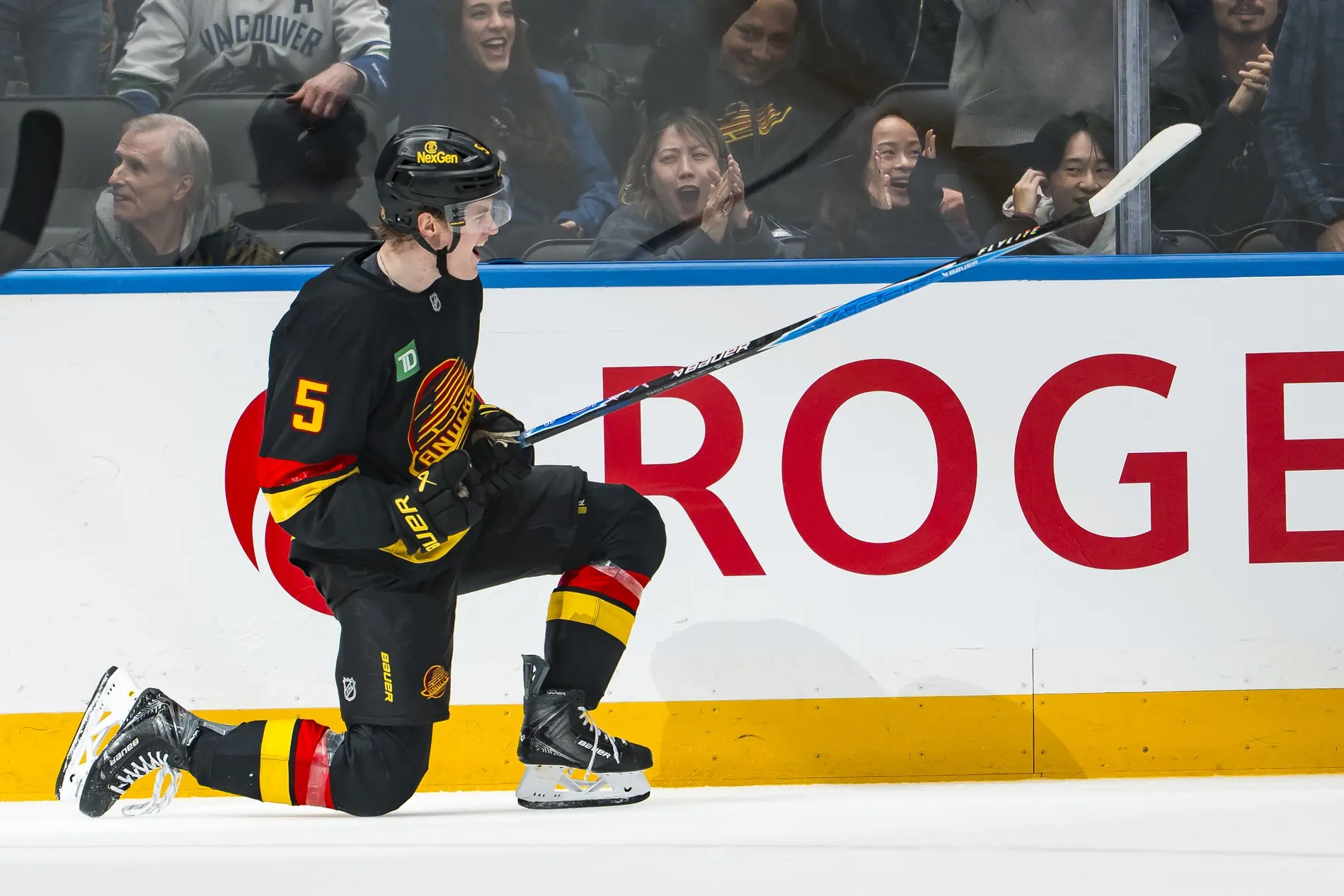
Photo credit: © Bob Frid-Imagn Images

Apr 23, 2026, 12:00 EDTUpdated: Apr 23, 2026, 11:47 EDT
There’s a difference between breaking into the NHL and being relied upon once you get there. And through no fault of his own, Vancouver Canucks rookie Tom Willander may have been leaned on a bit too heavily.
Between injuries, roster turnover, and uneven play, Vancouver didn’t have the luxury of easing the young Swedish defenceman into the league. Instead, Willander was given consistent ice time in difficult conditions — the kind that rarely produce clean outcomes, especially for a first-year player.
On the surface, Willander’s stat line of 21 points in 69 games is credible, but the underlying numbers tell a more layered story. He scored five goals on just 3.41 expected goals. He wasn’t creating much in terms of volume or quality, yet showed an ability to capitalize when chances materialized — a modest but meaningful step in addressing concerns about his offensive upside.
Where Willander’s year really comes into focus is through his heavy deployment.
Willander logged more than 1,170 minutes, averaging just under 17 minutes per night — a notable workload for a rookie defenceman. More importantly, those minutes were not scattered or protected. They were largely spent with one of Vancouver’s most consistent defensive pairs.
Marcus Pettersson logged 608 minutes alongside the right-hand defenceman this season, the highest total among Canucks pairings that saw regular usage. That level of continuity is uncommon across the league, let alone for a rookie. It also didn’t translate to strong results.
The Pettersson–Willander duo posted a 42.9% Corsi share, a 41.0% shot share, and a 43.8% expected goals share, while being outscored 35–22 at five-on-five. Those numbers aren’t flattering, but they illustrate a pairing that spent a significant portion of its time defending.
Willander’s individual usage supports that. He spent 42% of his time in the defensive zone, above league average, with just 40.5% in the offensive zone. His offensive-zone start rate sat at 31%. These are the markers of a player starting shifts in disadvantageous situations and being tasked with defending through them. His even strength offensive-zone time also trailed league average, further limiting his ability to generate offence.
As a team, Vancouver spent long stretches without the puck. Willander and Pettersson absorbed a large share of those minutes, which naturally suppresses possession and expected goal metrics. And, to be fair to the Swede, given the rest of their supporting cast, that can’t all be placed on their shoulders.
Still, Willander showed there were plenty of aspects he could handle in the NHL.
The former 11th overall pick’s skating is central to understanding why he stuck at the NHL level right away. Willander’s max skating speed of 36.25 km/h ranked in the 84th percentile across the NHL, while his 62 bursts above 32 km/h placed him in the 86th percentile. Simply put, when Willander gets up to speed, he can move.
That mobility shapes him as a player. With over 272 kilometres skated on the season, multiple games exceeding five kilometres, Willander was consistently getting around the ice on a shift-to-shift basis. His wheels allow him to recover quickly when out of position, close the space between him and an opposing attacker on the backcheck, or steer plays wide off the glass to retrieve pucks.
Willander showed offensive flashes early that earned him a shot on the Canucks’ top power play unit. That wasn’t an area he earned in the NCAA with Boston University, but it shows early growth to do so at the next level, even though he wasn’t able to maintain the role after his audition.
Even so, there were encouraging signs. His 8.5% shooting rate sat above league averages for defencemen, and his five goals exceeded expected output. He didn’t create much, but he made something out of what he had.
And that’s really the takeaway. Willander didn’t tilt the ice or dominate his minutes. But he also wasn’t put in a position to do so. He was dropped into a difficult environment, given consistent responsibility, and was left to figure it out at NHL speed.
He handled the pace, absorbed substantial minutes, and stayed in the lineup without insulation. For a rookie defenceman, that’s often the first real benchmark.
Whether that usage helped or hindered his development is a fair question. A stint in Abbotsford might have offered a more controlled environment. But there’s also value in being pushed early and learning through adversity. How these frustrating results manifest themselves will take time to reveal.
It’s not easy for a rookie defenceman to earn the trust of his coaches so early. But with his speed and adaptability he displayed throughout the season, Tom Willander deserved a long leash, and did enough with it to hold his spot throughout his rookie season.
Willander’s final total of 21 points has him tied for 16th in franchise history for points by a rookie defenceman, one ahead of Alex Edler. If that is the benchmark of what’s to come, Canucks fans can expect to see a mainstay on the blueline for years to come.
Sponsored by bet365


Breaking News
- Scenes from practice: Rossi returns and Canucks shake up forward lines in effort to snap 8-game losing streak
- Canucks and their fans hit a home run honouring John Garrett on Cheech night
- What are the Canucks’ expiring UFAs worth in a trade now, and where might they be by the deadline?
- ‘Same story again’: Canucks’ Pettersson and Sasson express frustration after losing streak extends to eight
- The Stanchies: Hot dogs fall from the sky as Canucks fall 6-3 to the Hurricanes

Vancouver CanucksTeam Cap Summary

Cap Summary
2026-27
2027-28
Projected Cap Hit
$87,295,050
$71,329,167
Projected Cap Space
$16,704,950
$42,170,833
Current Cap Space
$18,732,718
$42,170,833
Active Players
23/23
13/23
Draft Picks
Round
'27
'28
1
1
1
2
2
2
3
1
1