
CanucksArmy has no direct affiliation to the Vancouver Canucks, Canucks Sports & Entertainment, NHL, or NHLPA
How to read the Canucks’ PuckPedia page for the 2025-26 NHL season

Photo credit: © Bob Frid-Imagn Images

Oct 15, 2025, 13:00 EDTUpdated: Oct 15, 2025, 12:45 EDT


Another Vancouver Canucks season, another set of Vancouver Canucks-related minutiae to master.
It’s been a year and a half now since the hockey world lost CapFriendly, but our friends at PuckPedia have stepped into that gap ably ever since, if we do say so ourselves. And good thing they have, for the world of hockey salaries have only grown more complicated in the wake of the end of the flat cap era and a brand-new CBA.
Right now, at the outset of the 2025-26 campaign – before anything gets any more complicated – is probably the best time to check in with the Canucks’ own PuckPedia page for a refresher on how to read it, what information is contained within, and what changes have taken place since the last time we talked about all this.
To follow along, you may want to open up said PuckPedia page in another tab.
(Cap-related numbers can change daily, but this article was written on the morning of Tuesday, October 14, 2025 and should be as up-to-date as possible.)
(The Canucks sent Braeden Cootes down a couple hours after this article was written on Tuesday morning, so it’s been rewritten and should now be as up-to-date as possible until the Canucks inevitably recall Max Sasson on Wednesday or Thursday and mess with the numbers again!)
The first thing you might notice is that the Canucks are listed as having the 13th-highest projected cap hit in the NHL with $94.09 million. That number, as we’ll come to find, is not the be-all and end-all of measuring cap space, but it does at least provide some good context as to where the Canucks rank among the league as a whole.
The Vancouver roster, as of right now and following the re-assignment of Braeden Cootes to the WHL, includes 24 players. That’s 22 active players (of a maximum 23) and two on Injured Reserve for the moment in Nils Höglander and Pierre-Olivier Joseph. While on IR, Höglander and Joseph do not take up one of the 23 maximum active roster spots, but they do count against the daily cap accounting.
The Canucks also have a handful of players not on the roster that are incurring cap-related costs. That’s Guillaume Brisebois and his $88,802 of “Season-Opening Injured Reserve” cap hit (which will disappear as soon as Brisebois is healthy again and can be demoted), Oliver Ekman-Lrasson’s $4,766,667 in buyout penalty, and Ilya Mikheyev’s $712,500 of retained salary.
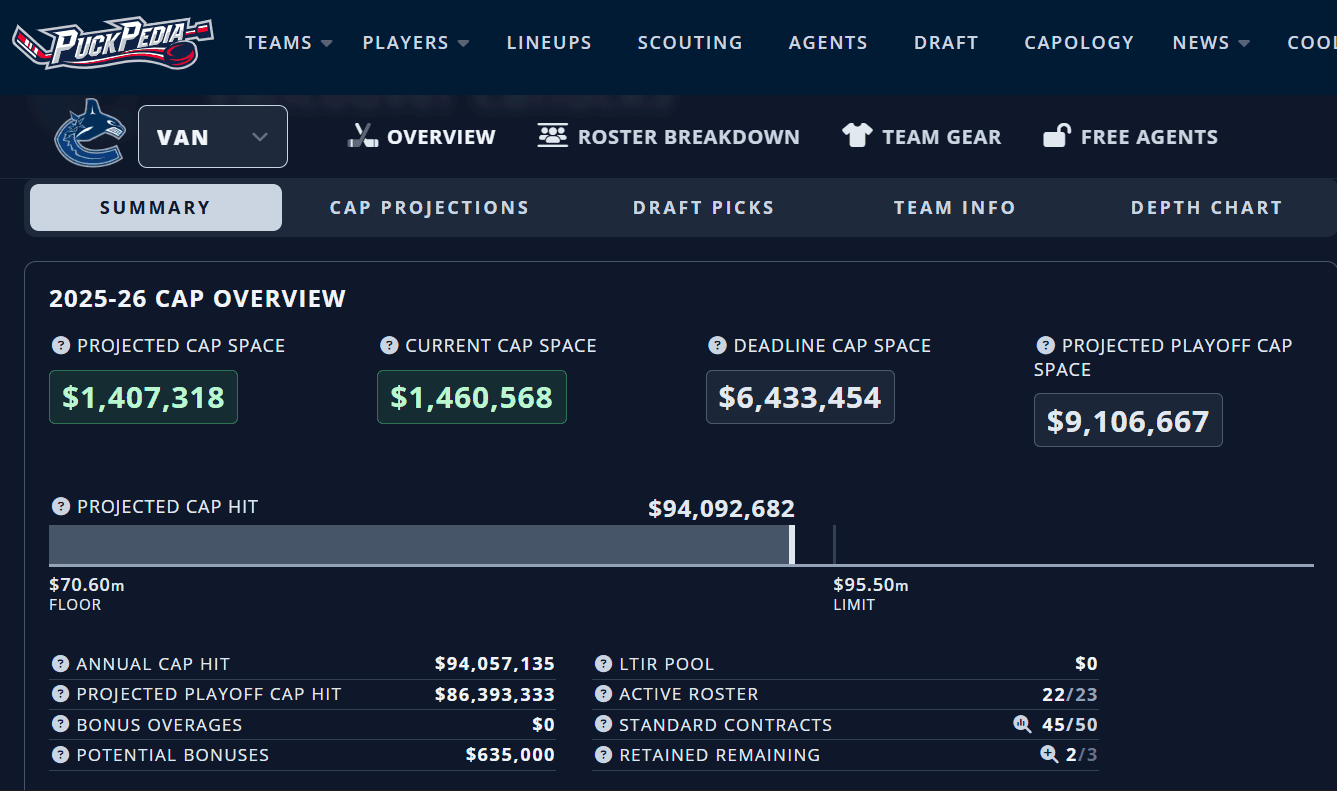
As we mentioned earlier, this leaves the Canucks with a projected total cap expenditure for the year of $94,057,135, or $1,407,318 under the 2025-26 cap ceiling of $95.5 million.
Which doesn’t sound like a lot of money. It’s enough for any one call-up from Abbotsford, but not two. Thankfully, it’s only the most basic, and least relevant, measure of what we call ‘cap space.’
 PuckPedia
From PuckPedia
What “Projected Cap Space” really amounts to is how much in total the Canucks are projected to dole out in daily cap spending over the course of the entire season, were nothing to change with the roster from here on out, and how far away from the cap ceiling that would leave them. How they’re able to use that space, however, comes down to a set of different numbers.
It’s important now to understand how cap ‘accrual’ works. We put ‘accrual’ in scare-quotes there, because no one ever gains any actual cap space through the process. It’s more like saving for later.
See, the cap is accounted daily, and teams are truly limited in their spending by that daily cap limit – the maximum cap ceiling, divided by the number of days in the season. As long as your daily cap spending never reaches an amount that, were it to continue for the rest of the season unabated, would eventually climb over that cap ceiling of $95.5 million, you’re ‘under the cap,’ and thus good.
We tend to think of cap as ‘accruing’ because the longer one saves some of that $95.5 million, the more one can do with it.
Think of it this way. A team who has a player on their roster with a cap hit of $10 million for the entire season will have to incur that full $10 million in cap hit, split up by all the days in the season.
But if a team were to acquire that player exactly halfway through the season, they’d only be paying them that daily cap amount for half the days in the season. Thus, it would only cost them $5 million against that $95.5 million total.
The NHL Trade Deadline typically takes place about three-quarters of the way through the regular season. If that same $10 million AAV player were to be acquired at the deadline, the team acquiring them would only be responsible for about $2.5 million of that cap hit.
So, all a team needs to do to have $10 million in effective spending ability at the Trade Deadline is to maintain a Projected Cap Hit some $2.5 million under the cap ceiling for the entirety of the season. This multiplier in purchasing power is what we tend to refer to as ‘accrual.’
Let’s navigate back to that PuckPedia page. As you can see, the Canucks have already effectively accrued a little cap space by being under the projected cap ceiling for the first week of the season. That’s why their Current Cap Space is listed at $1,460,568, a slightly higher number than their Projected Cap Space of $1,407,318. Because a week has passed, all league contracts now have a week’s fewer daily cap hits attached to them. As such, the Canucks could add an annual cap hit of $1,460,568 to their roster right now. Now that’s getting closer to the territory of having space for two call-ups. What luxury!
Were the Canucks able to maintain this exact cap picture from now unto the March 6, 2026 Trade Deadline, however, that’s when the effective accrual could really count. Look to the right of the page, and you’ll see the Canucks’ “Deadline Cap Space” listed at $6,433,454. This is the ‘real number,’ so to speak. Keep this same roster configuration until the deadline, and the Canucks would be able to add a little more than $6 million in annual cap hits to their roster.
Keeping the same roster configuration until the deadline is impossible, what with the reality of injuries. But the Canucks are set up to accrue under most scenarios, and potentially in great amounts whenever healthy. In fact, by sending Cootes down on Tuesday and waiting to recall Max Sasson until later in the week, they’ve reduced their daily spend and effectively saved more for later. (When this article was first written pre-demotion, that Deadline Cap Space was a little over $2 million.)
Last year, the Canucks were able to accrue enough to have nearly $10 million in spending space by the 2025 Trade Deadline. They just didn’t ever end up spending any of it.
Could the 2025-26 Canucks get to such a lofty total? Probably not. But they should be able to, at the very least, accrue enough millions to be useful closer to Deadline Day.
Right now, as we said earlier, Höglander and Joseph’s full daily cap hits are counting against the cap, as are those of their roster replacements. Let’s imagine an unlikely scenario in which Höglander and Joseph return to health before any other injuries occur. At that point, for them to be activated, two roster spots might have to be opened up. For now, let’s imaginarily re-demote the recently recalled Victor Mancini and the not-yet-recalled Sasson to get the roster back to 23 active players and none on the IR.
Following those demotion’s, Mancini’s annual cap hit of $870,000 and Sasson’s of $775,000 disappear from the daily accounting. Each day they’re off the books, more spending space is effectively accrued, and that Deadline Cap Space number will grow.
Further injuries delay, but do not stop the process – not until the team incurs so many injuries that it needs to consider using Long-Term Injured Reserve (but that’s a topic for another day).
These numbers will all be updated on PuckPedia on a daily basis, so there’s no real need to track it ourselves. Instead, you just need to know that the numbers will change. That Deadline Cap Space measure remains the most important, and it will grow in times of health and grow slower in times of injury.
There’s one more number worth talking about on the PuckPedia page, and it’s a new one this year: Projected Playoff Cap Space. In a bid to stop teams like the Vegas Golden Knights from essentially circumventing the cap, the league has instituted a new rule that means a team’s 20-player roster for any given playoff game (plus all their dead cap) can never hold annual cap hits that would exceed the $95.5 million ceiling.
Right now, the Canucks are listed as having some $9,106,667 in Playoff Cap Space, and that number is based on the last 20-player roster they iced. That seems like plenty, and they have a long ways to go before they even consider the postseason, anyway, so we’ll deem this number nothing to worry about for now and perhaps return to it at a later date.
Sponsored by bet365


Breaking News
- Canucks’ Ohgren responds to healthy scratch: ‘I know I have to play harder’
- Former Canucks captain Quinn Hughes speaks ahead of return to Vancouver
- How Canucks’ Cootes is doing compared to other 2025 first-round picks playing in the AHL
- Scenes from practice: Pettersson and Boeser reunited as Canucks skate at UBC on Saturday
- Abbotsford Canucks preview: Players to watch in weekend rematch with the Wranglers

Vancouver CanucksTeam Cap Summary

Cap Summary
2026-27
2027-28
Projected Cap Hit
$87,295,050
$71,329,167
Projected Cap Space
$16,704,950
$42,170,833
Current Cap Space
$19,176,096
$42,170,833
Active Players
23/23
13/23
Draft Picks
Round
'27
'28
1
1
1
2
2
2
3
1
1