


Gone camping. ⛺️ See the #Canucks full Training Camp roster for this weekend in Penticton. DETAILS | vancanucks.co/48saO3E

CanucksArmy has no direct affiliation to the Vancouver Canucks, Canucks Sports & Entertainment, NHL, or NHLPA
In the end, the Canucks were right to skip on Jack Roslovic and other available centres this offseason
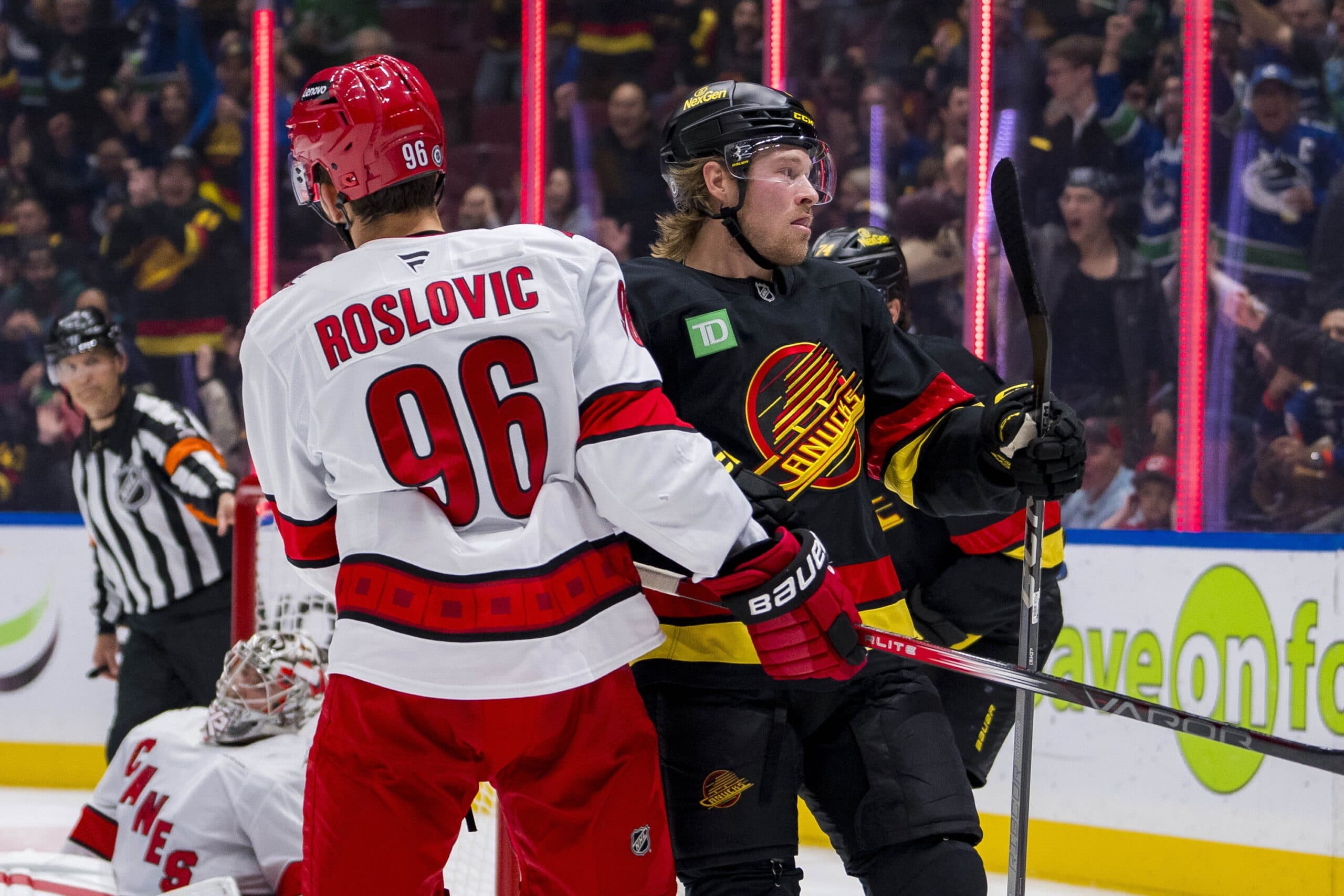
Photo credit: © Bob Frid-Imagn Images

Sep 19, 2025, 11:00 EDTUpdated: Sep 19, 2025, 10:58 EDT
The Vancouver Canucks have begun their 2025 Training Camp in Penticton as of Thursday. Ahead of the opening, the team released their official camp roster…
…and exactly zero surprises were contained within. The roster contains mostly players already under contract with the Canucks, plus a handful of invitees who have already signed minor league contracts with Abbotsford. The one and only tryout offered to someone from entirely outside the organization went to 19-year-old Zack Sandhu, an undrafted defender out of the OHL.
That means that GM Patrik Allvin and Co. have decided against signing any remaining veteran free agents to any PTOs. Most notably, it likely means that the Canucks have truly moved on from the possibility of adding Jack Roslovic, who remains unsigned and uninvited to any team’s camp as of this writing.
Throughout the offseason, many pointed to Roslovic as the easiest and most direct way to – at least temporarily – solve the team’s issue with a lack of a 2C. Roslovic, after all, was coming off a career high of 22 goals and had scored as many as 45 points in a season before. And some of those points had, indeed, come from the centre position.
But as many pointed out in those summer discussions on the topic, Roslovic is more of a winger-who-can-occasionally-cover-at-centre than a true, blue NHL centre. One with several holes in his game, especially when it comes to defensive coverage, that specifically preclude teams from having much success with him as part of their pivot rotation.
Those shortcomings, combined with what we can assume is some outsized expectations of salary and/or term from Roslovic’s camp, are the obvious reasons why Roslovic remains teamless this late in the game. But, especially in retrospect, it’s easy to see why Roslovic ended up being not all that interesting to the Canucks in particular – he was never a solution to the 2C problem, but he was a potential barrier to solving it elsewise.
Most have estimated that Roslovic will cost at least $3 million a season, and most of the other contracts signed this offseason would support that notion. Having waited this long, he may need to compromise. Either way, it’s a price that the Canucks could have, and still could, afford. After having traded Dakota Joshua, the Canucks opened up more than $3 million in cap space that they still haven’t filled.
But unfilled cap space has a purpose. It will accrue over time, and if left long enough, should balloon to the kind of cap space the Canucks might need in order to accommodate the acquisition of a true 2C…eventually, and should one become available for a reasonable asking price.
It’s tough to feel as though Roslovic would have done anything other than occupy that cap space himself, preventing the team from accruing the kind of space they might need later, and all the while not doing all that much to make them a better team. To borrow an overused phrase from the modern sporting era, Roslovic was never going to move the needle for the Canucks. But he was potentially going to block them from having the room to add a needle-mover.
And the same is more or less true of all the various centres that were feasibly available to the Canucks this past offseason.
Everyone seemed to recognize that the Canucks dodged a bullet in their being unable to sign Christian Dvorak, who instead took a one-year, big-salary deal with the Philadelphia Flyers. Dvorak felt very much of the same ilk as Roslovic, in that he was only a 2C in the vaguest, most technical terms, and not someone who would change the dynamic of the forward corps much.
The UFA market was, ultimately, a pretty dry one. None of Roslovic, nor Dvorak, nor Radek Faksa was the centre the Canucks were looking for. In the end, there was one player of 2C quality available in Mikael Granlund, and he signed for an AAV of $7 million.
And, yes, though it may be controversial, we probably have to include Pius Suter in this reckoning. For a brief period last season, in the wake of JT Miller’s trade and Elias Pettersson’s injury, Suter filled in adequately as the team’s top centre. In those moments, Suter was a needle-mover.
But any team counting on Suter as their long-term 2C would have to count on him holding that same quality of play over the long-term, and that’s just not realistic. A team with Suter locked in as 2C isn’t really any closer to contention than the Canucks were last year or are this year, and that is the real point of adding a 2C, after all. Not to do so for the sake of doing so, but to do so in a way that is going to matter.
Very few centres of note even ended up being available for trade this offseason. Trevor Zegras moved. So, too, did JJ Peterka, though the cost was high and he might not be a true centre, either. Beyond those two, the next-most notable centres to be traded were 33-year-old Charlie Coyle and Nick Roy, who got traded for Mitch Marner’s signing rights.
It was not exactly an offseason flush with centres.
We heard plenty about two potentially available centres that would, indeed, be major needle-movers. But it became clear that the Minnesota Wild were not interested in moving Marco Rossi unless the return was enormous, and in the end they kept him. And the resources required to offer sheet or trade for Mason McTavish were always going to be far more than the Canucks could realistically afford.
Minus those two options, and absent of any other names hitting the market, Allvin and Co. were left with a Sea of Roslovics – players that might have counted as doing something toward solving the 2C problem, but who in the end would do little except occupy cap space best spent elsewhere.
In the end, they were right to hold off for better opportunities in the future.
In fact, we might go as far as to say that the best available needle-moving centres for the Canucks this offseason were the two they already had in hand.
A healthy Filip Chytil is still mostly an unknown entity, and certainly in Vancouver. He’s scored as many as 45 points in a season, too, and paced for more – and he’s an actual centre, unlike Roslovic. It does feel as though if Chytil can avoid injuries, he’ll stand more of a chance of making a difference than anyone the Canucks could have signed this offseason.
Then there’s Aatu Räty, who scored goals and won faceoffs at a ridiculous clip after his late-season call-up last year. At 22, Räty is still more than young enough to have a few more big steps forward left in him. At the very least, he’s got more potential as an eventual 2C than anyone old enough to be a UFA this summer.
Best of all: Chytil and Räty are already acquired, and their salaries are already built right into the books. The Canucks can try them out at 2C to start 2025-26, all the while accruing the kind of cap space they might eventually need to upgrade at centre, should that still prove necessary.
Which, in the end, looks like a better path than any of the others the team could have taken this offseason.
READ NEXT: Canucks Notebook: 3 takeaways from Day 1 of training camp
Sponsored by bet365


Recent articles from Stephan Roget
Breaking News
- NHL Notebook: Jets trade Hellebuyck to Devils for package of four players and two draft picks
- The Statsies: Where the Canucks got dominated at 5v5 again is loss to Red Wings
- Manny Malhotra and Brock Boeser offer up slightly different theories for Canucks’ struggles
- The Stanchies: Jonathan Lekkerimäki notches a goal and an assist, and that’s all we’ll say
- ‘It’s embarrassing’: Brock Boeser brutally honest following Canucks’ ninth straight loss

Vancouver CanucksTeam Cap Summary

Cap Summary
2026-27
2027-28
Projected Cap Hit
$87,295,050
$71,329,167
Projected Cap Space
$16,704,950
$42,170,833
Current Cap Space
$18,951,815
$42,170,833
Active Players
23/23
13/23
Draft Picks
Round
'27
'28
1
1
1
2
2
2
3
1
1