
CanucksArmy has no direct affiliation to the Vancouver Canucks, Canucks Sports & Entertainment, NHL, or NHLPA
The case for Elias Pettersson as a Selke Trophy candidate at the 2026-27 quartermark
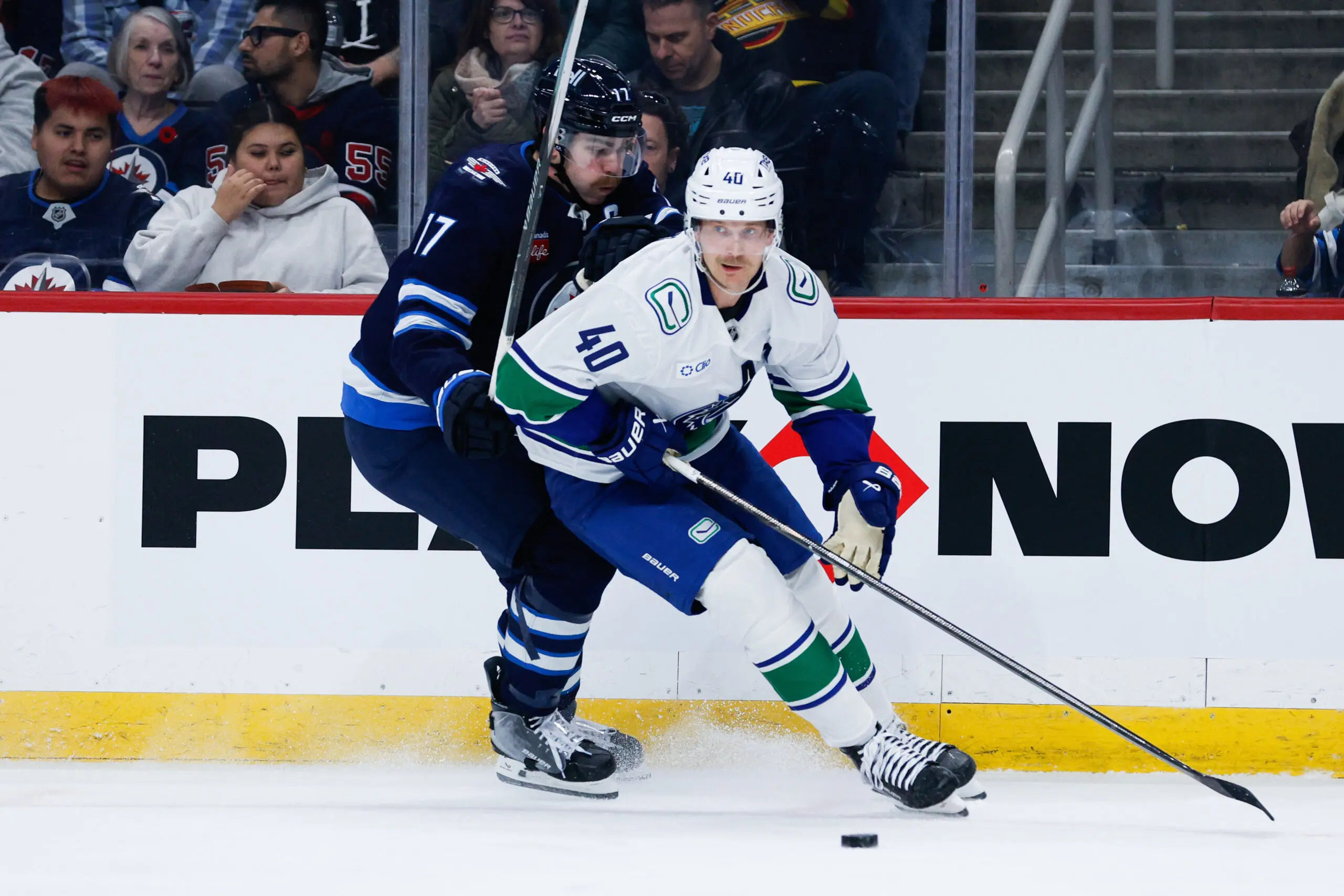
Photo credit: Terrence Lee for IMAGN IMAGES via Reuters Connect

Nov 14, 2026, 17:28 EST


The NHL’s new 84-game schedule hasn’t changed the shape of the 2026-27 season all that much, but it has allowed something that was impossible under the previous 82-game setup: the ability to split the season into even quarters.
The Vancouver Canucks played Game 21 of the season on Friday against the New York Rangers, meaning they’re now officially and exactly 25% through the season. That makes it as good a time as any to check in on a few things, including scoring paces, projected totals, and…early candidates for the various league awards.
The Canucks weren’t really expected to be in the running for any individual awards this year, or, really, any awards at all. But at the quarter mark, there is indeed a case to be made for Elias Pettersson as a strong Selke Trophy candidate.
The History of the NHL’s Selke Trophy
The Selke Trophy tends to be a bit of a legacy award, in that it’s only rarely handed out to a first-time nominee, and seems to be something that players need to earn over an extended period of time.
This factor might work against Pettersson, who has never been nominated for the Selke before. He did, however, finish seventh in Selke voting in 2022-23, and 26th in 2023-24. Maybe that precedent will be enough to get him into the conversation.
The Scoring
Another odd quirk about the Selke is that, although it’s an award for the best defensive forward in hockey, no one ever seems to win it without having a great offensive season at the same time. While there have been some exceptions, a player tends to need to be on pace to score at least 60 points in a Selke-winning season, and often more than that.
Not counting lockout- or pandemic-shortened seasons, the lowest point-total for a Selke winner in the past was Patrice Bergeron with 53 points in 2016-17 – and that’s Bergeron, which speaks to the legacy aspect we just mentioned. The three winners of the award since Bergeron’s retirement, Aleksander Barkov twice and most recently Nick Suzuki, have done so with seasons of 80, 71, and 101 points, respectively.
And after a long time without, Pettersson finally qualifies for this Selke requirement. Through 21 games, he’s got five goals and 16 assists for a total of 21 points, exactly a point-per-game. That production rate might not mean that Pettersson is all the way back to 100%, but it’s more than enough for a Selke, so long as he meets the many other qualifications. He’s also been producing oddly consistently throughout the year.
The Deployment
Selke Trophy winners don’t just need to perform well offensively and defensively, they usually have to be used in specifically defensive deployment. Pettersson has that front covered well. He’s playing in all situations with a career-high 20:36 a night. Pettersson has started about half of his shifts in the defensive zone, a rate that might be suppressed a little by the fact that Pettersson is also relied on so heavily offensively.
The same could be said of his quality of competition. Pettersson technically has a qual-comp over and above the league average, but because he’s playing so much in general, he’s not exactly getting exclusively deployed against top-six opponents. Again, he’s playing in quite literally every situation.
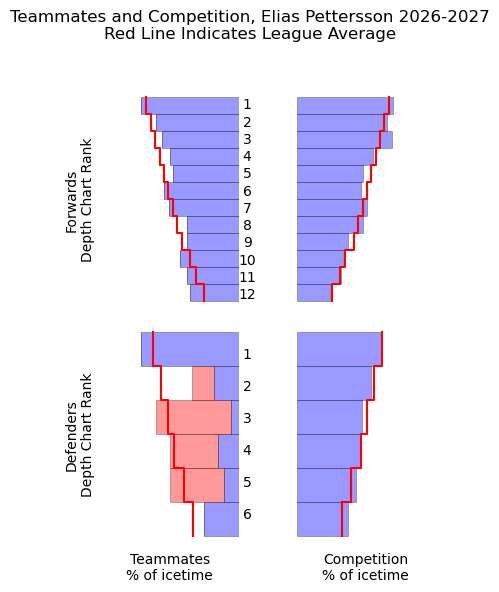 HockeyViz.com
From HockeyViz.com
It’s probably worth mentioning here that Pettersson hasn’t always received the most defensive support from his linemates this year. The bulk of his time has been spent with Brock Boeser, whose speed can make him a liability at times.
The Blocked Shots
There are few more singularly obvious forms of defensive hockey than the blocked shot, and if it’s a factor in Selke voting, Pettersson has this category sealed up nicely. Last year, he led all NHL forwards in blocked shots with 108. He’s on pace to exactly equal that with 26 through his first 21 games in 2026-27.
For a minute there, Pettersson was on pace to beat Alex Tuch’s single-season record of 113 blocks. A couple of block-heavy games, and he’ll be right back on that pace.
The Faceoffs
Pettersson is still not the best faceoff-taker in the league with a win-rate of just 48.9% this year. But he’s far and away the busiest faceoff-taker this year with 448 total. That speaks to the aspect of Pettersson carrying such a major load for the Canucks this season. To wit, even with an overall losing percentage on the dot, Pettersson’s 219 faceoffs wins are third in the league, and he’s only getting better under Manny Malhotra’s tutelage.
The Defensive Metrics
This one is a little difficult to parse, because Pettersson plays on perhaps the worst defensive team in all of hockey right now. That means that none of his on-ice fancy stats are going to be all that sparkling.
Pettersson’s even-strength Corsi rating, for example, is only at 44.72%, which is only the eighth-highest among Vancouver forwards. Pettersson plays tougher minutes than all those ranked ahead of him, but it still bears mentioning. His expected goals rate (41.46) looks better comparatively and ranks third behind Max Sasson and Marco Rossi. Pettersson does about the same when it comes to his control of scoring chances (46.01%) and especially high-danger scoring chances in particular, where his 48.21% ranks second behind Sasson.
(A brief interlude here to mention that Sasson, too, is having an excellent defensive season, albeit in lesser and easier minutes than Pettersson has faced.)
Most simply, we could say that at even strength, Pettersson has been on the ice for 20 goals for and 22 against. That’s a goal differential of -2, which doesn’t sound great, but no Canucks have actually been on the ice for more goals for than against. A -2 isn’t all that bad when the Canucks themselves are already -38 as a team, especially given how much Pettersson is playing.
If we want to separate Pettersson’s defensive impact from his team’s defensive woes, we have to get a little more specific with the stats. The folks over at data-driven-hockey.com have been attempting to compile a few Goals Above Replacement measurements this year, and that includes Defensive Goals Above Replacement, which purports to measure a player’s individual impact on preventing goals.
According to them, Pettersson has the second-highest Defensive GAR in the league among forwards this season, trailing only Connor McDavid. Data-Driven-Hockey’s three Selke nominees at the quarter-mark were McDavid, Pettersson, and Tim Stutzle, largely off the strength of this stat.
Plus/Minus Marks Against
If there’s a mark against Pettersson’s potential Selke nomination, it’s his plus/minus. Yes, it’s a flawed stat, and yes, it has as much to do with the team around an individual as the individual themselves, but the fact is that a player hasn’t won the Selke with a minus rating since Steve Kasper did so in 1981-82 with a -18. And Kasper, for the record, had the job of shadowing Wayne Gretzky back in those days, so a -18 ain’t bad!
Barkov came close two years ago, winning the award with a +1.
Pettersson is currently at -6 overall. Again, that’s understandable with the context of the team, but it’s going to make for an odd threshold. If Pettersson can get his rating to a positive place, it’ll be one more feather in his Selke cap, because that’d be a true accomplishment on these current Canucks. But if he’s still in the minuses come the end of the year, it’s hard to imagine him getting that nomination.
Other Things Worth Noting
Pettersson leads the Canucks in takeaways with nine.
He also leads all Canucks forwards in shorthanded ice-time with an average of 2:16 a game, for whatever that’s worth on the worst PK team in the league.
Hits aren’t always considered a component of defensive play, but they probably should be. Pettersson has slowed down on this front after a very heavy start, but his 40 hits still rank second among Canucks forwards after Paul Cotter, and are definitely more than he usually throws.
And if we’re trying to measure one-on-one defence, we’ve got to note that a week ago, Pettersson was leading the NHL in puck battles won.
Other Candidates Around The League
The thing that will ultimately work against Pettersson in terms of his being nominated for or winning the Selke this year is that there are going to be other, equally worthy candidates who happen to play on better defensive teams. And it’s going to be tough to beat those folks.
Recent two-time winner Barkov projects to miss most of the season, so he’s out of the running. Last year’s winner, Suzuki, had an injury of his own, but now has 16 points in 13 games while being just as defensively-sound as usual.
Frequent candidates Anthony Cirelli and Nico Hischier aren’t scoring as much as is Pettersson, but certainly have stronger defensive metrics on their much strong defensive teams.
Sebastian Aho, coming off a championship with the Carolina Hurricanes, is getting a lot of buzz with 28 points in 20 games and a +15 rating.
One has to hope that the Selke voters (members of the Professional Hockey Writers Association) are buying particularly hard into the bounceback narrative this season. If they’re willing to compare what Pettersson is doing this year to what he’s done in recent years, and especially if they’re willing to apply the context of the team around him, there’s some reason to believe Pettersson could walk away from this season with at least a nomination.
If not, the three nominees will probably be three players from teams that score more goals than they let in, and that’s just the way it goes. That Pettersson is even back in the conversation is probably enough for most to be satisfied with his performance so far this year.
PRESENTED BY VIVID SEATS


Breaking News
- The case for Elias Pettersson as a Selke Trophy candidate at the 2026-27 quartermark
- Should this version of Canucks be better than it is as Henrik Sedin insisted?
- The Canucks’ scoring paces through 25% of the season and what they mean
- The Statsies: Chytil’s line crumbles as Rangers rout Canucks
- The Stanchies: Canucks put up solid 20 minutes of hockey in 5-1 loss to Rangers

Vancouver CanucksTeam Cap Summary

Cap Summary
2026-27
2027-28
Projected Cap Hit
$87,846,504
$70,329,167
Projected Cap Space
$16,153,496
$43,170,833
Current Cap Space
$21,032,069
$43,170,833
Active Players
23/23
12/23
Draft Picks
Round
'27
'28
1
1
1
2
2
2
3
1
1