
CanucksArmy has no direct affiliation to the Vancouver Canucks, Canucks Sports & Entertainment, NHL, or NHLPA
Is trading Drew O’Connor the Canucks’ easiest route to another decent draft pick?
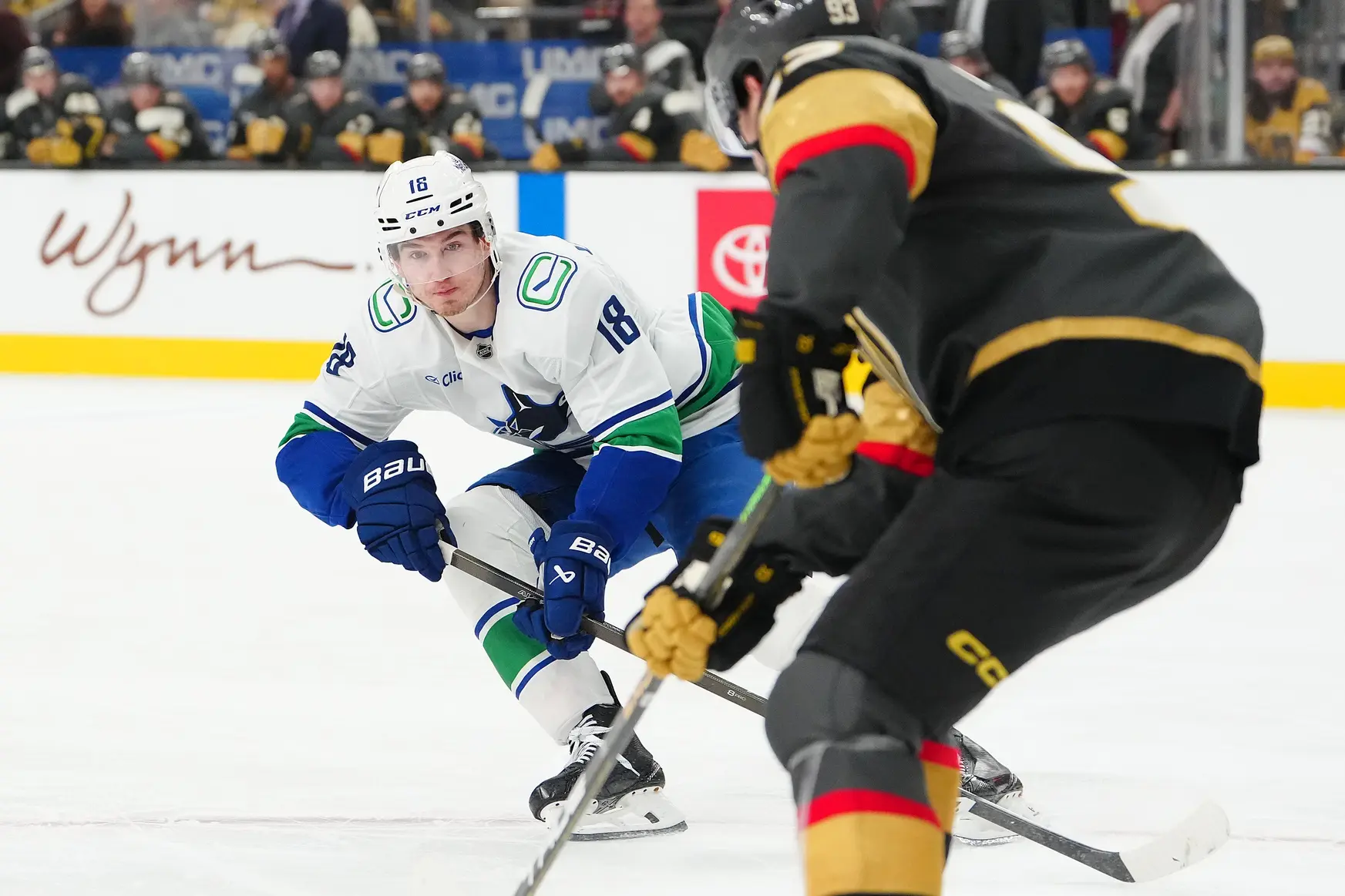
Photo credit: © Stephen R. Sylvanie-Imagn Images

Feb 13, 2026, 12:00 ESTUpdated: Feb 12, 2026, 21:32 EST


The very nature of the Vancouver Canucks’ current rebuild has almost demanded a focus on mid-round picks. Following the dealing of Kiefer Sherwood for two seconds and a prospect, the Canucks were left with a number of pending UFA veterans who are expected to return the likes of a third-round pick or less. We’re talking Evander Kane, we’re talking Teddy Blueger, we’re talking David Kämpf.
Now, mid-round picks – and the trades that involve them – are worth talking about. Draft picks are often compared to lottery tickets, and teams in a rebuilding phase are always in need of more tickets. Piling up thirds and fourths and even later picks is all a vital part of the process.
But it’s not very exciting. Nor is it the be-all and end-all of prospect-cupboard-stocking. The Canucks will need some higher-end talent along the way, and higher-end talent typically comes from higher up in the draft. For that, they probably need more first- and second-round picks, if they can get them.
First-round picks are thought of as the premium future-based asset in hockey for a reason. An average first-rounder has about a 70% chance of making it to 100 NHL games, and about a 55% chance of playing more than 300. Of course, those percentages can shift dramatically depending on where in the first round a pick is slotted.
Second-rounders have about a 40% chance of making it to 100 NHL games, and about a 25% chance of playing more than 300. That’s a notable drop from the first round, but they’re still pretty good odds.
By the time we get to the third round, we’ve traded good odds for long ones. An average third-rounder has about a 28% chance of playing 100 NHL games and only about a 17% chance of making it to 300. That’s not insignificant to a rebuilding team. If the Canucks can turn Kane or Blueger, for example, into a 17% chance at a future long-term NHLer, they should absolutely do that.
But, ideally, the Canucks would increase their odds of doing so by increasing their stock of higher picks. This far in the rebuild, they’ve acquired one extra first (from the Minnesota Wild for Quinn Hughes) and two extra seconds (from the San Jose Sharks for Sherwood). What can they do to get their hands on more?
The most direct way to get more firsts and seconds is to consider trading some of the “big fish” on the Vancouver roster. Players like Filip Hronek and Elias Pettersson, if dealt, would almost certainly bring back firsts and/or seconds in the deal. Some of the other longer-term veterans, like Conor Garland or Marcus Pettersson, might also entail such a return under the right circumstances.
But trading such players may or may not be part of the plan, and if they do end up being part of the plan, those trades will be complicated by the contracts attached to those players.
If the Canucks are looking for a simpler and less complicated way to get their hands on at least another second-round pick, the only non-“big fish” option is probably Drew O’Connor.
We talked a lot this year about how Sherwood was a more-or-less perfect mid-season acquisition for a contending team. His low salary, combined with his ability to play all over the lineup and in all situations, combined with his ornery play-style, ensured that Sherwood was practically built to boost a contender.
O’Connor has a very similar, albeit lesser, profile.
He is in the midst of a career season. He went into the Olympic Break with 13 goals and 21 points in 57 games, which should put him on pace to shatter his previous goal-high of 16 and threaten his point-high of 33.
And this is all coming after a significant cooldown. O’Connor had seven goals and 12 points in his first 26 games, and had 10 goals and 16 points by the New Year. Since January 1, he has just three goals and two assists in 18 games.
Either way, production-wise, it’s an impressive year for O’Connor. If he can get back on any sort of hot streak in the two weeks between the Olympic Break and the Trade Deadline, it could look even more impressive. It wouldn’t take much to get him back on pace for 20+ goals and 40+ points.
That’s already some pretty considerable production for a person with O’Connor’s salary. He extended with the Canucks last year for two seasons at a cap hit of just $2.5 million. That’s a sub-average salary for an NHL forward, and based on his scoring alone, O’Connor is already surpassing his expected value. But then, O’Connor also does a lot more than just score.
O’Connor ranks fourth among Canucks forwards in penalty kill minutes. But he might also be their most effective overall PKer this season, and has certainly looked like their most consistent shorthanded threat.
O’Connor isn’t overtly physical. But he does hit plenty, especially on the forecheck, and he seems to have followed the leads of Sherwood and Garland in becoming a bit of an agitator this season. He always seems to be at the centre of a scrum.
And in a league now dominated by speed, it cannot be understated how fast O’Connor is. According to NHLEdge, O’Connor’s max skating speed of 22.82MPH is in the 82nd percentile for this season, and his 12 22MPH+ speed bursts rank all the way up in the 95th percentile. Few players motor as fast as O’Connor does out there, and now that his hands have caught up with him a bit more at the age of 27, he could be said to have put together a truly intriguing package that is not without some remaining upside.
Unlike some of those longer-term veterans we discussed earlier, O’Connor’s term also makes him a near-perfect deadline acquisition for a playoff-bound team. While expiring rentals remain popular, many contenders have moved toward acquiring players with at least a year remaining on their contract. A deal that expires a year-and-change from now, like O’Connor’s, is sometimes preferred.
Acquiring a player with such term allows a team to bring that player in for this current playoff run and then keep them for a whole other regular season and subsequent postseason. Getting “two runs” in with an acquisition has value, and it’s value that teams tend to play a little bit extra for.
Especially when said player can be fit into the books with relative ease. As we said, O’Connor’s $2.5 million cap hit is below the NHL average, and there aren’t many teams who couldn’t justify adding something like that to one of their four forward lines.
The Canucks could also juice that value a bit by retaining. They’ve got two available retention slots currently, and one more opens up as of July 1 after Ilya Mikheyev’s retention comes off the books. The Canucks could retain 50% of O’Connor’s salary to bring him down to just a $1.25 million cap hit, and that is something that truly every playoff-bound team could afford.
The only thing that could limit O’Connor’s potential destinations is his no-trade clause, but even that is only limited to 12 teams, and should be fairly easily navigated.
Put all that together, and you don’t quite have another Sherwood, but you do have the next best thing. We believe that O’Connor should be able to bring home at least a second-round pick as a return – especially if retained on – and perhaps a little extra on top of that.
And if that’s the case, the Canucks should strongly consider making that move. The triedest and truest way of succeeding at a rebuild is to accumulate draft picks, and the higher the better. If another second is on the table – and thus another roughly 25% shot at producing another quality NHLer – the Canucks can’t really afford to pass that up for a player already in the midst of his prime playing days.
Sponsored by bet365


Breaking News
- JPat: A word on Aatu Räty’s past, present, and future as Canucks place young centre on waivers
- Canucks place Aatu Räty on NHL waivers
- WWYDW: Who or what has most surprised you through 10% of the Canucks’ season?
- The Statsies: Brock Boeser has his best game of the year in Canucks’ loss to Islanders
- The Stanchies: Despite growing pains on defence, Canucks battle valiantly in 3-2 loss to Islanders

Vancouver CanucksTeam Cap Summary

Cap Summary
2026-27
2027-28
Projected Cap Hit
$88,074,947
$71,329,167
Projected Cap Space
$15,925,053
$42,170,833
Current Cap Space
$17,163,668
$42,170,833
Active Players
23/23
13/23
Draft Picks
Round
'27
'28
1
1
1
2
2
2
3
1
1