
CanucksArmy has no direct affiliation to the Vancouver Canucks, Canucks Sports & Entertainment, NHL, or NHLPA
31 days, 31 questions: Is 2026-27 truly make-or-break territory for Canucks’ Jonathan Lekkerimäki?
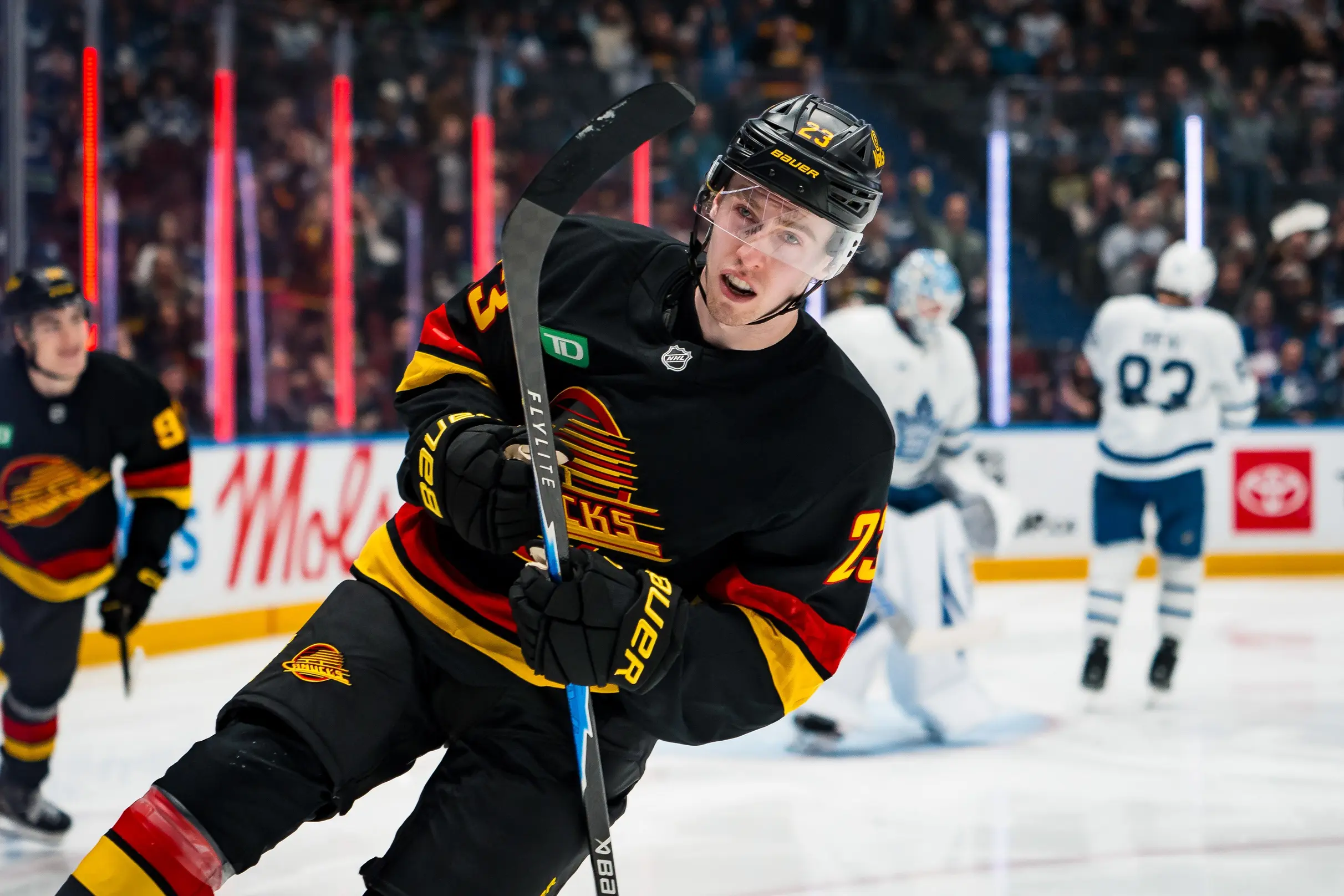
Photo credit: © Bob Frid-Imagn Images

Aug 30, 2026, 18:24 EDT


Welcome to a new series here at CanucksArmy, where over the month of August we’ll ask a new question each day about the Vancouver Canucks. We’re calling it “31 days, 31 questions”. Today, we’re examining if it truly is make-or-break territory for Jonathan Lekkerimäki.
Jonathan Lekkerimäki has reached the point in his development where patience is becoming harder to separate from expectations.
The Vancouver Canucks selected the Swedish winger 15th overall in 2022, betting on one of the best shots in his draft class developing into a legitimate top-six NHL weapon. Four years later, Lekkerimäki is 22 years old with 37 NHL games, five goals and nine points on his resume. He has shown more offensive punch in the American Hockey League, but a permanent spot in Vancouver has yet to follow.
A shoulder injury derailed what would have been his best opportunity to stick in the NHL last season. Lekkerimäki made the Canucks out of training camp before getting hurt in October, eventually undergoing surgery in February after trying to play through the issue. General manager Ryan Johnson said earlier this summer that the timing of the procedure was designed to have him ready for camp, while Rick Dhaliwal reported in August that the winger remained on pace to be in Penticton.
That gives Lekkerimäki another chance to push forward, but how much longer can Vancouver reasonably afford to wait for a breakthrough?
Offence isn’t a problem
There is a reason Lekkerimäki has remained an intriguing prospect despite the delays in his development.
His shot drove much of his draft stock — NHL Central Scouting ranked him sixth among international skaters in 2022 — while NHL.com described his release as one of the best available in the class. Lekkerimäki had already scored seven times in 26 SHL games as a 17-year-old and then led the U18 World Championship with 15 points in six games during Sweden’s gold-medal run.
However, his development took an immediate detour after being drafted. Mononucleosis, a concussion, and a foot injury contributed to a difficult draft-plus-one season in Sweden’s second division, where Lekkerimäki managed just three goals and nine points in 29 games. The following year showed the type of response Vancouver was looking for, as Lekkerimäki scored 19 goals and 31 points in 46 games for Örebro, leading the team in scoring and finishing sixth in the entire SHL in goals while earning rookie-of-the-year honours.
Whenever he has been healthy enough, his North American production has followed a similar pattern. Lekkerimäki scored 19 times in 36 AHL games during 2024-25, then improved to 13 goals and 20 points in only 21 appearances last season. His 0.619 goals-per-game rate ranked fourth in the AHL at the time his season ended. Across those two campaigns, he’s scored 32 goals in 57 regular-season AHL games.
The question surrounding Lekkerimäki isn’t about scoring against professional competition, but translating that ability to the NHL.
Daily Faceoff ranked him fourth in Vancouver’s prospect pool this month, with Steven Ellis praising his ability to find shooting space while pointing to defence and physical strength as outstanding concerns. NHL.com also placed him fourth among Canucks prospects and highlighted similar questions about whether his size and strength will allow his offence to carry upward.
How far behind the 2022 class is he?
Lekkerimäki’s draft class makes the situation more urgent.
Through the end of 2025-26, he ranks 23rd in NHL games played among the 32 players selected in the 2022 first round. His nine points are tied with 14th-overall selection Rutger McGroarty, with 21 first-rounders having already produced more.
Several players drafted in the neighbourhood of Lekkerimäki have established considerably larger NHL samples. Noah Östlund, selected one spot later, has played 68 games and recorded 27 points. Liam Öhgren, taken 19th, is at 97 games and 25 points. Jimmy Snuggerud, picked 23rd, has 55 points through 77 appearances, while 28th-overall selection Jiri Kulich has 29 points in 75.
There are still first-rounders travelling at a similar pace — McGroarty has appeared in 32 games, Joakim Kemell has played 18, and some players from the back half remain below Lekkerimäki in NHL experience. Four years after the draft, however, most of his class has at least started graduating beyond the prospect stage.
What have previous 15th-overall picks done by 22?
Looking specifically at forwards drafted in Lekkerimäki’s slot produces an interesting divide.
J.T. Miller was already a 58-game NHL player with 23 points at 21 and followed with 22 goals and 43 points over a full 82-game season at 22. Dylan Larkin had three complete NHL seasons behind him before his 22-year-old campaign, when he scored 32 goals and 73 points. Luke Kunin reached 63 games, 15 goals and 31 points at the same age.
Cole Caufield, another small, right-shot scoring winger taken 15th overall, had already scored 23 goals in 67 games by age 21. His age-22 season produced another 26 goals in just 46 appearances.
The slower developers picked at 15 offer a potential warning sign. Peter Holland played only 21 NHL games at 22 before eventually carving out a 266-game career, mostly as a depth forward. Grigori Denisenko was at 18 NHL games during his age-22 campaign and has managed only 33 in his career. Zach Senyshyn, selected 15th by Boston in 2015, finished with 16 NHL appearances to his name.
Those examples are too small a sample to determine Lekkerimäki’s future, but they show how quickly the trajectories of scoring forwards tend to diverge. Players such as Miller, Larkin and Caufield were established before or during the age Lekkerimäki is entering now, while the players still fighting for NHL minutes at the same stage generally ended up with lower ceilings.
There are exceptions. Ryan Pulock, the 15th pick in 2013, played only one NHL game at 22 before becoming a full-time defenceman the following season and eventually surpassing 600 career appearances. Development curves can be far less uniform than draft pedigree sometimes makes them appear.
How long should a prospect get?
A 2025 study published in Frontiers in Sports and Active Living examined 10,485 NHL draft picks from 1980 through 2024. The median time between being selected and playing a first NHL game was two years, with the middle 50 percent falling between one and four. Draft position was the strongest determinant of how quickly a player arrived.
Lekkerimäki has already cleared the first hurdle, but establishment is a much higher bar. The same study defined NHL “permanence” as reaching at least five seasons and 268 games, something only 16.76 percent of all drafted players accomplished. Its median time from draft to that threshold was eight years.
At 22, there is still time for Lekkerimäki to have a meaningful NHL career, and Vancouver has every reason to provide him with ample opportunity this season, but what becomes less common with every additional developmental season is turning a player who remains on the fringe into the kind of high-end scoring forward originally envisioned on draft night.
Vancouver also has contractual reasons to want an answer soon, as Lekkerimäki is entering the final season of his entry-level contract at a $918,333 cap hit and will become a restricted free agent next summer. He remains waiver-exempt in 2026-27, so the Canucks have the ability to move him between Vancouver and Abbotsford, but that exemption would expire in 2027-28, assuming he does not reach the games-played threshold sooner.
The internal competition is also increasing. Daily Faceoff Vancouver’s recent training-camp projection identified openings in the top-six but listed Linus Karlsson and Liam Öhgren as potential front-runners, with Lekkerimäki among those pushing for a larger opportunity.
A fifth post-draft season spent primarily in Abbotsford would be difficult to reconcile. Staying healthy and finally taking the next step will be two of the biggest questions surrounding Lekkerimäki when camp opens, while holding an NHL job and beginning to produce goals would considerably change his outlook.
Calling 2026-27 the season that decides whether Lekkerimäki ever becomes an NHL player is going a step too far. He’s only 22, his AHL scoring record is too strong, and injuries have taken away substantial development time.
Vancouver needs to start seeing evidence that its former 15th-overall pick can use his greatest weapon against NHL competition regularly; however, if the Canucks are still wondering where Lekkerimäki fits when next August arrives, the conversation around him will look considerably more dire.
Sponsored by bet365


Breaking News
- The Stanchies: 3 positives, 3 negatives, rebuilding lessons, and more from Canucks’ loss to Canes
- Instant Reaction: DeBrusk scores twice at 5v5 while Pettersson adds two assists in Canucks’ loss to Hurricanes
- Canucks notebook: Cotter’s keeping receipts, Elias Pettersson says he’s ‘having a lot of fun’
- Scenes from morning skate: Canucks healthy scratch Schenn and Gallagher against Stanley Cup champs in Carolina
- How many roster spots might the Canucks need to open up between now and next season?

Vancouver CanucksTeam Cap Summary

Cap Summary
2026-27
2027-28
Projected Cap Hit
$88,074,947
$71,329,167
Projected Cap Space
$15,925,053
$42,170,833
Current Cap Space
$16,699,785
$42,170,833
Active Players
23/23
13/23
Draft Picks
Round
'27
'28
1
1
1
2
2
2
3
1
1