
CanucksArmy has no direct affiliation to the Vancouver Canucks, Canucks Sports & Entertainment, NHL, or NHLPA
Which Canucks prospects that don’t have roster spots now will need them in 2026-27?
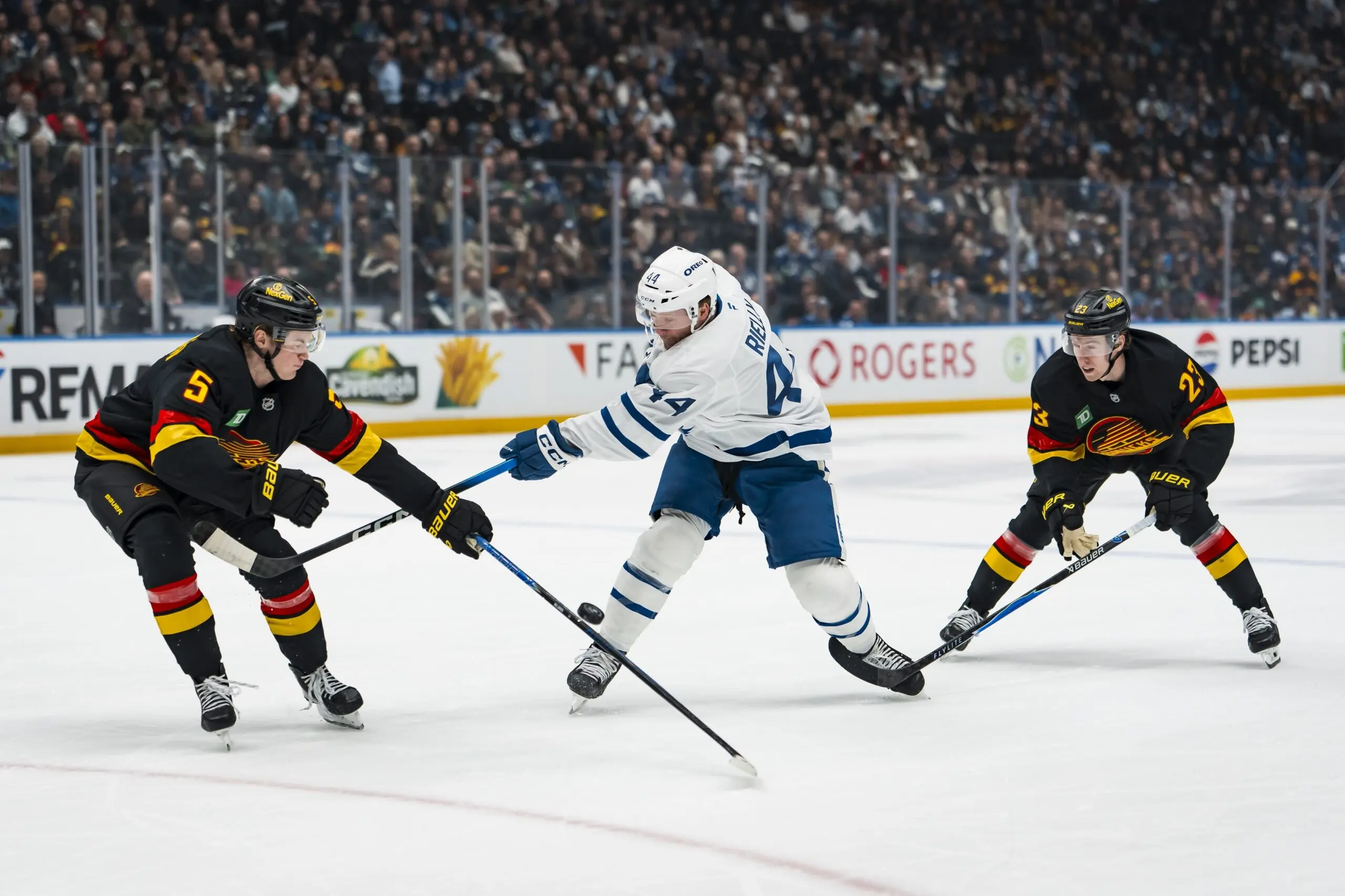
Photo credit: © Bob Frid-Imagn Images

Feb 2, 2026, 12:00 ESTUpdated: Feb 2, 2026, 12:01 EST


The Departures terminal at YVR is going to have to get a little busier eventually.
Whether it happens in the next couple of days, before the Olympic Roster Freeze, or whether it happens in the two weeks between that and the Trade Deadline, it is all but certain that more Canucks are about to be traded.
Heck, even if the pending UFAs like Evander Kane, Teddy Blueger, and David Kampf aren’t dealt, then they’ll be departing via free agency eventually, anyway. Beyond that set, virtually everyone else over the age of 25 has been included in various rumours, and there’s better-than-even odds of at least one veteran with a longer-term contract being moved.
The point we’re getting at here is that, when the 2026-27 opens up this October, there are going to be some vacated spots on this Vancouver roster. And for those who have embraced a fairly full-fledged Canucks rebuild, these roster departures serve two purposes.
The first purpose is, of course, the accumulation of assets to help the rebuild move along, primarily in the form of picks and prospects.
But when it comes to moving some of those mid-and-lower-tier assets like Kane, Blueger, and Kampf, the expectation is that the Canucks probably won’t get much back at all. The onus to trade these players is less about the return, and more about enacting the youth movement – both by making the roster a little younger overall, and by clearing space for more young players to both join and achieve meaningful minutes.
Some of the impetus to clear out some of the longer-term veterans comes from a similar place, and that same desire to make room.
But how much room do the Canucks really need to create for 2026-27? Or, phrased differently and more similarly to our headline, how many Canucks prospects need roster spots in 2026-27 that don’t already have them?
It’s a question worth asking, even this far out with no definitive answers.
At this exact juncture of the 2025-26 season, the Canucks have almost all of their available young pieces of note already in the NHL lineup. Up front, they’ve got 16 forwards on the roster (including Marco Rossi and Brock Boeser on IR), and that group includes Liam Öhgren, Aatu Räty, Max Sasson, and Jonathan Lekkerimäki.
Were everyone to be healthy, at least two forwards would need to be sent down. As of now, that’s probably Lekkerimäki – due to his not needing waivers – and somebody else. However, the hope has to be that a trade is made before any waiving is necessary, anyway.
The larger point to be made is that, in order for Lekkerimäki to have a spot in 2026-27 and for the likes of Öhgren, Räty, and Sasson to maintain theirs, there is a need to move at least two other forwards off the roster between now and then.
Which shouldn’t be an issue. As we mentioned, Kane, Blueger, and Kampf are all but gone.
What about incoming forwards? The Canucks could have two of note. The first is Braeden Cootes, who made the team out of camp as an 18-year-old, and will presumably take a good run at doing the same as a 19-year-old.
The other is whoever the Canucks happen to draft at the top of the 2026 NHL Entry Draft, assuming that player is a forward.
There are definitely scenarios in which both Cootes and the new draftee need spots right away in 2026-27, but, again, those spots don’t seem terribly hard to come by. The departures of Kane, Blueger, and Kampf already left one open forward spot over and above the current configuration, and all it would take is just one more veteran player traded to open up the other.
There’s also no guarantee that Cootes or the draftee need spots. As of next year, the Canucks should be able to assign a 19-year-old Cootes to the AHL rather than the WHL, which opens up a fine option for his development. A freshly-drafted player can also always be returned to juniors or college.
Suffice it to say that, unless the Canucks suddenly acquire a number of NHL-ready young forwards, they’re not going to experience much of a roster crunch up front, at least not as soon as 2026-27.
The same is mostly true of the blueline. Without any trades on the horizon there, it seems like the plan is for the Canucks to enter the 2026-27 season with the same top-six they have now, which means veterans Filip Hronek, Marcus Pettersson, and Tyler Myers, and youngsters Zeev Buium, Tom Willander, and Elias Pettersson.
For extras, Derek Forbort seems to have perhaps reached the end of his career, and P-O Joseph is in take-or-leave territory as a pending RFA. In other words, there are up to two open spots available if the Canucks want them, and they may want them.
Victor Mancini is only a second-year pro, and has a whole ‘nother season of waiver-exemption waiting for him if he needs it. At the same time, however, Mancini is already 23 years old, and there has to be some worry of him getting stagnant down in Abbotsford. Chances are that management and coaching staff alike would prefer Mancini at least be a part of the NHL rotation in 2026-27, so he’ll have one of those spots penciled to his name.
If we’re talking AHL stagnation, we better talk about Kirill Kudryavtsev, too. He’s younger than Mancini at 21, but already has more than 100 AHL games under his belt, and has spent many of them being a top-pairing defender. He has two more years of waiver-exemption available, however, if he needs it.
The only other defender who might end up pushing for minutes right away might be Keaton Verhoeff, were the Canucks to select him instead of Gavin McKenna or Ivar Stenberg from the top of the 2026 draft.
Otherwise, the Canucks are in pretty good shape here, too. They’ve essentially got all the spots they need, even if they want Mancini and Kudryavtsev to both join as full-time NHLers next year. And, if one or both of those players proves unable, it’s fairly easy to sign a short-term veteran to fill-in as an extra for the interim.
The only place the Canucks might truly need to create some roster space, as we’ve previously mentioned, is in the crease. The 25-year-old Nikita Tolopilo is out of waiver-exemption as of this summer, and will not be able to be re-assigned without waivers as of Training Camp 2026. Should Thatcher Demko’s surgery get him back on the ice by October, then the Canucks would have a three-headed goaltending issue to resolve between Demko, Tolopilo, and Kevin Lankinen.
Aside from that, the only real need to create further roster spots would come from trades involving young, NHL-ready players arriving in Vancouver. As far as those young pieces already on hand, or likely to arrive via the draft in the near future, the Canucks would seem to have plenty of room.
Enough room, in fact, that the Canucks may even be able to earmark some of those roster spots for non-youth, specifically in the form of veteran cap dumps taken on to accumulate further future assets. But that’s perhaps an idea for another day, and another article.
For now, suffice it to say that the Canucks might need to make trades, but they can feel secure making those trades for the sake of themselves, as opposed to needing to create roster space.
Sponsored by bet365


Breaking News
- Canucks’ Jack Thompson clears NHL waivers, will report to AHL Abbotsford
- JPat’s Monday Mailbag: Canucks chemistry lessons, a hot dog feast and press box bingo
- The Statsies: Canucks overwhelmed at 5v5 in Hughes’ return after a strong first period
- The Stanchies: Boo birds rain on Hughes in return to Vancouver; Canucks lose 4-2 to Wild
- Instant Reaction: Canucks start strong but fall 4-2 to Wild in Hughes’ return to Vancouver

Vancouver CanucksTeam Cap Summary

Cap Summary
2026-27
2027-28
Projected Cap Hit
$87,295,050
$71,329,167
Projected Cap Space
$16,704,950
$42,170,833
Current Cap Space
$19,290,240
$42,170,833
Active Players
23/23
13/23
Draft Picks
Round
'27
'28
1
1
1
2
2
2
3
1
1