
CanucksArmy has no direct affiliation to the Vancouver Canucks, Canucks Sports & Entertainment, NHL, or NHLPA
In 2026, the Canucks need to put their focus on acquiring (and drafting) young forwards over everything else
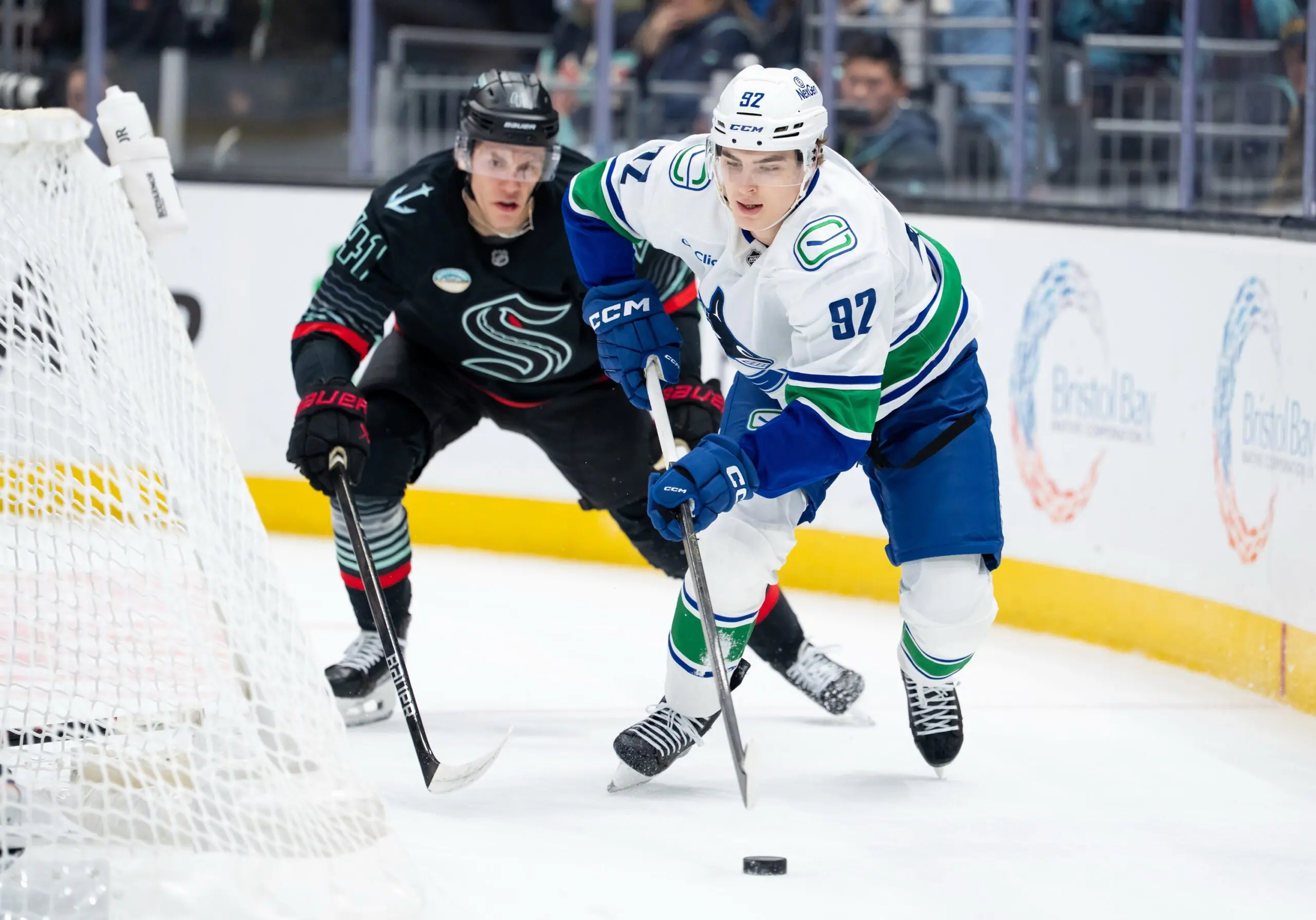
Photo credit: © Stephen Brashear-Imagn Images

Dec 31, 2025, 14:14 ESTUpdated: Jan 1, 2026, 20:51 EST


The conventional wisdom holds that, in most scenarios, a hockey team should focus on landing the “Best Player Available.” This notion is typically tied most closely to the draft and tends to be seen as truer the higher one sits in that draft. It’s also applied to trading, and especially the kind of trading that the Vancouver Canucks are currently engaged in – as in, older players out, younger players in.
The thinking here is in line with “beggars can’t be choosers.” Any team going through a rebuild or retool or re-anything needs to add talent, and they can’t necessarily afford to be choosy about that talent. In other words, a rebuilding team should not sit at the draft table and worry about whether they need a centre, a left defence, or a goaltender more. A rebuilding team should – according to conventional wisdom – take the player with the most talent, aka the best player available.
But does that really apply to the Canucks in their current stage of roster refurbishment?
The truth is that, although the Canucks have committed to a ‘hybrid rebuild’ of some sort, they’re not exactly starting from scratch. Ill-fated attempts to compete in years past, combined with the big deal that already went down within this season, have left the Canucks with a better-than-decent collection of young players to build on.
They just mostly happen to be on the back end.
Currently, the Canucks have three defenders aged either 20 or 21 playing every night in the NHL. These three are Elias Pettersson (the Younger), Tom Willander, and Zeev Buium, and one gets the idea that none of them are going anywhere for a very long time. In fact, with this one trio, the Canucks could have half of their blueline sealed up for the next decade.
Willander and Buium both project as near-guaranteed top-four talents, and probably each has top-pairing upside if they maximize their potential. Pettersson has some top-four potential himself, and if he doesn’t hit it, he’ll remain a rock-solid bottom-pairing defender for a long time.
All three should remain more or less under team control until they’re about 27, which will come at some point in the 2030s. The future of the Canucks’ blueline is here and now.
The trio of Willander, Buium, and Pettersson are currently complemented by Filip Hronek, Marcus Pettersson, and Tyler Myers. Hronek is signed until 2032, and Pettersson is signed until 2031.
With the stated plan to hang on to the veterans and use them to help develop the youngsters, one questions how the Canucks would even integrate a new youthful defender or two into that mix. And yet, they’re already going to have to. Both Victor Mancini and Kirill Kudryavtsev are going to be pushing for spots as soon as next year, and they’ll be in their last season of waiver-exemption by then.
Flash-forward a bit to the 2027-28 season, the one after Myers’ contract expires, and the Canucks may have a blueline on their hands that looks something like this:
Buium – Hronek
M Pettersson – Willander
E Pettersson – Mancini
Kudryavtsev
Now, nothing ever works out quite as planned, and there will surely be some unexpected hiccups along the way to that future vision. Either way, it highlights the depth the Canucks have already built up at the position, which is the point we’re trying to make.
The same is true for the crease, albeit to a lesser extent. As it stands, the plan is apparently for the Canucks to hang on to both Thatcher Demko and Kevin Lankinen, with their contracts running until 2029 and 2030, respectively.
Behind those two, the Canucks have the 25-year-old Nikita Tolopilo, who performed well in NHL relief duty this season already, and the still-18-year-old Aleksei Medvedev as key goalies-in-waiting.
Goaltending is the most mercurial position in hockey, and we’d never call a goaltending situation truly settled. But the Canucks are well-stocked enough at the position to justify focusing their drafting and their prospect-acquiring in another direction.
Which direction? The forward direction, of course.
Things are much more dire up front. The Canucks are not entirely devoid of future impact players up front. Braeden Cootes, Jonathan Lekkerimäki, and Liam Öhgren all belong to that same ‘21-and-under’ club. But whereas Willander, Buium, and Pettersson are all making a definitive NHL impact already, only Öhgren can be said to be doing the same right at this present moment, and that’s only been for a very small sample size.
The Canucks are much, much shorter on forward talent than they are anywhere else. And that’s a particularly acute issue, because hockey rosters are composed of about two-thirds forwards.
Which brings us all the way back to that original point. Should the Canucks really be adhering to any sort of ‘Best Player Available’ mantra when they appear to have their back-end built out unto the 2030s?
We think not.
Instead, the Canucks are at the point where they should be looking in almost all scenarios at the ‘Best Forward Available.’
Of course, only a Sith deals in absolutes, and the last thing we want is for the Canucks to do a sithy job with their rebuild. Some circumstances may arise in which a young defender or goaltender becomes available that is far over and above the forwards available in the same scenario. Then, of course, the Canucks could make an exception. There’s no issues with having too much of a good thing.
But the Canucks are only going to realistically receive so many opportunities to add talent to their organization over the next few years. And they should be using as many of those opportunities as possible on adding forwards.
This should begin immediately. As the Canucks continue the process of trading veterans like Kiefer Sherwood and Evander Kane, getting back draft picks – draft picks that can be used on forwards – is ideal. But the Canucks have stated a preference for acquiring more developed prospects instead. No real problem there, so long as they try to focus on developed forward prospects, specifically.
If all goes (to the bottom of the) well, the Canucks will end up with at least one very high pick in the 2026 Entry Draft. Currently, there is a clear top three of forwards Gavin McKenna and Ivar Stenberg, and defender Keaton Verhoeff. We think you know what we’re thinking here. If the Canucks are picking 3OA and both McKenna and Stenberg are off the board, then the Canucks probably happily pick Verhoeff and adjust their future plans accordingly. But if either of the two superstar forwards is still on the board, the Canucks pretty much have to select one of them.
That thought process continues throughout the 2026 first round and beyond: that Minnesota first-rounder should be held onto and used on a forward, too.
Adding at least a couple forwards with true top-line potential is the absolute imperative here. It’s something the Canucks need to do if they want the foundation they’ve already built to ever count for something.
If the Canucks do anything in 2026, they need to add some young forwards at least as good as Willander, Buium, and Pettersson to the mix. A trio of such forwards would be ideal, but if it’s only one or two, that still makes a difference.
The year 2026 should be the year of forward focus for the Vancouver Canucks. It’s not just the main priority; it might be the only priority.
PRESENTED BY VIVID SEATS



Breaking News
- Instant Reaction: Brady Tkachuk scores late hat trick in Canucks’ overtime loss to Florida
- Canucks trade Aatu Räty to Maple Leafs for forwards Jacob Quillan and Brandon Buhr
- What’s behind the early struggles from Canucks’ Zeev Buium and Filip Hronek?
- Canucks’ Räty clears NHL waivers, will report to AHL Abbotsford
- Blackfish: Romani opens strong, Cootes continues to impress and Malhotra shows his offensive potential

Vancouver CanucksTeam Cap Summary

Cap Summary
2026-27
2027-28
Projected Cap Hit
$88,074,947
$71,329,167
Projected Cap Space
$15,925,053
$42,170,833
Current Cap Space
$17,259,555
$42,170,833
Active Players
23/23
13/23
Draft Picks
Round
'27
'28
1
1
1
2
2
2
3
1
1