
CanucksArmy has no direct affiliation to the Vancouver Canucks, Canucks Sports & Entertainment, NHL, or NHLPA
Why size mattered for the Canucks at the 2026 NHL Entry Draft | Wagner’s Weekly
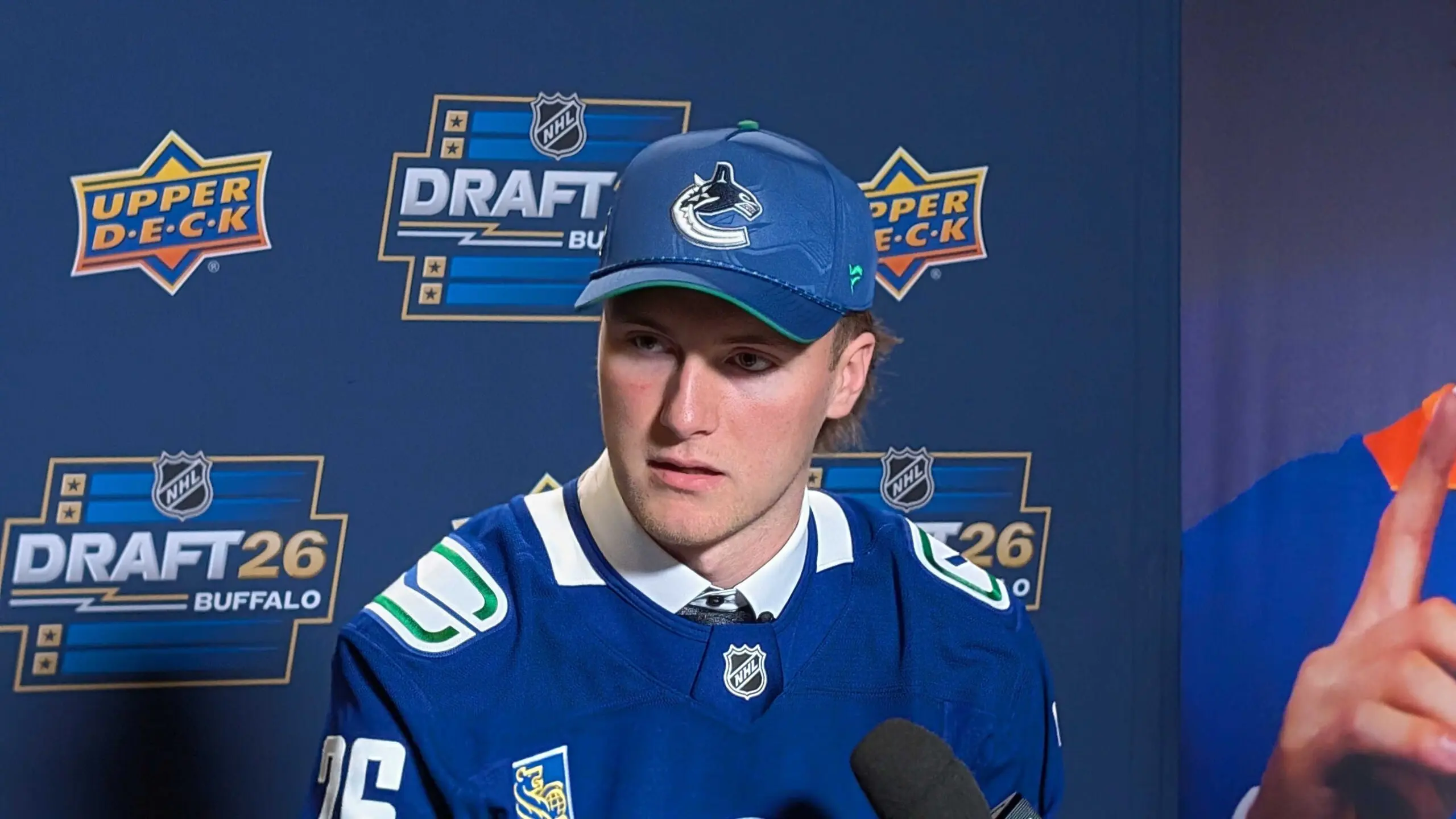
Photo credit: Steven Ellis | The Nation Network

Jun 28, 2026, 15:00 EDTUpdated: Jun 28, 2026, 14:54 EDT


It wasn’t hard to figure out the Vancouver Canucks’ draft strategy at the 2026 NHL Entry Draft.
It became pretty clear when the Canucks selected 6’7” centre Brooks Rogowski with the first pick in the second round, then followed that up with a pair of 6’4” wingers and a 6’5” defenceman — size was a major factor at the Canucks’ draft table. By the end of the draft, they hadn’t selected a single player under 6’0”.
It seemed like the Canucks’ new front office was not only trying to build a foundation for their rebuild but also to send a message about what they want their new team identity to be.
“We had some direction from, obviously, RJ and the staff,” said director of amateur scouting Todd Harvey to the media after the draft. “We wanted to get bigger, we wanted to get faster, we wanted to get harder. You can say, ‘Oh, we didn’t take any skill,’ but let’s not underrate the skill on these guys — these guys have skill.”
Focusing on size at the draft feels like an old-school approach, harkening back to the Canucks’ first general manager, Bud Poile, who said after the team’s first draft in 1970, “We may not win many games, but we should win a few fights.”
That could raise some eyebrows, particularly after the Carolina Hurricanes won the Stanley Cup with 5’11” Jackson Blake leading the team in points, while 5’8” Logan Stankoven led the team in goals. Let’s not forget that the Canucks passed up on drafting Stankoven in favour of 6’2” power forward Danila Klimovich, who is heading to free agency without having played a single game for Vancouver.
But Harvey is right: the Canucks didn’t sacrifice speed and skill in their pursuit of size. Reading the scouting reports and watching the video for each of the Canucks’ picks, it’s clear that each prospect brings more than just the ability to reach items on the top shelf of the grocery store.
The Canucks took players with pace, high motors, soft hands, and dangerous shots. Apart from goaltender Dmitri Ivchenko and defenceman Samuel Eriksson, each of the Canucks’ picks could back up those scouting reports with goals and assists.
Certainly, there were a few smaller, skilled players whom the Canucks could have taken at different points in the draft, but there were no egregious Klimovich-over-Stankoven missteps.
Some might quibble with that take, pointing to the Vancouver Giants’ Mathis Preston, who the Canucks passed over twice in the second round in favour of Brooks Rogowski and Niklas Aaram-Olsen. But Rogowski and Aaram-Olsen were perfectly reasonable picks when the Canucks took them, with each expected to be selected right around where the Canucks took them.
Whether Preston has more upside is arguable, as both Preston and Rogowski produced at about the same rate. Preston had 44 points in 46 WHL games; Rogowski had 42 points in 46 OHL games. Meanwhile, Aaram-Olsen dominated in the Swedish U20 Nationell, scoring 20 goals and 40 points in 29 games.
Who’s to say that Preston is a more promising prospect than Rogowski or Aaram-Olsen, even before you take into account their size? There’s a case to be made that Preston’s style of play is less translatable to the NHL than the two Canucks prospects, with some labelling him boom-or-bust, while Rogowski and Aaram-Olsen have higher floors to go with their high ceilings.
That’s not to denigrate Preston, who is a legitimately promising prospect with great wheels, but more to point out that the Canucks made reasonable bets with the picks they made. The Canucks’ lone reach came in the fifth round when they picked Connor Davis, and that late in the draft, it’s hard to even call it a reach. Those in the public sphere have all rated the Canucks’ draft highly, with Elite Prospects giving them an A+ and The Athletic giving them an A-.
Here’s the key for the Canucks: the potential payoff is huge. If just one of the hulking forwards they picked hits, the Canucks will have a player that is nearly impossible to find outside of the draft: the ever-elusive power forward.
If that player happens to be Rogowski, they’ll have a unicorn — a 6’7” right-shot centre with a strong two-way game who is a dual scoring threat.
Don’t get me wrong, there’s a place for small, shifty forwards too, but it’s hard to fault the Canucks for taking a swing at size, especially when there’s a case to be made that those sizeable prospects have just as much offensive upside as their smaller peers.
It also suggests the direction the Canucks want to go. The Canucks already have plenty of small skill on the roster and in the system. Elias Pettersson is above six feet, but slight, while Marco Rossi is 5’9”, making them small down the middle. The team’s top prospect on the wing is the willowy Jonathan Lekkerimäki. Brock Boeser and Jake DeBrusk are 6’1″, but neither is a power forward in the traditional sense, and they also lack speed.
There really wasn’t anyone in the Canucks’ system with the profile of the players selected by the Canucks this weekend. Vilmer Alriksson has the size, but never produced points like Rogowski.
All told, the Canucks’ 2026 draft suggests the direction that Ryan Johnson and the Sedins want to take the team: more size and harder to play against, but without losing sight of the speed and skill that are so essential to winning in today’s NHL.
Now we’ll have to see if their big bet will pay off.
Sponsored by bet365


Breaking News
- Checking in on 16 former Canucks one week into 2026-27 season
- Blackfish: Malhotra’s NCAA debut, Cootes’ AHL debut, and more
- Scenes from practice: Mancini appears set to make season debut as Canucks start road trip in Carolina
- What a $127.5 million NHL salary cap could mean for the Canucks in 2028-29
- Breaking down how the Canucks have had so much success on the counterattack

Vancouver CanucksTeam Cap Summary

Cap Summary
2026-27
2027-28
Projected Cap Hit
$88,074,947
$71,329,167
Projected Cap Space
$15,925,053
$42,170,833
Current Cap Space
$16,610,002
$42,170,833
Active Players
23/23
13/23
Draft Picks
Round
'27
'28
1
1
1
2
2
2
3
1
1