
CanucksArmy has no direct affiliation to the Vancouver Canucks, Canucks Sports & Entertainment, NHL, or NHLPA
Why Chris Tanev’s lack of offensive production doesn’t matter


Mar 24, 2015, 16:15 EDTUpdated:


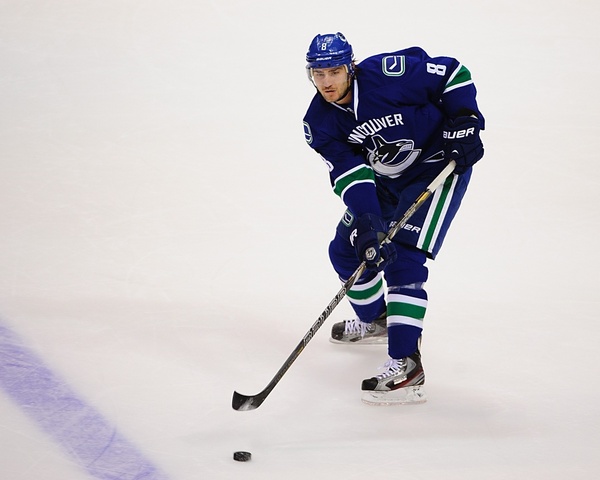
Photo Credit: Anne-Marie Sorvin/USA TODAY Sports
On Tuesday morning, the Vancouver Canucks signed defensive defenseman Chris Tanev to a lucrative five-year contract extension. No one doubts Tanev’s ability to key the rush or block shots or disrupt the possession game of Vancouver’s opponents, but the 25-year-old’s offensive game has been non-existent throughout his career.
Does that matter? Nope, but we understand the confusion. Let’s get into precisely why it doesn’t matter on the other side of the jump.
Theory
If you’re anything like me you grew up with a stack of hockey cards and the Hockey News’ annual NHL yearbooks. You pored over the statistics and judged players accordingly. 10 goals and 40 points is what a good defenseman should produce, right?
That was the extent of my thinking about NHL players back in the day, but hockey is a game of ratios, not a game of raw numbers. Scoring 10 goals and recording 40 points isn’t cool. You know what’s cool? Helping your team outscore the opposition consistently at the NHL level.

The Cooler
Whether or not it really matters, at the end of the day Tanev is something of an offensive black hole.
It’s not his counting stats that should concern you though, it’s that the Canucks legitimately generate fewer shots, fewer goals and fewer scoring chances when he’s on the ice. Like William H. Macy in the Cooler depresses a casino’s customers’ ability to win, Tanev does legitimately restrain the club’s ability to manufacture offense.
My favourite way of measuring a defenseman’s individual impact on 5-on-5 offense isn’t by looking at goals, assists and total points. Rather it’s by looking at team relative shot rate. Team relative shot rate compares how many shots a team generates with a player on the ice, versus how many shots they manage when the player is on the bench (or in the press box nursing an injury). Over the past three seasons the five defenseman who score best by this metric are Erik Karlsson, Kris Letang, Duncan Keith, Christian Ehrhoff and Johnny Boychuk – which sounds about right.
With Tanev on the ice over the past three seasons the Vancouver Canucks have generated .43 fewer shots on goal, rated per 60 minutes of even strength ice time, than they have when Tanev isn’t on the ice. So to some extent what Tanev does on the ice – whether it’s a lack of offensive instincts, or his not having a booming slapper – it has legitimately served to downgrade the rate at which the Canucks score goals at 5-on-5.
That .43 number though isn’t that bad though. It is below average for a player that logs as much ice time as Tanev does, but it’s a better number than that managed by a variety of more famous defenseman with a reputation for being good at offense, including Tyler Myers, Dion Phaneuf and Jack Johnson.
A game of ‘more’

So why does a defenseman having a negative impact on his club’s overall offensive game at 5-on-5 not matter? The short of it is that, of course it does. It just doesn’t matter that much in Tanev’s case because his positive defensive value outweighs his negative offensive value. By a lot.
While the Canucks have generated .43 fewer shots rated per 60 minutes of 5-on-5 ice time with Tanev on the ice over the past three seasons, they’ve also given up 3.81 shots fewer. Or to put it simply: Tanev is good enough in his own end of the rink that he still helps the Canucks outshoot their opponents in spite of his lagging offensive abilities.
It’s like the flip side of an offensive defenseman – be it Keith or Karlsson or P.K. Subban – who can be error prone on occasion when keying the transition game. You’ll take the odd costly turnover, because on balance, what they’re providing the team is so much more valuable than a costly turnover every five games or so.
Opportunity
Here’s another key thing to remember about Tanev’s lack of offensive production: he basically never sees the ice during Vancouver’s power play opportunities. For his career to this point, Tanev has averaged fewer than 15 seconds of power-play ice time per game, a paltry number.
Everyone focuses on his lack of shots and other such statistics, but those need to be qualified with the admission that Tanev is almost never used at 5-on-4.
Generally speaking coaches are good and reliable talent evaluators, so Tanev’s lack of power-play time very probably does speak to a lack of pure offensive ability. Tanev’s only marginally below average even-strength production rates are still crucial context here though, particularly because it’s not like he’s a massive offensive liability. In fact Tanev’s even-strength scoring rates are – far from cataclysmic – legitimately on the low-end of what you might reasonably expect from a top-four defenseman.
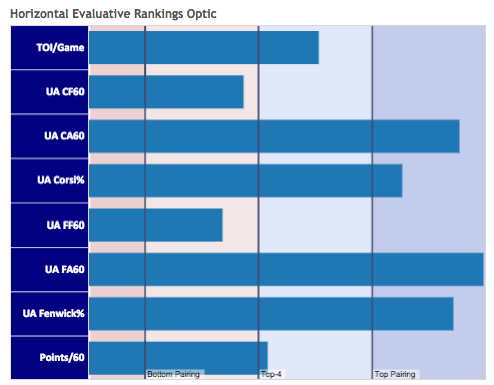
(Courtesy: Ownthepuck.blogspot.com)
Of course the offensive stats aren’t what should stand out to you from the chart above. Rather it’s his elite defensive impact.
Conclusion
In discussing Tanev’s new contract with the media on Tuesday, Canucks general manager Jim Benning characterized the Vancouver blue liner in a rather interesting way.
“He’s unique.. because he’s like a transitional defensive defenseman where he’s real good defensively, but he can skate the puck out of his own end and get it up to our forwards,” Benning said.
A ‘transitional defensive defenseman’ is a lovely term, and an excellent upgrade on the ‘hybrid shutdown defender’ lingo we’ve been throwing around over the past few years. It speaks to Tanev’s quiet value.
With Tanev on the ice the Canucks outshoot opponents. A team that consistently outshoots their opponents will, over time, win more games than they lose.
What logically follows is that Tanev helps the Canucks win games. Offensive production be damned


Breaking News
- Cootes scores first career AHL goal and Mueller scores a pair in Abbotsford Canucks’ opening weekend
- Canucks Game Day: Closing out a busy weekend with a visit from Vegas
- ‘Trying to play a hard game’: Canucks’ Pettersson explains early physical surgence
- The Statsies: Leevi Meriläinen saves a full goal above expected in Canucks’ win over Flames
- The Stanchies: Canucks rip four third period goals, Meriläinen shuts down Flames in 4-1 win

Vancouver CanucksTeam Cap Summary

Cap Summary
2026-27
2027-28
Projected Cap Hit
$88,074,947
$71,329,167
Projected Cap Space
$15,925,053
$42,170,833
Current Cap Space
$16,260,317
$42,170,833
Active Players
23/23
13/23
Draft Picks
Round
'27
'28
1
1
1
2
2
2
3
1
1