
CanucksArmy has no direct affiliation to the Vancouver Canucks, Canucks Sports & Entertainment, NHL, or NHLPA
Who’s to blame for the Canucks’ terrible penalty kill? | Wagner’s Weekly
Photo credit: © Bob Frid-Imagn Images

Mar 29, 2026, 16:00 EDTUpdated: Mar 29, 2026, 15:15 EDT


The Vancouver Canucks’ penalty kill could be worse. But not by much.
After allowing two power play goals on three opportunities on Saturday night against the Calgary Flames, the Canucks’ league-worst penalty kill fell to 70.7% on the season.
If the season ended today, that would be the seventh-worst penalty kill percentage since the league started tracking the statistic in 1977. It’s also just shy of the franchise record for the worst penalty kill in Canucks history, held by the 1984-85 Canucks at 70.5%.
In fact, if Matt Coranato’s opening goal on Saturday had come six seconds earlier, while Evander Kane was still in the penalty box, the Canucks’ penalty kill would have fallen to 70.2%, just below that franchise low. With 10 games left in the season, there’s still a distinct possibility they set a new franchise record.
In other words, the 2025-26 Canucks have one of the worst penalty kills in NHL history. That might not be too surprising. After all, the 2025-26 Canucks are very clearly a bad team, set to finish last place in the league.
But you don’t have to be a good team to have a good penalty kill. It doesn’t take elite skill to kill penalties, just good defensive awareness, coachability, and the willingness to get your body into shooting lanes.
Case in point: the Chicago Blackhawks, who currently sit 31st in the NHL, have the best penalty kill in the league, clicking at 84.6%. The Blackhawks have allowed a lot of goals against this season, just not on the penalty kill.
So, if it’s not a given that a bad team like the Canucks would also have a bad penalty kill, who’s to blame?
It’s not a meaningless question: the Canucks will need to figure out what went wrong with the penalty kill this season to avoid making the same mistakes in the future.
Let’s take a look at some potential culprits.
Shoddy goaltending
It’s a commonly held belief in hockey that your goaltender is your most important penalty killer. It stands to reason, then, that if you have the worst penalty kill in the league, your most important penalty killer isn’t doing a great job.
Unsurprisingly, given the number of power play goals they’ve allowed, the Canucks have the worst save percentage in the league while on the penalty kill at .793. The next worst team, the Ottawa Senators, is at .805, and the league average is .855, just to give some context for how bad the Canucks’ goaltending has been.
That might seem like it’s case closed, especially when you look at the rate of shot attempts the Canucks have allowed on the penalty kill: 100.2 per 60 minutes, which is ranked 12th in the NHL — better than average. With even average goaltending, then, the Canucks’ penalty kill would presumably be right around league average instead of historically bad.
But it’s not quite that simple. Sure, the Canucks would love to have a few more saves, especially from Kevin Lankinen, whose .765 save percentage on the penalty kill is second worst in the league, ahead of only Jordan Binnington. But goaltenders can only do so much, particularly if the penalty killers in front of them repeatedly allow cross-seam passes or wide-open chances from dangerous areas.
It’s worth noting that Nikita Tolopilo and Thatcher Demko are both also below league average in penalty kill save percentage this season. Tolopilo is at .82,5 and Demko is at .848 — 56th and 41st among the 68 goaltenders who have played at least 60 minutes on the penalty kill.
When all of your goaltenders are performing below average, you start to look at other potential causes. And when we look at underlying statistics beyond shot attempts (Corsi), they start to get worse and worse the more granular you get.
| PK Statistic | 2025-26 Canucks | League Rank |
|---|---|---|
Corsi Against/60 | 100.2 | 12th |
Fenwick Against/60 | 80.7 | 18th |
Shots Against/60 | 54.8 | 21st |
Expected Goals Against/60 | 9.7 | 27th |
Goals Against/60 | 11.3 | 32nd |
The Canucks may be better than average in Corsi on the penalty kill, but they’re below average in Fenwick, and head to the bottom of the league as you get into expected goals via Natural Stat Trick.
If you look at the Canucks’ heat map of shots against on the penalty kill via HockeyViz, it becomes awfully difficult to blame the team’s penalty kill struggles on goaltending.
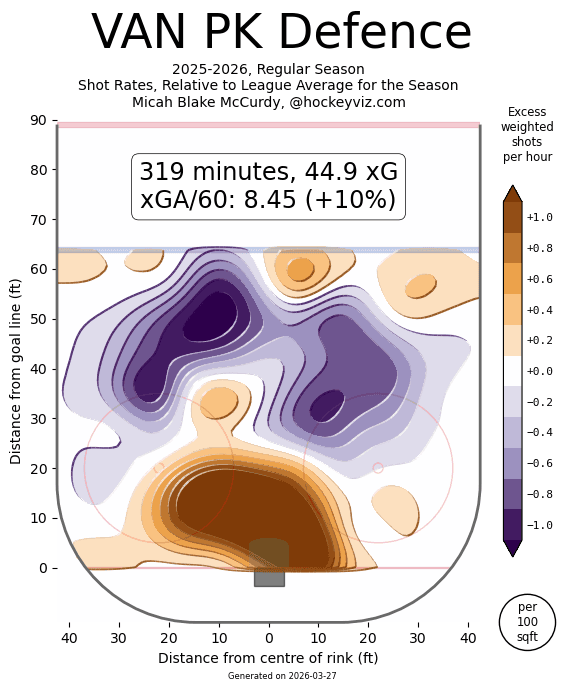
While the Canucks’ goaltending could be better, especially Lankinen, I think we need to look elsewhere.
Untested and inexperienced youth
The Canucks have a young team, especially on defence, where three defencemen under the age of 22 — Tom Willander, Zeev Buium, and Elias Pettersson — have played significant minutes.
Penalty killing at the NHL level is a skill that takes time and experience to hone. So, is the team’s youth part of the problem on the penalty kill?
No. Well, probably not.
The truth is, few of the Canucks’ young players have seen a lot of ice time on the penalty kill this season. Buium can be ruled out as part of the problem, as he’s played fewer than two minutes shorthanded for the Canucks.
The only young players who have played at least 20 minutes on the penalty kill are Willander, Pettersson, Liam Öhgren, and Aatu Räty. That’s it.
Also, Öhgren and Willander barely clear that bar, playing around 22-23 minutes each, while Räty’s minutes on the penalty kill have been incredibly specialized. Räty mostly just gets sent out to win a faceoff and then immediately gets off the ice.
In his limited minutes, Öhgren has sterling underlying numbers on the penalty kill: on the ice for the lowest rate of shot attempts, unblocked shot attempts, shots on goal, expected goals, and actual goals against.
| Player | TOI | CA/60 | FA/60 | SA/60 | xGA/60 | GA/60 |
|---|---|---|---|---|---|---|
Liam Öhgren | 21.92 | 90.3 | 65.7 | 35.6 | 5.87 | 5.48 |
Aatu Räty | 47.42 | 94.9 | 72.1 | 50.6 | 8.29 | 7.59 |
Drew O’Connor | 82.57 | 92.3 | 74.9 | 52.3 | 9.82 | 14.53 |
Kiefer Sherwood | 91.33 | 93.9 | 75.6 | 50.6 | 9.04 | 9.20 |
Jake DeBrusk | 54.35 | 101.6 | 78.4 | 53.0 | 9.91 | 6.62 |
Teddy Blueger | 48.43 | 91.7 | 79.3 | 55.8 | 8.53 | 9.91 |
Tom Willander | 22.53 | 95.9 | 79.9 | 55.9 | 10.65 | 13.31 |
Filip Hronek | 166.00 | 98.3 | 79.9 | 51.3 | 9.10 | 11.20 |
Brock Boeser | 55.33 | 96.5 | 80.2 | 60.7 | 9.66 | 10.84 |
Tyler Myers | 157.17 | 101.9 | 80.2 | 55.7 | 9.57 | 12.22 |
Marcus Pettersson | 198.58 | 102.4 | 81.0 | 53.2 | 9.91 | 10.88 |
Elias Pettersson (D) | 71.02 | 97.2 | 81.1 | 52.4 | 10.71 | 7.60 |
Elias Pettersson (C) | 60.97 | 104.3 | 84.6 | 57.1 | 10.90 | 15.75 |
Conor Garland | 93.10 | 108.3 | 86.4 | 54.8 | 10.82 | 12.24 |
David Kämpf | 58.37 | 110.0 | 94.6 | 55.5 | 10.27 | 12.34 |
Räty’s numbers are nearly as strong, which is actually pretty impressive, since the times he actually ends up on the ice for a penalty kill are when he has failed to win a faceoff and get a clear. With that in mind, he’s held his own in his penalty killing minutes.
The one young player who has been on the penalty kill for a significant amount of time is Pettersson, whose underlying numbers aren’t great. He was forced into playing more shorthanded minutes than was likely planned heading into the season because of Derek Forbort’s injury, which limited him to just two games.
That said, while Pettersson’s underlying numbers aren’t great, he’s actually been on the ice for one of the lowest rates of actual goals against on the penalty kill among Canucks skaters, so it’s hard to pin too much blame on him.
I’m not convinced that the team’s young players are the primary driver of the Canucks’ penalty kill struggles. Among the personnel, that leaves the…
Struggling veterans
Head coach Adam Foote has relied heavily on his veterans to kill penalties this season, handing heavy minutes to Marcus Pettersson, Filip Hronek, and Tyler Myers on defence, and using top-six forwards Elias Pettersson, Brock Boeser, and Jake DeBrusk in significant roles.
They largely haven’t been great.
Marcus Pettersson, Hronek, and Myers were all lit up on the penalty kill this season. DeBrusk has actually held his own, but Boeser has struggled at times.
Elias Pettersson (C) has generally been a decent penalty killer in his career, but his underlying numbers are ugly this season. He’s been on the ice for the highest rate of goals against among Canucks penalty killers, and one of the highest rates in the entire league.
The highest rate, incidentally, belongs to Marco Rossi at 23.14 goals against per 60 minutes, but that was almost entirely with the Minnesota Wild. He’s not to blame for the Canucks’ penalty kill issues, but don’t expect him to help fix them either.
Then there’s David Kämpf, who initially looked like he was helping the penalty kill improve when he was brought in, but ended up with the worst underlying numbers of the lot.
But the canary in the coal mine that suggests that maybe the personnel aren’t to blame at all is Conor Garland.
Garland was one of the Canucks’ best penalty killers last season, using his quickness and tenacity to close gaps quickly, pursue the puck up ice, and generally make life a nightmare for opposing power plays. This season, he was one of the worst penalty killers on the Canucks.
He’s not the only one who saw the bottom fall out of his penalty killing. That’s typically been a strength of Marcus Pettersson’s game, but he has struggled mightily this season.
Maybe it’s because the team’s veterans lost some of the players who helped them.
Does the blame lie with management?
The Canucks lost a few penalty killers last offseason. Did the team’s management do enough to replace them?
Pius Suter is an obvious one. He was typically partnered with Teddy Blueger last season, and that duo was generally first over the boards for every penalty kill.
J.T. Miller and Dakota Joshua were two other penalty killers traded last season. That said, Miller’s role on the penalty kill had diminished significantly, largely because he was very bad at it, and Joshua was also used sparingly.
The real loss was Suter, and it could definitely be argued that the Canucks didn’t really replace him. Combine Suter’s absence with Blueger’s early injury, and the Canucks were entirely without their go-to forward pair.
That has an impact, with other players having to step into that role, with mixed results. Some portion of the blame should be placed on Patrik Allvin’s shoulders for letting Suter walk without finding a way to replace what he brought to the team.
Even still, it feels like the Canucks had decent enough personnel to hold things together on the penalty kill or, at the very least, not be one of the worst penalty kills in NHL history.
The coaching staff bears some responsibility
The goaltending hasn’t been great; the youth have made rookie mistakes; the veterans have underperformed; and the management has fallen short. But it’s hard to avoid pointing the finger at the coaching staff for the Canucks’ struggles on the penalty kill.
At 5-on-5, the Canucks’ defensive structure has been a disaster. The skaters are constantly chasing the puck around the zone, have failed to clog passing lanes in the middle of the ice, and keep giving up grade-A scoring chances from dangerous areas of the ice.
The responsibility for those structural issues falls partly on the players for failing to execute, but the lion’s share of the blame has to go to the coaching staff that put that structure in place and are responsible for teaching it to the players.
If the Canucks are struggling that much with their defensive structure at 5-on-5, is it any wonder they have structural issues on the penalty kill?
But perhaps the biggest indictment of the Canucks’ coaching staff is their inability to fix the issues over the course of the season.
The Canucks’ historically low penalty kill percentage isn’t the result of a bad start early in the season when they had injuries, a bad mid-season streak due to bad luck, or struggles down the stretch as the team has struggled to find motivation. It’s been bad all season long, and the coaching staff has been unable to address the problems as the season has progressed.
While the answer to the question posed by the headline is “all of the above,” the Canucks’ coaching staff needs to take a hard look in the mirror in the offseason — assuming they’ll even still be part of the team.
Sponsored by bet365


Breaking News
- ‘Important to stay together’: Gallagher leaning on togetherness amid Canucks’ losing streak
- Scenes from practice: Canucks promote Linus Karlsson to top line; Rossi absent due to illness
- Abbotsford Weekly: Canucks’ Braeden Cootes a point-per-game player through 6 AHL games
- Canucks: Why Elias Pettersson is benefitting from playing under Manny Malhotra
- 3 Canucks Stars of the Week: Pettersson and Willander stand out on the blue line

Vancouver CanucksTeam Cap Summary

Cap Summary
2026-27
2027-28
Projected Cap Hit
$87,295,050
$71,329,167
Projected Cap Space
$16,704,950
$42,170,833
Current Cap Space
$18,625,059
$42,170,833
Active Players
23/23
13/23
Draft Picks
Round
'27
'28
1
1
1
2
2
2
3
1
1